A due-diligence framework for founders and agencies evaluating a web, WordPress or automation partner: ownership, release process, evidence, access, handover and failure response. 
Editorial promise#
This article is a buyer due-diligence guide, not a claim that Sazvara is the right partner for every project. The criteria are designed to remain useful when comparing Sazvara with other providers.
The Sazvara framework#
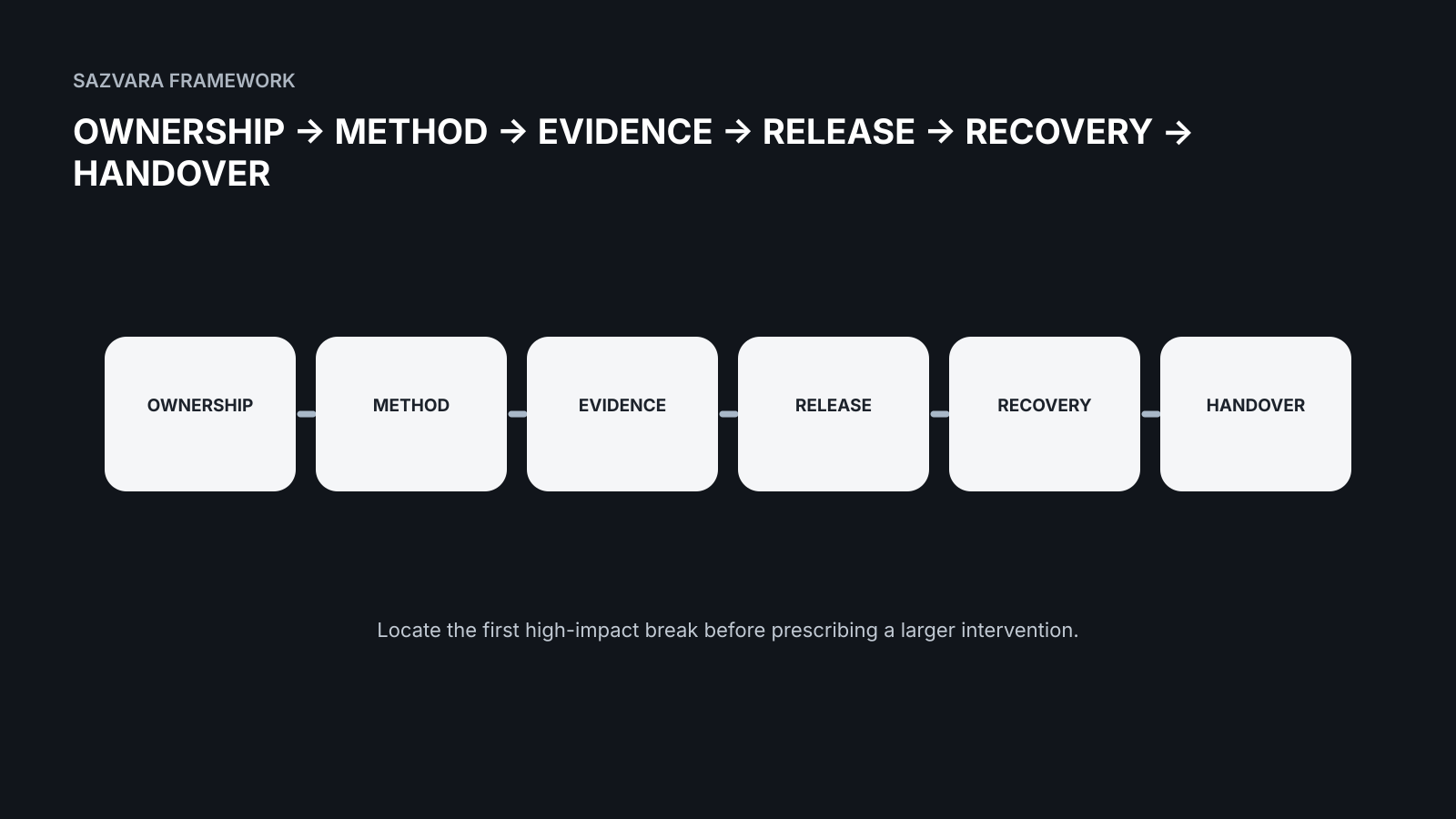
OWNERSHIP → METHOD → EVIDENCE → RELEASE → RECOVERY → HANDOVER
The short answer#
Choose a technical partner by examining how they reduce operational risk, not only by reviewing visual portfolios or hourly rates. The strongest signals are clear ownership boundaries, reproducible delivery methods, evidence-based validation, safe release practices, recoverability and complete handover.
A capable partner should make the client more independent over time, not more dependent on hidden knowledge.
Evidence anchors#
- OWASP secrets management — Credentials should be handled through controlled mechanisms, not embedded in handover documents.
- GitHub CODEOWNERS — Repository ownership and review responsibility can be made explicit.
- GitHub protected branches — Protected change paths can reduce accidental production changes.
- GitHub deployments — Deployment environments and approvals make release ownership visible.
- NIST SSDF — Secure software practice includes defined roles, controlled change and verification.
- WordPress backups — A partner working on production should establish a recovery position first.
- WordPress coding standards — Platform-native engineering standards are one inspectable quality signal.
- OWASP logging — Operational evidence matters when releases or integrations fail.
- Google helpful content — Content delivery partners should preserve useful, people-first content rather than optimize only templates.
- W3C WCAG — Accessibility responsibilities should be explicit in design and implementation scope.
Start with ownership#
Ask who owns domains, hosting, repositories, analytics, automation accounts and vendor relationships. Client-owned organizational accounts reduce exit risk and make handover simpler.
Avoid arrangements where critical assets live permanently inside a contractor's personal account.
Ask how scope becomes acceptance criteria#
A partner should be able to translate vague goals into observable outcomes. “Improve lead capture” might become reliable durable receipt, assignment, acknowledgement, monitoring and a measured conversion event.
Clear acceptance criteria make estimates and reviews more meaningful.
Inspect the change process#
Ask how work moves from development to production, how changes are reviewed, and what happens when a release fails. The answer should fit the scale of the project; not every site needs enterprise process.
What matters is that production changes are intentional and recoverable.
Look for evidence, not ceremony#
Screenshots, logs, test results, before/after measurements, source-controlled changes and release notes provide stronger evidence than a long process document nobody uses.
The partner should be able to show what was verified before asking the client to accept the work.
Evaluate access practices#
Credentials should be handled through appropriate secure mechanisms, permissions should be limited, and access should be removable when work ends.
Password sharing in documents or chat is a warning sign.
Ask how incidents are handled#
A useful answer includes containment, evidence preservation, rollback or recovery, communication and post-incident correction. “We will fix it quickly” is not a process.
The exact response model can be lightweight for small businesses while still being explicit.
Check documentation quality#
Documentation should help another competent person operate the system. Key items include architecture overview, important accounts, deployment or release steps, backups, logs, known constraints and recovery actions.
Documentation does not need to explain every line of code.
Require handover from the beginning#
Handover is easier when ownership and documentation are designed during the project. Waiting until the final day creates missing accounts, forgotten dependencies and unclear responsibility.
Ask what the final handover package will contain before work starts.
Price the risk boundary#
A low hourly rate can be expensive if the client must manage the work closely or absorb rework. A higher fixed diagnostic can be economical if it resolves uncertainty and defines a safe path.
Compare providers on scope clarity and ownership as well as price.
For agencies: protect client ownership#
White-label or overflow partners should work within clear communication boundaries. Decide who talks to the end client, who approves scope changes and who controls production release.
A delivery partner should strengthen the agency's client relationship rather than create a competing one.
Run a small paid test#
Before assigning a large rebuild or complex automation, consider a bounded diagnostic or rescue task. It reveals communication quality, evidence discipline and handover behavior with limited exposure.
Choose a task that is representative enough to test the partnership.
Red flags#
Be cautious when access ownership is vague, production is edited directly without a recovery plan, estimates lack assumptions, success is described only in visual terms, or documentation is treated as an optional add-on.
Another warning sign is a partner who cannot explain how they know a change is safe to release.
A simple evaluation scorecard#
Score ownership, scope clarity, technical evidence, release safety, security/access, recovery, communication and handover. Weight the dimensions by the consequence of the work rather than treating every category equally.
Use the scorecard to structure questions, not to pretend a complex partner decision can be reduced to a single number.
Where Sazvara fits#
Sazvara is positioned as a bounded technical delivery and rescue partner where websites, WordPress and automation intersect. The operating model emphasizes client ownership, validation, rollback, evidence and handover.
A sensible first engagement is a diagnostic or contained workstream with explicit acceptance criteria rather than an open-ended retainer.
What good looks like in practice#
A strong delivery relationship leaves the client with more control than before. Critical assets live in client-owned accounts, scope changes are explicit, production releases are supported by evidence, and access can be removed cleanly. Documentation describes the operating system at the level another competent person needs to continue it.
Good partners also make uncertainty visible. They can say what they know, what they need to test, which assumptions affect the estimate and what would cause them to change the recommended path. A bounded trial project is useful because it exposes this behavior under real constraints. The buyer learns how the provider communicates, verifies, recovers and hands work back—not merely how convincing the proposal sounded.
Decision table#
| Signal | What it usually means | First action |
|---|---|---|
| Critical assets live in contractor accounts | Ownership risk | Require client-owned organizational accounts. |
| Production is edited directly without recovery | Release risk | Require a controlled change and rollback path. |
| “Done” has no acceptance evidence | Quality risk | Define observable acceptance criteria before work begins. |
| Credentials are shared in chat/docs | Security risk | Use appropriate secret and permission controls. |
| No handover artifact is planned | Continuity risk | Make handover part of scope from kickoff. |
| Large engagement is proposed immediately | Fit uncertainty | Use a bounded representative paid task first. |
Worked scenario#
An agency needs overflow help for an inherited WooCommerce site. Two providers have similar portfolios. One asks for a shared administrator password and proposes editing production directly. The other requests a scoped access path, documents the current state, proposes a reproduction step and defines what evidence will be required before release.
The second provider may appear slower during the first hour, but the process reveals how the partner will behave when something goes wrong. Due diligence should evaluate that operating behavior, not only visual output or speed of response.
Implementation sequence#
Use a short qualification call to clarify ownership and method, then run a bounded paid task. Require an explicit scope, acceptance criteria, access plan and handover artifact. Review the evidence at completion and record what it was like to operate with the partner.
Only then expand into a larger workstream or recurring overflow relationship.
Measurement plan#
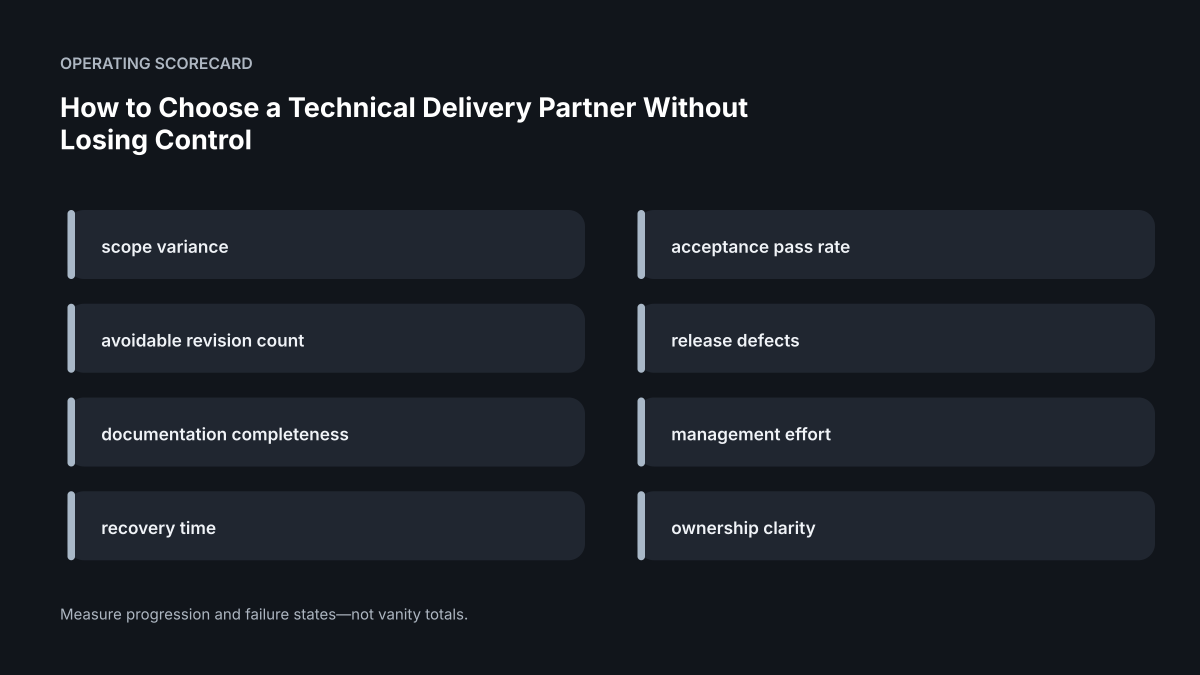
For a partner trial, assess scope variance, acceptance-pass rate, number of avoidable revisions, release defects, documentation completeness, time to recover from issues and the amount of founder/agency management required. These are more useful than hours billed alone.
Also track whether ownership became clearer at the end of the engagement.
Operating scorecard#
| Measure | Why it matters |
|---|---|
| scope variance | Turns the operating state into a measurable signal that can drive a decision. |
| acceptance pass rate | Turns the operating state into a measurable signal that can drive a decision. |
| avoidable revision count | Turns the operating state into a measurable signal that can drive a decision. |
| release defects | Turns the operating state into a measurable signal that can drive a decision. |
| documentation completeness | Turns the operating state into a measurable signal that can drive a decision. |
| management effort | Turns the operating state into a measurable signal that can drive a decision. |
| recovery time | Turns the operating state into a measurable signal that can drive a decision. |
| ownership clarity | Turns the operating state into a measurable signal that can drive a decision. |
Common mistakes to avoid#
Do not choose solely on hourly rate, tool familiarity or portfolio aesthetics. Do not allow critical accounts to remain contractor-owned. Do not accept “done” without observable acceptance evidence. Do not postpone handover until the relationship ends.
A good partner reduces future switching cost even while hoping to earn repeat work.
Founder decision questions#
Ask who will own every critical asset at the end of the engagement, how the partner proves work before release, what happens when a release fails, and what documentation remains if the relationship ends tomorrow. Ask how scope changes are approved and whether the partner can explain a recent mistake without hiding behind vague process language.
The answers reveal operating maturity more reliably than claims about being “full service.” A trustworthy partner can state limits, uncertainty and dependencies while still giving a clear plan.
Procurement brief#
For a trial engagement, require a bounded problem statement, named owner, access plan, acceptance criteria, change method, release evidence and handover artifact. Keep the trial meaningful enough to expose real working behavior but small enough that a poor fit is inexpensive.
At completion, review not only the technical result but how much management effort the work required. A partner who leaves the system clearer, better documented and easier to transfer has created value beyond the immediate task.
Deep-dive: evaluate the evidence a partner leaves behind#
The strongest signal of a delivery partner is not the confidence of the sales conversation but the quality of the operating evidence produced during real work. A small paid test can reveal how the partner scopes ambiguity, handles access, records decisions, tests changes, communicates risk and prepares handover. Choose a test that is meaningful enough to expose working habits but bounded enough that failure does not endanger the business.
Before the test begins, agree on the evidence expected at completion. That might include a short architecture note, change log, acceptance results, rollback instruction, repository or file locations, known limitations and ownership of any new account or credential. The goal is not bureaucracy. It is to see whether the partner makes the system easier to operate after the engagement.
Worked scenario: agency needs specialist overflow capacity#
Consider an agency that owns the client relationship and needs a specialist to repair an inherited website integration. The agency should retain ownership of the client account, hosting, repository and production approvals. The specialist can receive the minimum access needed for diagnosis and a controlled test environment. Scope is written around the failing business path and acceptance evidence, not around an open-ended promise to “fix the site.”
During the test, the specialist documents the dependency causing the failure, proposes a reversible repair, demonstrates the normal and failure cases, and records what changed. Production access is time-bounded and removed after release. The agency receives the evidence needed to explain the repair to the client and to operate the site without the specialist.
A technically correct fix with no handover, unmanaged credentials and undocumented production changes should score poorly because it increases future dependency. Conversely, a partner who identifies that the requested fix is unsafe and proposes a smaller diagnostic step may be demonstrating stronger judgement than one who immediately accepts the full scope.
Check account and repository ownership directly#
Ask who creates repositories, cloud projects, analytics properties, domains, automation workspaces and vendor accounts. Client-critical assets should normally be owned by the client or the organisation responsible for them, with the partner invited through named access. Shared personal accounts create avoidable exit risk.
For repositories, inspect whether the work is committed to the agreed source of truth and whether another operator can build or deploy from documented instructions. For no-code platforms, ask how workflows are exported, documented or transferred. For credentials, verify that secrets are stored in an appropriate secret-management surface rather than embedded in documents or code.
Make acceptance criteria observable#
“Complete” should translate into evidence: a route returns the expected content, a form creates an owned lead, a workflow handles an error without duplication, a backup restores, or a release can be rolled back. Ask the partner to state what will be demonstrated before work starts. This reduces disputes and reveals whether the team understands the business consequence of the task.
When acceptance depends on a third party, separate what the partner controls from what it can only observe. A good delivery record should state both.
Run an exit test before the relationship becomes critical#
Do not wait for termination to learn whether handover works. After the first meaningful project, ask a different operator to locate the source, understand the deployment path, identify credentials ownership, read the runbook and reproduce a basic non-destructive check. Any missing information becomes a handover improvement while the original team is still available.
For longer relationships, repeat this test periodically as infrastructure and staff change. Continuity is a maintained property, not a final-day document.
Procurement questions that expose operating maturity#
Ask how the partner handles production access, backup verification, rollback, incident escalation, change review, secrets, ownership transfer and post-release evidence. Then ask for a concrete example of the artifact or process—not a client identity or confidential story, but the structure of the deliverable. The answers should be specific enough that you can imagine operating the system afterward.
Minimum partner evidence packet#
For each completed workstream, retain scope and acceptance criteria, affected systems, source location, account ownership, changes made, tests run, release evidence, rollback path, known limitations, ongoing monitoring and handover status. If the partner cannot produce this level of clarity on a bounded task, increasing their production authority should be a deliberate risk decision rather than an assumption.
Distinguish capability, capacity and continuity#
A partner can be technically capable but unavailable when an incident occurs, or responsive but dependent on one undocumented specialist. Evaluate these dimensions separately. Capability concerns whether the team can solve the class of problem. Capacity concerns whether it can support the promised schedule. Continuity concerns whether the work remains operable if a particular person leaves.
Ask who else can access the repository, deployment process and runbooks, and how responsibility is transferred internally. For critical systems, a partner should be able to explain how vacations, turnover and emergencies are handled without making the client dependent on one individual's memory.
Review commercial boundaries as carefully as technical ones#
Confirm what is included, what triggers a change request, how urgent incidents are handled, who approves third-party spend and what happens when a dependency blocks progress. Ambiguous commercial boundaries create pressure for unsafe shortcuts because teams disagree about whether investigation, rollback or documentation is “in scope.” A clear agreement protects both sides.
Evidence to request before renewing a long engagement#
Review the current system inventory, access list, open risks, incident history, outstanding technical debt, backup and recovery evidence, deployment ownership and handover readiness. Renewal should not rely only on relationship comfort. It should confirm that the partnership is still reducing operational risk rather than accumulating dependency.
Buyer checklist#
Before approving the work, confirm:
- The team can state the asset ownership condition in plain language.
- The scope clarity evidence is inspectable rather than assumed.
- Ownership for release evidence is named.
- A failure involving access control has a defined response.
- The recovery signal is measured after release.
- The team knows how handover is restored or handed over.
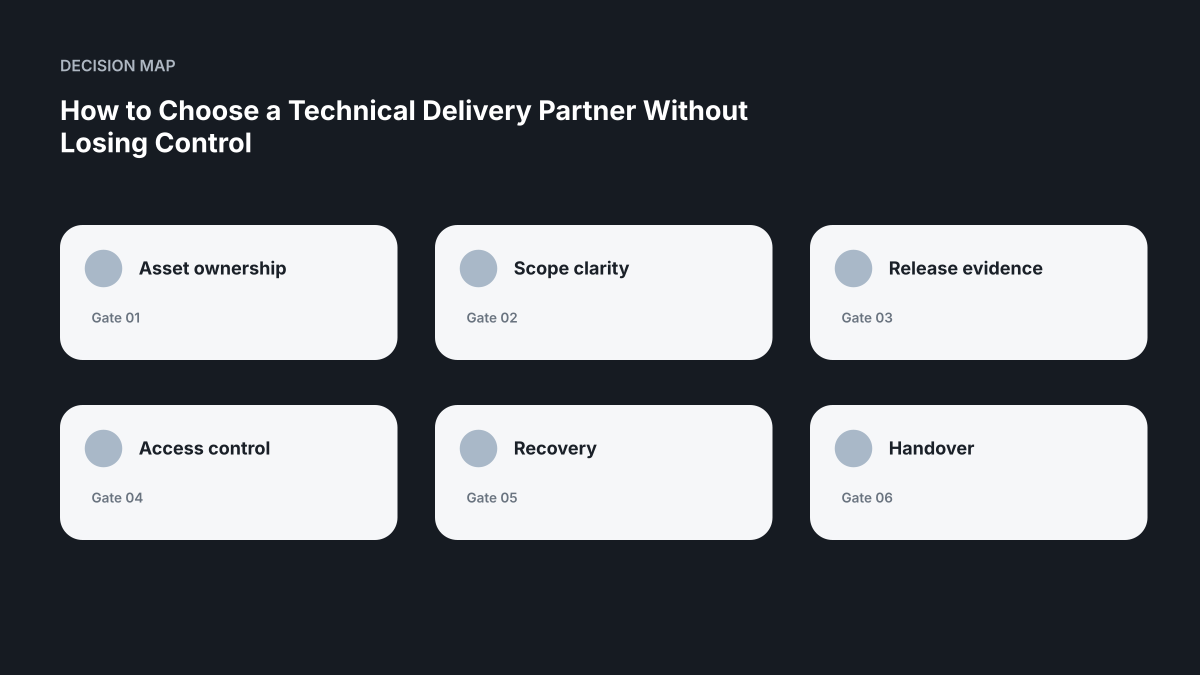
Release / acceptance gate#
| Gate | Evidence required before calling the work complete |
|---|---|
| Ownership | Domains, hosting, repositories and vendor accounts remain client-controlled. |
| Scope | Deliverables and exclusions are explicit. |
| Evidence | Completion is demonstrated with tests or inspectable artifacts. |
| Release | Production change has an approved method and rollback. |
| Access | Permissions are limited and removable. |
| Handover | Another competent operator can continue the system. |
A partnership should not expand while ownership, release evidence or handover obligations remain ambiguous.
Related Sazvara guidance#
- /services/
- /work/
- /contact/
- /insights/wordpress-agency-overflow-playbook/
- /insights/technical-handover-standard/
Editorial note#
The cited standards and platform documentation support the ownership, security, accessibility and deployment facts used here. The due-diligence scorecard and partner scenarios are Sazvara analysis and are not testimonials or undisclosed project results.
Sources and further reading#
- OWASP secrets management
- GitHub CODEOWNERS
- GitHub protected branches
- GitHub deployments
- NIST SSDF
- WordPress backups
- WordPress coding standards
- OWASP logging
- Google helpful content
- W3C WCAG
Next step#
Request a scoped technical partnership review. Start with the highest-consequence path described in this guide, capture a baseline, and require observable acceptance evidence before expanding the scope.
Have a system that is stuck, manual or difficult to ship?
Sazvara diagnoses the system before prescribing the technology. Bring the constraints, failure modes and current state.