Updated: September 20, 2026 Author: Sajjad Farajollahi Primary intent: agency overflow / white-label WordPress delivery Audience: small and mid-sized digital agencies, web studios, SEO agencies and marketing teams that need reliable technical capacity without immediately adding permanent headcount
The short answer#
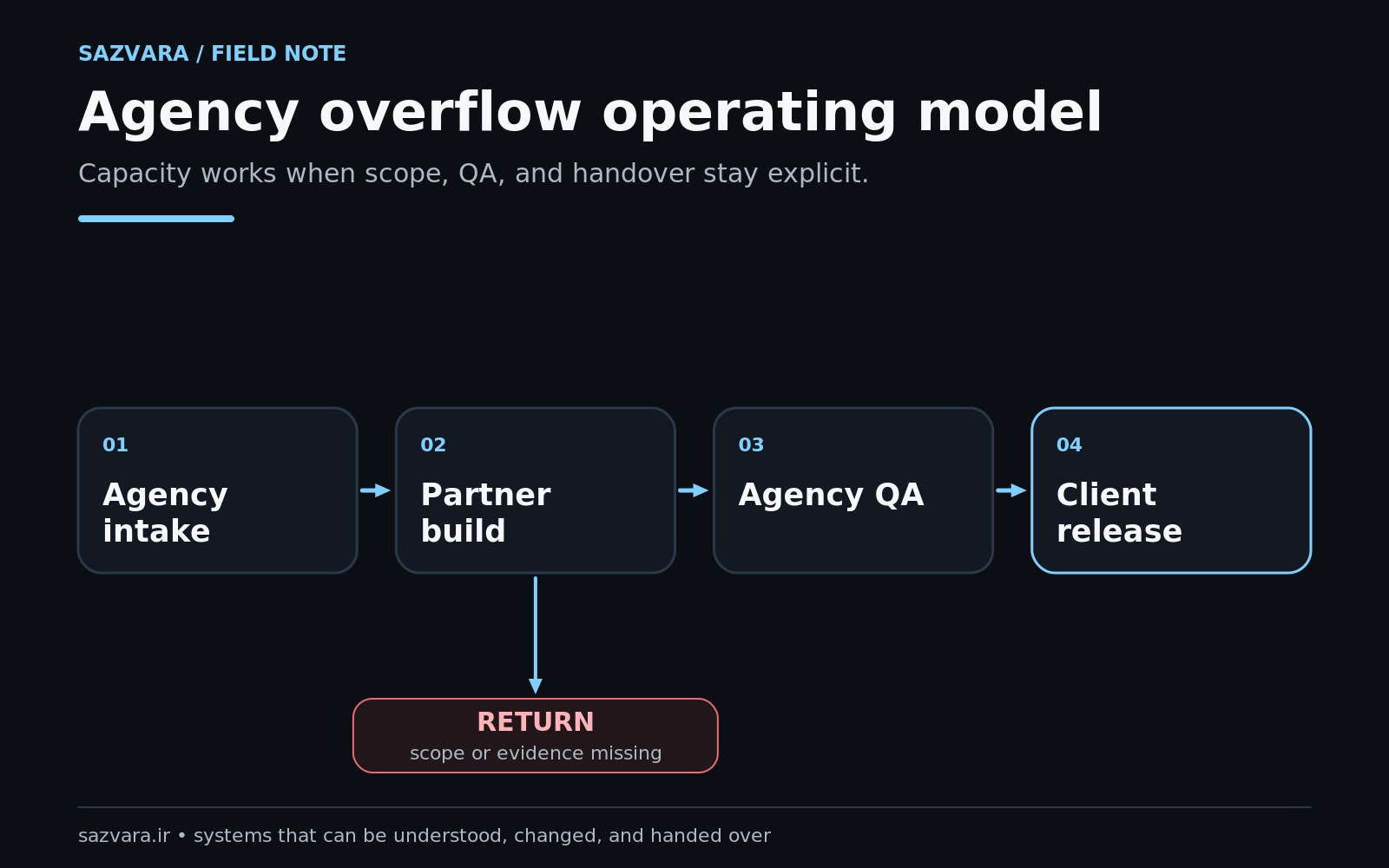
Agency overflow works when extra delivery capacity is treated as an operating system, not a list of freelancers. The agency should keep client ownership, commercial control and release authority while the overflow partner receives a clearly bounded technical mandate, reproducible environment, acceptance criteria, escalation path and evidence requirements. The relationship becomes valuable when it reduces bottlenecks without creating a second management burden.
That model is timely because buyers are asking for more implementation work, not only strategy. Upwork's June 2026 hiring data reported growth in AI integration, CRM and lead-generation work, while its July and August research showed clients searching more specifically for implementation and automation capabilities (June 2026 hiring insights, July 2026 insights, August 2026 insights). For agencies, the commercial question is therefore less "Can we find a developer?" and more "Can we add capacity without damaging the client relationship or our delivery standard?"
The practical answer is a five-part overflow model: qualify the work, isolate ownership, standardize handoff, gate releases, and measure partner performance by accepted outcomes rather than hours consumed.
Why agency overflow fails even when the developer is technically capable#
The most common failure is not code quality. It is unclear operating ownership.
A project arrives late. The account team promises a quick turnaround. A developer outside the core team receives credentials, a short message and a vague instruction such as "fix the checkout" or "finish the WordPress build." The developer makes reasonable local decisions, but nobody has specified which plugins are authoritative, what cannot change, how production is backed up, who approves a release, or how the agency will explain the change to the client. The code may work and the engagement may still be a failure.
Overflow therefore needs to solve four constraints at once:
- capacity must increase;
- client ownership must remain with the agency;
- delivery quality must remain inspectable;
- the agency must not spend more time coordinating the partner than it would have spent doing the work internally.
Clutch's current agency rankings illustrate why specialization matters. Providers are evaluated partly on service focus and ability to deliver, not simply on whether they claim to build websites (Clutch digital agency rankings). In practice, an agency seeking overflow should apply the same logic internally: choose a partner whose operating model matches the class of work being delegated.
Define overflow before choosing a partner#
In this guide, agency overflow means temporary or elastic delivery capacity added behind the agency's client relationship, with explicit boundaries for scope, access, review, release and support.
That is different from ordinary outsourcing. Outsourcing can transfer an entire function. Overflow is usually narrower: the agency remains accountable and uses external capacity to absorb work that exceeds current bandwidth or requires deeper technical specialization.
Typical overflow work includes:
- inherited WordPress rescue;
- plugin conflicts and PHP compatibility work;
- custom blocks, templates or integrations;
- WooCommerce fixes;
- API and CRM integrations;
- performance and deployment work;
- technical QA before a launch;
- automation connecting forms, CRM, email and internal tools;
- backlog reduction on client sites already under care.
The WordPress project itself provides detailed coding standards and development guidance because maintainability matters in shared ecosystems (WordPress coding standards, Plugin Handbook). Overflow work should be held to at least the same principle: another developer must be able to inspect what changed and understand why.
The Sazvara overflow boundary: four owners, not one vague team#
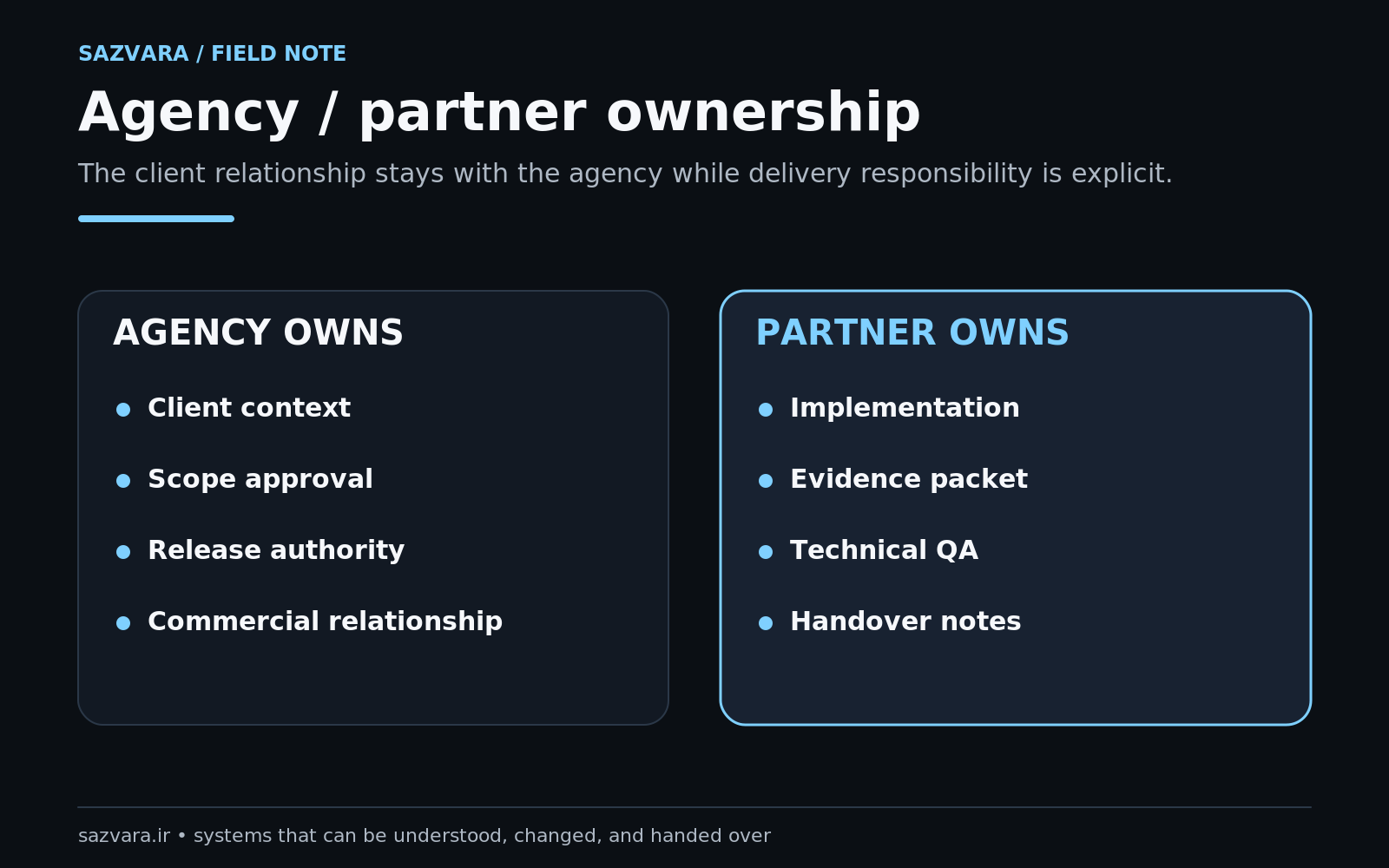
A useful engagement separates four kinds of ownership.
| Ownership | Normally held by | What it controls |
|---|---|---|
| Client ownership | Agency | relationship, scope, pricing, expectations |
| Technical task ownership | Overflow partner | implementation of the bounded work package |
| Release ownership | Agency or named approver | permission to move a change into production |
| Operational ownership | Named party | monitoring, incident response, rollback and post-release support |
Confusion begins when one person is assumed to hold all four without being told. For example, giving a partner server access does not automatically give them permission to deploy. Asking them to "take over" a broken plugin does not clarify whether they are responsible for future updates. A useful statement of work makes each owner explicit.
A worked example: inherited WooCommerce checkout failure#
Imagine a small design agency that manages a retailer's WordPress site. A payment or checkout update introduces intermittent failures. The agency knows the client and controls hosting, but its front-end developer is overloaded and does not want to debug payment hooks.
A weak overflow brief says:
Checkout is broken. Please fix urgently.
A strong brief says:
- reproduce failure on staging before changing production;
- preserve current theme and payment provider;
- identify whether failure originates in theme code, plugin interaction or provider response;
- provide a rollback point before modification;
- document files/configuration changed;
- run agreed checkout test cases;
- do not deploy without agency approval;
- remain available for the agreed observation window after release.
The second brief reduces uncertainty for both sides. It also makes pricing easier because the partner can see what "done" means.
Qualify the work before delegating it#
Not every project should go to overflow. Use a routing decision before sending credentials.
A task is usually a strong candidate when it is:
- technically bounded enough to describe;
- urgent or specialized enough to justify outside capacity;
- separable from sensitive client strategy;
- testable with explicit acceptance criteria;
- reversible if the implementation fails.
A task deserves more caution when it involves undocumented infrastructure, regulated data, a production database with no tested backup, unclear IP ownership, or client commitments the partner cannot see.
The fastest way to create a bad white-label relationship is to delegate ambiguity. If the agency itself does not know what system is authoritative, who approves changes or what outcome the client expects, the first engagement should be a diagnostic, not a build sprint. Sazvara uses the same logic in its services model: establish the operating problem before expanding implementation.
The handoff packet should be small but complete#
A partner should not need a two-hour meeting simply to discover where the staging site lives. Build a reusable handoff packet.
Minimum fields:
- client/project codename;
- production and staging URLs;
- repository and branch, if applicable;
- hosting/control-panel route;
- current WordPress/PHP versions;
- relevant plugin/theme inventory;
- exact problem statement;
- reproduction steps;
- acceptance criteria;
- prohibited changes;
- release approver;
- credential-access method;
- rollback location;
- support/observation window;
- evidence required at handoff.
Credentials should not be pasted casually into chat. OWASP recommends centralized, controlled secrets management, least-privilege access and documented rotation practices (OWASP Secrets Management Cheat Sheet). Even a small agency can follow the underlying principle: give only the access needed, use revocable accounts where possible, and remove access when the work ends.
Release gates protect the agency's reputation#
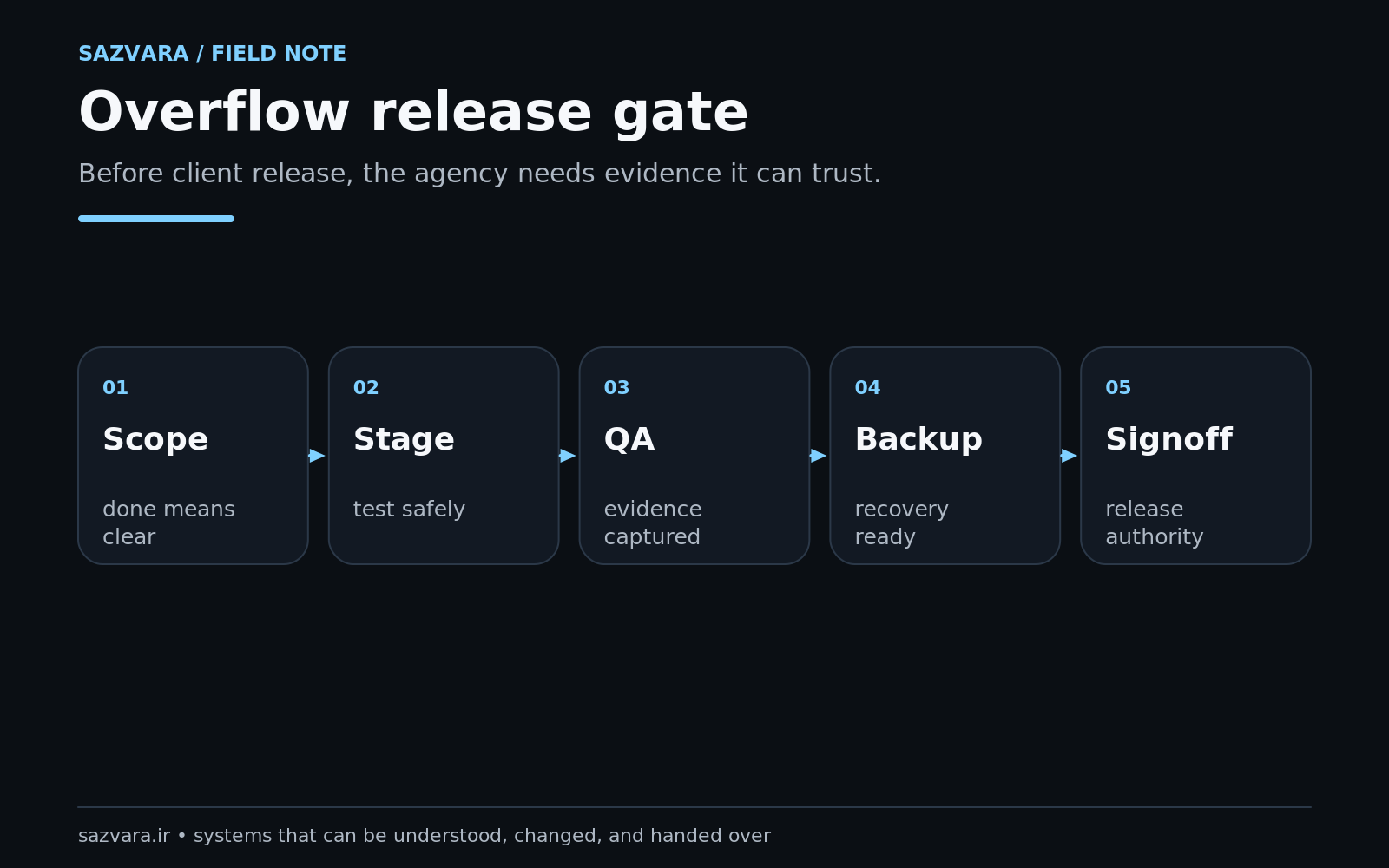
Overflow should never mean "the external developer deploys when they think it is ready." The release path needs its own gate.
A practical WordPress release gate asks:
- Is the issue reproducible before the change and absent after it?
- Are critical user paths tested?
- Is there a current backup or rollback point?
- Are database migrations understood?
- Are errors and warnings reviewed?
- Are cache/CDN effects considered?
- Is the diff or change list inspectable?
- Does the agency approve production release?
- Is someone watching the system afterward?
For repository-based work, GitHub branch protections can require review and passing status checks before merge (GitHub protected branches). Deployment environments can also require approvals and restrict access to secrets until protection rules pass (GitHub deployment controls). You do not need enterprise-scale CI/CD for every WordPress site, but the control principle is valuable: implementation authority and release authority should be separable.
White-label communication needs rules too#
Technical delivery is only half the white-label problem. Communication can expose the agency to unnecessary risk if nobody defines who talks to whom.
Choose one model before kickoff:
Model A: invisible technical partner#
The overflow partner communicates only with agency staff. This is appropriate when the agency wants a fully white-label relationship and can efficiently relay requirements.
Model B: controlled specialist access#
The partner joins selected calls as a technical specialist under the agency's lead. This reduces relay errors on complicated projects while preserving commercial ownership.
Model C: delegated workstream#
The partner communicates directly with named client stakeholders for a narrow technical workstream. The agency still controls scope, price and major decisions.
Problems arise when the engagement drifts from A to C accidentally. The client asks a technical question, the external developer answers in good faith, and suddenly pricing, timing or scope commitments appear outside the agency's control.
Document the communication model just as clearly as the deployment model.
Price overflow around risk and acceptance, not hidden hours#
Hourly billing can work, but it does not remove the need for a commercial boundary. Agencies need to know whether a partner can absorb work without destroying margin predictability.
Useful structures include:
- paid diagnostic followed by fixed implementation scope;
- fixed sprint with explicit acceptance criteria;
- retained capacity for a defined number of priority work units;
- time-and-materials for genuinely exploratory debugging, with a stop/go checkpoint.
The important distinction is whether the uncertainty is understood. A fixed price attached to a mystery system creates pressure to skip investigation. An unlimited hourly arrangement creates pressure on the agency to supervise every minute. A diagnostic or bounded discovery phase is often the cheapest way to protect both parties.
A simple economics example#
Suppose an agency has three delayed client tasks: a WordPress integration, a checkout defect and a form-to-CRM workflow. The strategic question is not whether an external engineer's hourly rate is higher or lower than an employee's hourly equivalent. It is whether using overflow:
- prevents a client delivery from slipping;
- frees the internal team for work only they can do;
- avoids premature permanent hiring;
- creates repeatable capacity for future peaks;
- preserves enough gross margin after coordination and QA.
Those are business outcomes. The cheapest hourly rate can be the most expensive option if the agency spends days rewriting or supervising the work.
Score the partner on evidence that matters#
After each engagement, use a small scorecard.
| Dimension | Evidence to capture |
|---|---|
| Scope accuracy | accepted without recurring scope confusion |
| Technical quality | tests, review findings, regressions, maintainability |
| Reliability | commitments met, blockers raised early |
| Communication | concise updates, escalation quality, handoff clarity |
| Release discipline | no unauthorized production changes |
| Recovery readiness | rollback and incident path documented |
| Agency effort | coordination required from internal team |
| Reusability | documentation/components useful on future work |
Do not grade a partner mainly on responsiveness in chat. Fast replies are pleasant; accepted work with low supervision is more valuable.
Create a three-level overflow bench#
An agency that plans to use elastic capacity repeatedly should not treat every supplier the same.
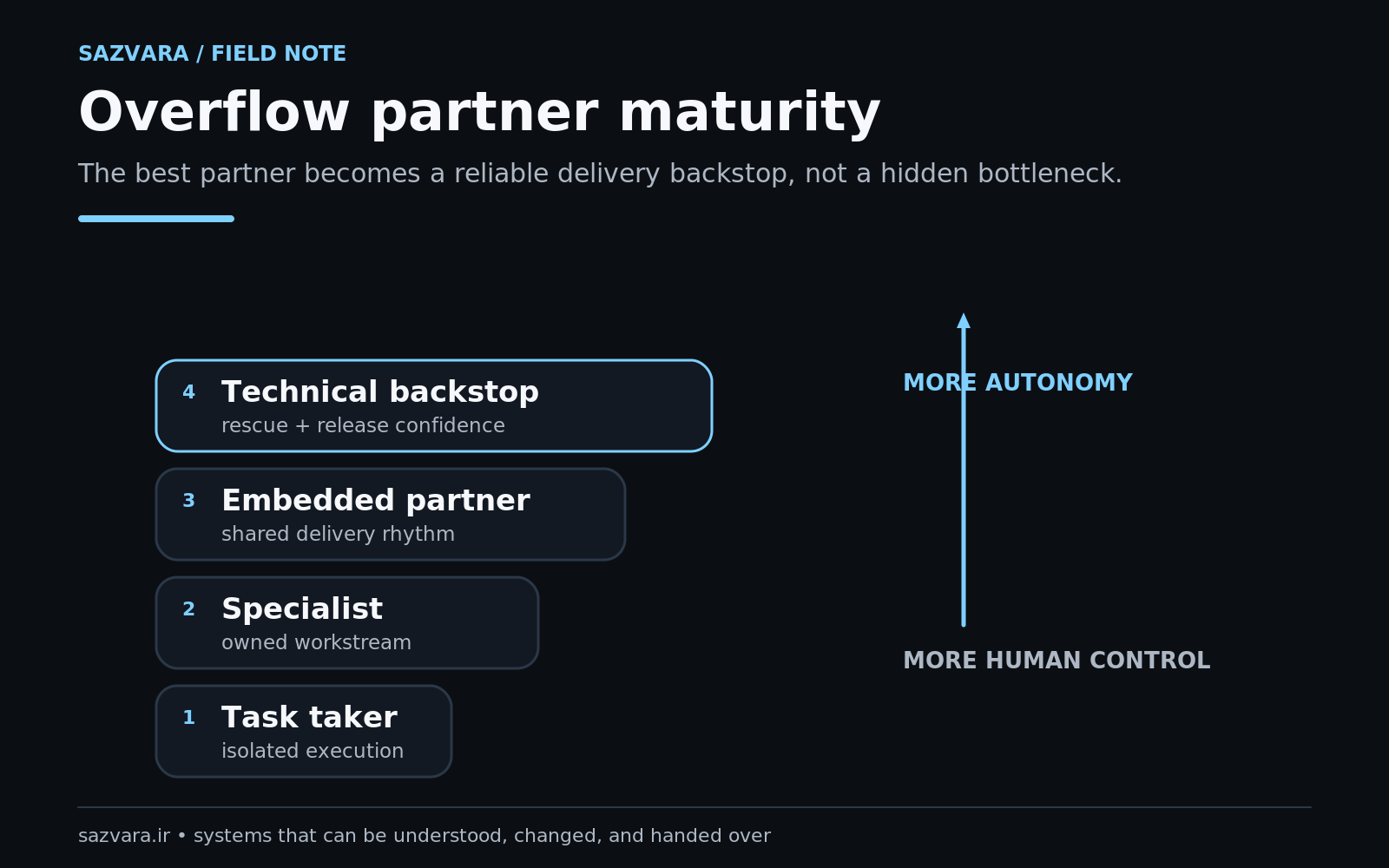
Level 1 — task partner: narrow, low-risk tasks with clear specifications. Level 2 — specialist partner: owns technically difficult bounded workstreams. Level 3 — delivery backstop: trusted with inherited systems, rescue, architecture decisions and controlled production support.
Promotion should be earned by evidence. A new partner should not receive broad production access merely because their portfolio looks strong.
This is similar to the distinction between directory presence and delivery confidence. Clutch explicitly separates service focus from ability to deliver in its provider methodology (Clutch rankings methodology context). An agency can use an internal version of the same idea: "What do they specialize in?" and "What have they repeatedly delivered under our operating rules?"
Use overflow to improve the core agency, not hide recurring dysfunction#
External capacity can become a trap if it is used to absorb the same preventable failure every month.
If every project arrives in QA with missing requirements, the problem is not developer capacity. If every WordPress build depends on undocumented production edits, the problem is configuration management. If every launch requires emergency weekend fixes, the problem is release discipline.
Use overflow data as an operational diagnostic. Track which work is repeatedly delegated and why.
Patterns often reveal opportunities to:
- standardize a starter theme or component library;
- create a pre-launch checklist;
- automate staging setup;
- formalize plugin selection rules;
- improve requirements capture;
- build reusable integration templates;
- assign a clearer technical owner earlier in the project.
The best overflow relationship therefore makes the agency less chaotic, not more dependent.
Build partner maturity deliberately#
Do not ask a new overflow partner to prove themselves on the highest-risk client in the portfolio. Create a progression that increases access and responsibility only after the operating evidence supports it.
A first engagement can be a bounded staging-only task. The next can include a controlled production release under agency supervision. Later work can include diagnostic ownership, architecture recommendations and incident support. The progression matters because trust in delivery should come from observed behavior: how the partner handles ambiguity, whether they protect credentials, how early they raise blockers, whether their handoff is usable by another developer and whether they follow release authority even under time pressure.
The agency should also define conditions that move a partner down the ladder. Repeated undocumented production edits, unnecessary privilege requests, scope commitments made directly to clients, weak rollback discipline or recurring regressions should reduce access until the operating problem is resolved. Trust is not a permanent badge. It is an evidence-backed level of responsibility.
Example: from one rescue task to repeat capacity#
A marketing agency first brings in a technical partner to repair a broken WordPress integration on staging. The partner reproduces the failure, documents the dependency, provides test evidence and waits for explicit release approval. On the next project, the agency delegates a custom block and API integration with repository access but still retains deployment authority. After several accepted deliveries, the partner becomes the agency's technical backstop for inherited projects and can join selected technical calls.
The important feature of this progression is not loyalty. It is reduced supervision per accepted outcome. That is the operating metric that turns overflow from emergency freelancing into durable capacity.
What to review every quarter#
Even a strong relationship needs recalibration. Review the classes of work being delegated, recurring defects, coordination load, access levels, credential ownership, turnaround expectations and the agency's margin on overflow-assisted projects. If the same work appears repeatedly, decide whether to standardize it internally, retain the partner for predictable capacity, or hire. Overflow should remain an explicit capacity choice rather than becoming an invisible dependency.
Content and SEO delivery deserve the same discipline#
Agencies increasingly combine technical delivery with content and AI-assisted production. That creates another place where external capacity can damage trust if volume replaces judgment.
Google's current guidance asks whether content provides original information, substantial analysis and clear authorship, and warns against extensive automation used primarily to attract search traffic (Google people-first content guidance). Its 2026 generative-search guidance likewise emphasizes valuable, unique, non-commodity content rather than special "GEO tricks" (Google generative AI optimization guidance).
For agencies outsourcing content-related technical work, the operating implication is straightforward: the external partner should inherit the same quality gate the agency promises its client.
The 12-question overflow readiness checklist#
Before assigning a project, answer these questions:
- What exact business or technical outcome is required?
- What environment can reproduce the issue safely?
- What is explicitly out of scope?
- What access does the partner need—and what do they not need?
- Who owns the client relationship?
- Who approves scope changes?
- Who can authorize production deployment?
- What tests define acceptance?
- What evidence must accompany handoff?
- What is the rollback route?
- Who owns support after release?
- What result will determine whether this partner receives more work?
If several answers are missing, delay delegation long enough to create them. Ten minutes of operational clarity is usually cheaper than hours of rework.
Where Sazvara fits#
Sazvara is most useful as an overflow partner when the problem is technically awkward rather than merely labor-intensive: inherited WordPress systems, unfinished builds, custom integrations, automation, release validation and rescue work. The operating goal is to let the agency preserve the client relationship while Sazvara owns a bounded technical outcome.
Review examples of the underlying engineering approach in Sazvara work or see the broader services model. For a live backlog or inherited system, request a diagnostic before committing the client to a large rebuild.
Sources and further reading#
- Upwork Monthly Hiring Insights — June 2026
- Upwork Monthly Hiring Insights — July 2026
- Upwork Monthly Hiring Insights — August 2026
- Clutch full-service digital agency rankings
- WordPress Coding Standards
- WordPress Plugin Handbook
- OWASP Secrets Management Cheat Sheet
- GitHub protected branches
- GitHub deployment controls
- Google people-first content guidance
- Google 2026 generative-search optimization guidance
Editorial note: This article was produced with AI-assisted research and drafting, then reviewed against Sazvara's evidence, originality, usefulness, SEO/GEO and release-quality controls. Prescriptive frameworks are Sazvara's synthesis; market and platform claims are linked to their sources.
Have a system that is stuck, manual or difficult to ship?
Sazvara diagnoses the system before prescribing the technology. Bring the constraints, failure modes and current state.