A practical way to decide whether a business website needs content optimization, a visual redesign, a technical rebuild, or a staged combination—without turning every problem into a full replacement project. 
Editorial promise#
This framework separates visual dissatisfaction from technical constraint. A rebuild is presented as one possible outcome, not the default commercial recommendation.
The Sazvara framework#
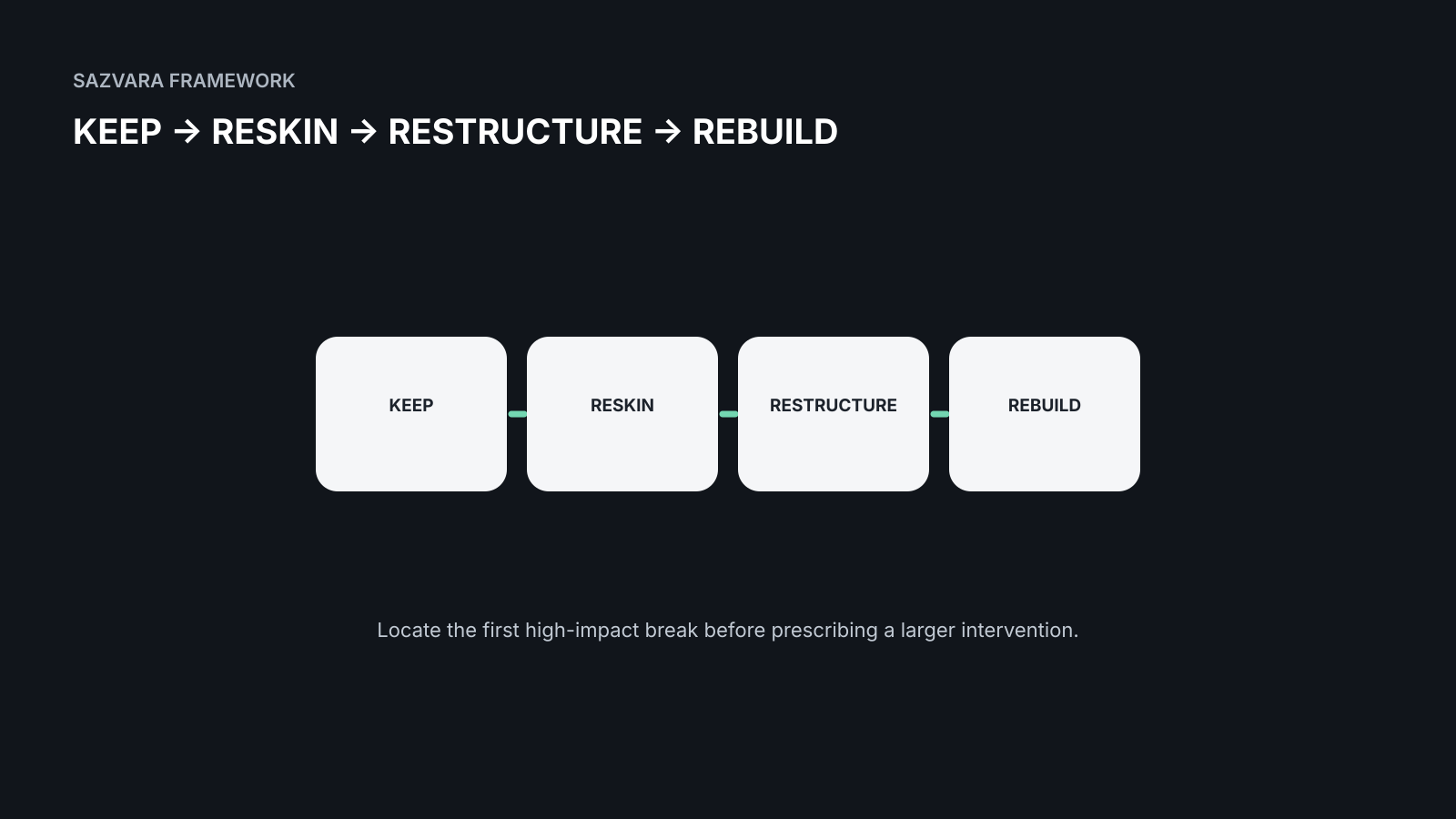
KEEP → RESKIN → RESTRUCTURE → REBUILD
The short answer#
Redesign changes how the website communicates and behaves. Rebuild changes the underlying implementation. Growing businesses often need some of both, but they should not be bundled automatically. The safest decision comes from separating four questions: Is the offer clear? Is the information architecture useful? Is the interface helping or hurting? Can the underlying system be changed safely?
Sazvara's decision model uses four outcomes: KEEP, RESKIN, RESTRUCTURE and REBUILD. The goal is to preserve what already works and spend effort only where the current system creates a measurable constraint.
Evidence anchors#
- Google site-move guidance — URL-changing migrations need explicit mapping, redirects, testing and monitoring.
- Google hosting-move guidance — Infrastructure changes can be separated from visible URL changes and should be monitored independently.
- Google redirect guidance — Permanent redirects should point old URLs to their relevant new destinations.
- Google canonical guidance — Canonical signals should remain coherent through restructuring and migration.
- Core Web Vitals — Performance decisions should be tied to real user experience on important page types.
- WCAG — Accessibility requirements should be preserved or improved during interface change.
- WordPress backups — Recoverability matters before changing production systems.
- OWASP logging — Logs are part of release verification and post-launch diagnosis.
- Google sitemaps — Sitemaps help communicate the intended URL set after substantial structural change.
- Google helpful content — A redesign should not replace useful content with thinner decorative copy.
Why teams over-prescribe rebuilds#
A full rebuild is emotionally attractive because it creates a clean starting point. It also resets many hidden assumptions at once: URLs, analytics, integrations, forms, content management, accessibility behavior, search signals and editorial workflows. That is why rebuilds can create new failures even when the new design is visually stronger.
Before approving one, identify which constraints genuinely come from the current implementation. If the main issue is weak positioning, a new framework will not fix it. If the problem is an unmaintainable theme with brittle plugins and no safe deployment path, cosmetic optimization will eventually hit a wall.
Outcome 1: KEEP and optimize#
Keep the platform when it is secure enough, maintainable, measurable and capable of supporting the required content and conversion work. Improve copy, hierarchy, internal linking, performance and forms without replacing the foundation.
This is often the highest-return path when the site is technically boring. Boring infrastructure can be an asset because the team can focus on demand and conversion instead of migration risk.
Outcome 2: RESKIN#
Choose a focused redesign when the content model and page structure are mostly sound but the visual system makes the company look less credible than it is. Typical symptoms include inconsistent typography, weak spacing, poor contrast, outdated components and mobile layouts that feel improvised.
A reskin should preserve URLs, semantics and working integrations wherever possible. Treat it as a controlled interface change with regression testing, not as permission to rewrite everything.
Outcome 3: RESTRUCTURE#
Restructure when buyers cannot find the right path because the information architecture reflects internal departments rather than customer decisions. This may require new service groupings, clearer proof, a stronger insights hub and better routes from educational content to commercial actions.
Restructuring can happen without a platform migration. Separating the content-architecture decision from the technology decision keeps the project easier to validate.
Outcome 4: REBUILD#
A rebuild becomes justified when technical debt prevents safe improvement: unsupported dependencies, tangled templates, persistent performance constraints, security exposure, inaccessible core components, unreliable integrations, inability to deploy predictably or lack of ownership over the system.
The case should be written as constraints and acceptance criteria, not as dislike of the current codebase. A rebuild is a business intervention with migration risk, not a design preference.
The seven decision tests#
Test maintainability, content flexibility, performance, accessibility, integration reliability, deployment/recovery and ownership. A single weak dimension does not force a rebuild, but multiple high-consequence failures create a stronger case.
For each test, write the current evidence, the business consequence and whether the issue can be corrected locally. This produces a decision record a founder can inspect without needing to understand the codebase.
Search and migration risk#
URL changes can disrupt accumulated search visibility and external references. Preserve successful URLs where practical, map intentional redirects, keep canonical signals clean and verify the sitemap after launch.
Do not assume a new site will automatically rank better. Search performance depends on content value, crawling, indexing, internal linking, external signals and user demand as well as implementation quality.
Analytics continuity#
Capture the current measurement configuration before changing templates. Define the events that matter—service interest, diagnostic starts, successful submissions—and verify them in staging and production.
A rebuild that removes measurement creates a period where the team cannot distinguish real improvement from anecdotal impressions.
Forms and integrations#
Inventory every form, webhook, CRM route, email notification, scheduling link and payment or provisioning dependency. Rebuilds frequently fail at the edges because the visible pages are tested more carefully than the downstream operational path.
For important lead flows, test normal, invalid, duplicate and downstream-failure cases. Preserve evidence of successful receipt and ownership.
Content migration#
Decide what to preserve, consolidate, rewrite or retire. Migration is an opportunity to reduce weak duplicate content, but deleting URLs without understanding their value can destroy useful entry points.
Create a content map before templates are finalized. Otherwise the new visual system may be designed around representative content that does not resemble the real publishing workload.
A staged alternative to the big-bang rebuild#
When risk is high, move in slices. Start with the highest-value service and conversion path, establish the design system, prove the deployment and measurement process, then migrate the next section.
A staged approach gives the team stop points. If an early assumption is wrong, the cost of correction is smaller than discovering it after the entire site has moved.
How to write acceptance criteria#
Acceptance criteria should describe observable behavior: critical pages meet agreed performance targets, forms create durable records, keyboard navigation works, analytics events fire once, old URLs redirect correctly, and rollback can be executed from a documented state.
Avoid acceptance criteria such as “looks modern” or “feels premium.” Those may be useful creative goals, but they are not sufficient release gates.
Cost should follow scope, not lead it#
Budget matters, but choosing a rebuild because a template package seems affordable can create hidden operational cost. Conversely, preserving a fragile system because replacement looks expensive can keep consuming maintenance time.
Compare the total cost of change: implementation, content migration, testing, downtime risk, post-launch fixes and ongoing ownership.
Where Sazvara fits#
Sazvara is most useful when the decision crosses commercial and technical boundaries. A short diagnostic can determine whether the next move is message optimization, design work, structural content changes, technical rescue or a rebuild with controlled migration.
That decision is valuable by itself because it prevents both unnecessary rebuilds and endless patching of systems that have reached a real constraint.
What good looks like in practice#
A healthy redesign program preserves stable assets while changing only the layers that create the constraint. If the platform can support the required content, forms, analytics and release process, a RESKIN or RESTRUCTURE path should leave that foundation alone. If safe change is repeatedly blocked by the implementation, the case for REBUILD becomes evidence-based rather than aesthetic.
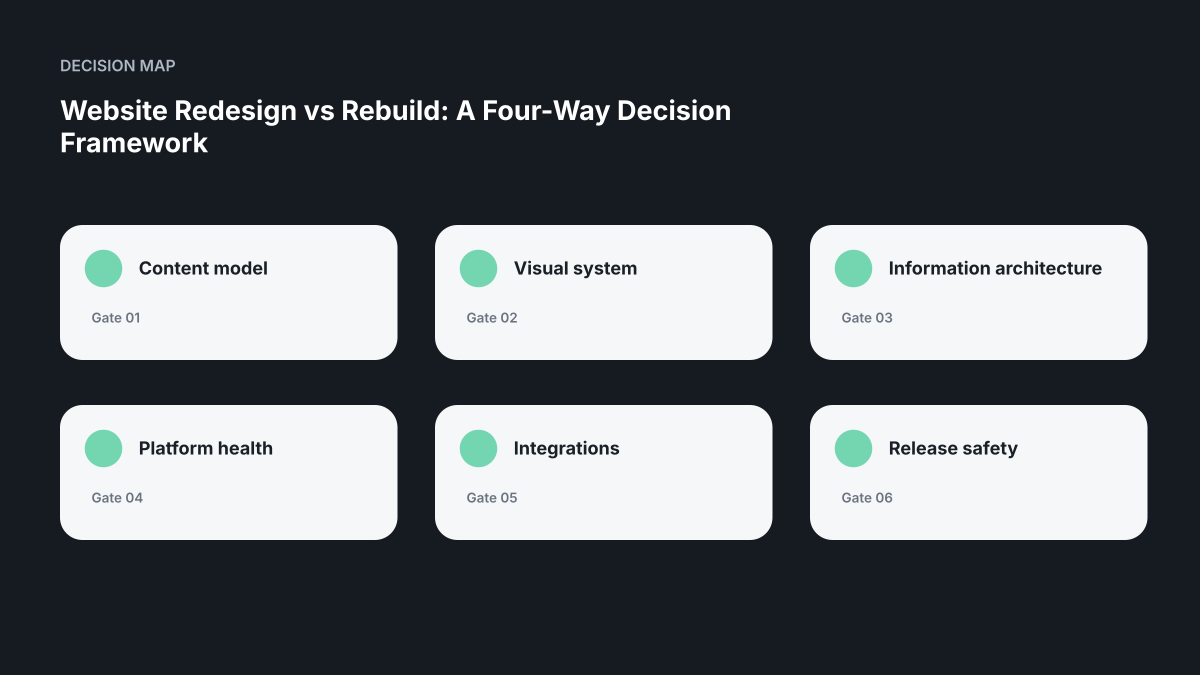
Good governance also separates decisions in time. First decide the buyer journey and information architecture. Then decide the visual system. Then decide what the existing platform can support safely. This sequence prevents a technology preference from dictating the content model and prevents a new design from hiding migration risk. Every larger intervention should have an explicit reason the smaller intervention is insufficient.
Decision table#
| Signal | What it usually means | First action |
|---|---|---|
| Platform is healthy; message/hierarchy is weak | KEEP | Optimize content, navigation, CTAs and measurement. |
| Structure works; visual system undermines trust/usability | RESKIN | Replace components and visual language while preserving stable foundations. |
| Buyers cannot navigate the offer or proof structure | RESTRUCTURE | Rework information architecture and page jobs; platform may stay. |
| Safe change, recovery or integration is structurally blocked | REBUILD | Replace the constrained implementation with explicit migration controls. |
Worked scenario#
A growing company has a five-year-old WordPress site with a dated visual system, but the content team can still publish safely and the lead form works. Performance is acceptable on most pages. A vendor recommends a complete rebuild because the theme is “old.” The decision framework produces a RESKIN + RESTRUCTURE outcome instead: preserve URLs and CMS behavior, create a new component system, simplify navigation, improve mobile layouts, and update the highest-value service content.
Contrast that with an inherited site where templates contain duplicated business logic, plugins cannot be updated safely, staging is unreliable, and the lead path breaks whenever cache rules change. That system is a stronger REBUILD candidate because the constraint is operational, not cosmetic.
Implementation sequence#
Begin with a constraint audit, then separate content, design and platform decisions. Freeze the URL inventory before redesign work starts. Prototype the new hierarchy using real content. Only then decide which templates need implementation changes and whether those changes can live safely on the current platform.
For rebuilds, add migration rehearsal, redirect mapping, form/integration testing, analytics continuity and rollback. The design process should not be allowed to consume the time reserved for these release controls.
Measurement plan#
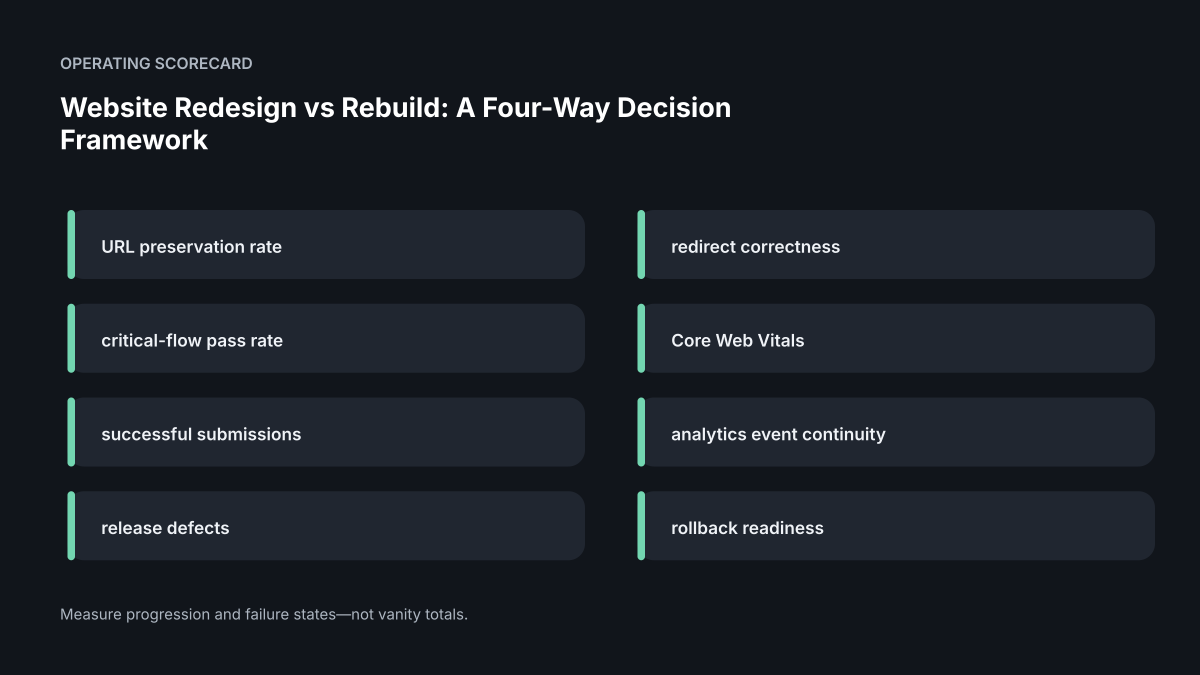
For a reskin or restructure, measure comprehension, progression to service pages, CTA interaction, successful submissions and mobile usability. For a rebuild, add technical measures: redirect correctness, indexing coverage, error rates, deployment reliability, Core Web Vitals, failed integration events and recovery time.
Do not compare only pre-launch and launch-week revenue. Sales cycles, seasonality and campaign changes can swamp website effects. Use a combination of behavioral and operational evidence.
Operating scorecard#
| Measure | Why it matters |
|---|---|
| URL preservation rate | Turns the operating state into a measurable signal that can drive a decision. |
| redirect correctness | Turns the operating state into a measurable signal that can drive a decision. |
| critical-flow pass rate | Turns the operating state into a measurable signal that can drive a decision. |
| Core Web Vitals | Turns the operating state into a measurable signal that can drive a decision. |
| successful submissions | Confirms the commercial path actually completes. |
| analytics event continuity | Turns the operating state into a measurable signal that can drive a decision. |
| release defects | Turns the operating state into a measurable signal that can drive a decision. |
| rollback readiness | Turns the operating state into a measurable signal that can drive a decision. |
Common mistakes to avoid#
The classic mistakes are equating modern appearance with business improvement, rewriting all URLs, migrating content late, allowing staging noindex rules into production, changing analytics during launch without a record, and deleting “old” pages before checking whether they attract qualified visitors.
Another mistake is rebuilding around a design system that cannot accommodate real editorial content. Use real long-form articles, service pages, tables and forms during design review.
Deep-dive: decide by constraints, not by visual age#
A website can look old and still have a sound technical foundation. It can also look modern while hiding brittle templates, undocumented integrations and deployment risk. The redesign-versus-rebuild decision improves when the team names the constraint that is actually blocking the next business outcome. That constraint may be message clarity, information architecture, component flexibility, performance, accessibility, integration reliability, ownership or release safety. The remedy should match the constraint.
A practical architecture review starts with a dependency map. Record the content system, template system, forms, analytics, CRM connections, payment or booking services, search-critical URLs, redirects, DNS, hosting, deployment path and any third-party scripts that affect the customer journey. For each dependency, state who owns it, how a change is tested and how it can be reversed. This turns “the site feels hard to work with” into a list of observable constraints.
Worked scenario: stable URLs, brittle templates#
Imagine a professional-services site with years of search history, useful editorial content and stable high-value URLs. The visual system is inconsistent, the service hierarchy has grown messy, and editors routinely duplicate page sections because the template library cannot express newer offers. Forms still work and the CMS is supported, but every meaningful layout change requires a developer to edit page-specific code.
A full rebuild is one possible answer, but it is not the only one. A staged restructure may preserve the domain, URL inventory, content database and proven integrations while replacing the component layer and cleaning the information architecture. The team can migrate one page family at a time, verify analytics and forms, and keep rollback available. This approach protects useful assets while removing the constraint that actually blocks change.
Now change one fact: the same site depends on an abandoned theme, production changes are made directly on the server, the deployment history is unknown, and critical form behavior is coupled to custom code nobody can safely modify. The decision moves toward rebuild because the foundation itself prevents reliable change and recovery. The visual complaint did not determine the answer; operational evidence did.
Make migration cost visible before choosing rebuild#
A rebuild estimate should include more than page construction. Account for URL mapping, content migration, structured data, analytics continuity, form and CRM verification, redirects, accessibility regression testing, DNS or hosting changes, release rehearsal, post-launch observation and rollback preparation. When those activities are excluded, a rebuild can appear cheaper than it really is and the business may discover the missing work during launch week.
The reverse mistake also happens. Teams sometimes keep an old system because migration looks expensive even though maintenance repeatedly consumes staff time and makes changes unsafe. In that case, document the recurring operational cost: fragile releases, duplicated templates, manual workarounds, incidents, vendor lock-in and inability to test. The decision becomes clearer when both migration cost and continued-fragility cost are visible.
Evidence packet before approval#
Before approving KEEP, RESKIN, RESTRUCTURE or REBUILD, require a small decision packet:
- current URL and content inventory, with the highest-value paths identified;
- architecture and integration map, including ownership and recovery notes;
- list of constraints with evidence rather than preference statements;
- target outcomes and acceptance criteria for the chosen path;
- migration and rollback plan where URLs, infrastructure or data will change;
- measurement plan that preserves critical events before and after release;
- unresolved risks that remain outside the approved scope.
This packet does not need to be large. Its purpose is to make the decision reversible and reviewable. A future operator should be able to understand why a rebuild was necessary, or why it was deliberately avoided.
Acceptance example#
For a restructure, acceptance might mean that the top service templates use the new component system, existing canonical URLs remain stable, contact and booking flows pass normal and failure tests, critical analytics events are visible, keyboard navigation is verified, and the previous production state can still be restored. Those conditions are stronger than “the new design is approved” because they connect the visual change to operational continuity.
Revisit the decision after discovery, not after design approval#
The chosen path should be provisional until the team inspects the real templates, integrations and content. If discovery reveals that a supposed visual project depends on replacing an unsupported integration, the scope may move from RESKIN to RESTRUCTURE or REBUILD. If the technical foundation proves healthier than expected, a proposed rebuild may shrink to a safer component and content project.
Record the reason for any change in direction and update acceptance criteria before implementation continues. This prevents sunk-cost pressure from turning an early assumption into an unnecessarily large release.
Buyer checklist#
Before approving the work, confirm:
- The team can state the content model condition in plain language.
- The visual system evidence is inspectable rather than assumed.
- Ownership for information architecture is named.
- A failure involving platform health has a defined response.
- The integrations signal is measured after release.
- The team knows how release safety is restored or handed over.
Release / acceptance gate#
| Gate | Evidence required before calling the work complete |
|---|---|
| URLs | High-value URLs are preserved or intentionally mapped. |
| Content | Real production content fits the new templates. |
| Forms | Lead and transaction flows pass normal and failure tests. |
| Analytics | Critical events are verified in the new environment. |
| Accessibility | Keyboard, labels, focus and structure are tested. |
| Rollback | The previous known-good state can be restored. |
A redesign or rebuild should not launch while URL, form, measurement or rollback gates remain unresolved.
Related Sazvara guidance#
- /services/
- /work/
- /contact/
- /insights/inherited-wordpress-rescue/
- /insights/technical-handover-standard/
Editorial note#
Source links support the migration, accessibility, search and recovery facts used here. The four-way KEEP/RESKIN/RESTRUCTURE/REBUILD framework and scenarios are Sazvara analysis intended to structure a decision, not evidence that one option is universally superior.
Sources and further reading#
- Google site-move guidance
- Google hosting-move guidance
- Google redirect guidance
- Google canonical guidance
- Core Web Vitals
- WCAG
- WordPress backups
- OWASP logging
- Google sitemaps
- Google helpful content
Next step#
Request a website architecture and conversion review. Start with the highest-consequence path described in this guide, capture a baseline, and require observable acceptance evidence before expanding the scope.
Have a system that is stuck, manual or difficult to ship?
Sazvara diagnoses the system before prescribing the technology. Bring the constraints, failure modes and current state.