A post-launch operating standard for teams using AI agents: what to evaluate, what to monitor, how to detect drift, when to stop automation and how to learn from failures. 
Editorial promise#
This article separates model quality from system quality. It treats evaluation as an operating loop, not a single score, and avoids implying that one universal benchmark can certify an agent for every business context.
The Sazvara framework#
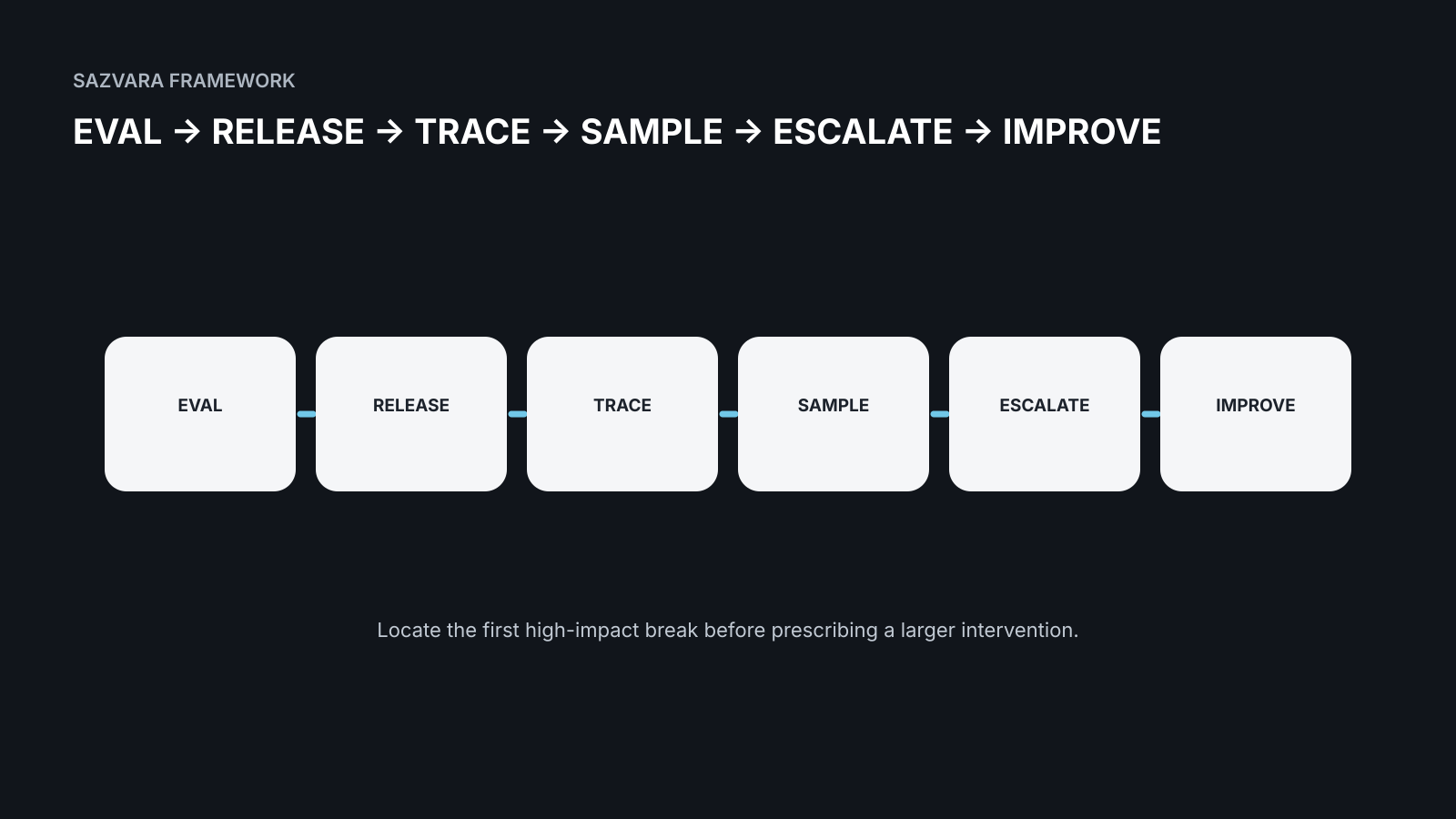
EVAL → RELEASE → TRACE → SAMPLE → ESCALATE → IMPROVE
The short answer#
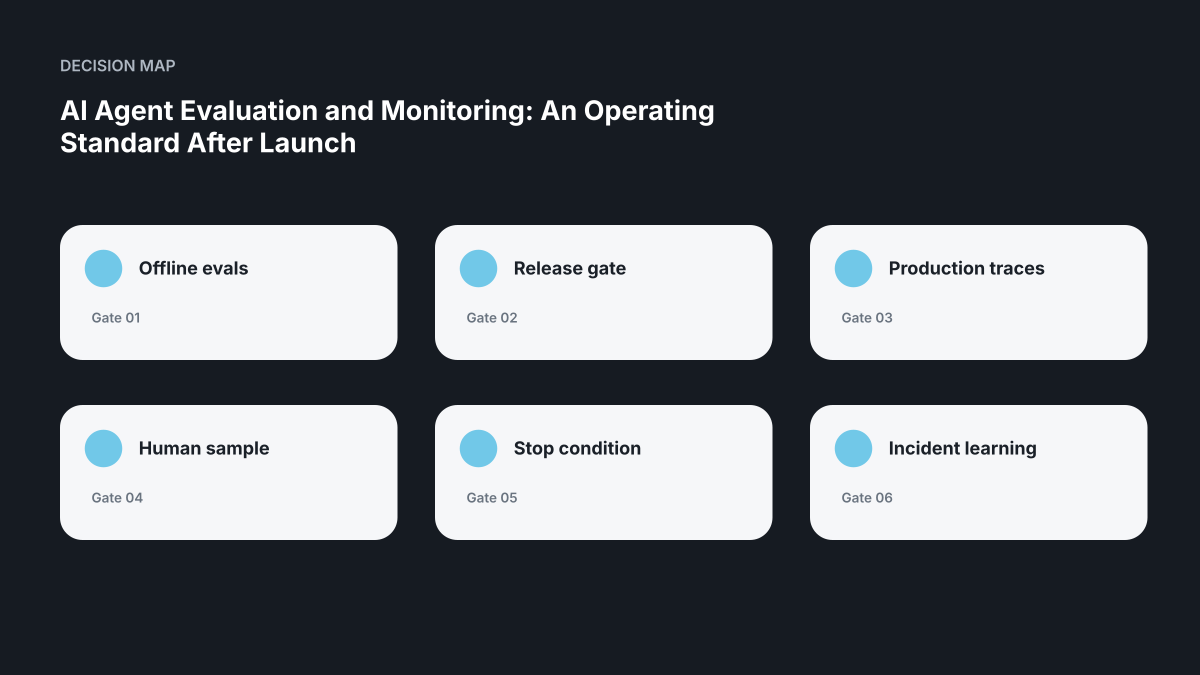
AI evaluation is not a one-time pre-launch test. Production systems need a loop that combines offline test cases, release gates, traces, sampled real-world review, incident escalation and controlled improvement.
The key is to evaluate the business task, not only the model output. A response can be fluent and still route the wrong customer, call the wrong tool or create an unacceptable operational state.
Evidence anchors#
- OpenAI Agents API — Long-running agent systems need operational infrastructure and a reliable harness.
- OpenAI Agents SDK evolution — Agent execution across tools and files benefits from controlled environments and inspectable behavior.
- OpenAI agent tooling overview — Integrated tracing and evaluation are part of the production tooling around agents.
- NIST AI RMF — Measurement should connect risk, context and operational decisions.
- NIST AI resource center — NIST implementation resources support ongoing measurement and governance.
- NIST generative AI profile — Production evaluation should consider risks specific to generative model behavior.
- OWASP LLM application risks — Security failure modes should be represented in testing and operational review.
- Microsoft human-AI guidance — Human review needs clear roles and interaction design to avoid rubber-stamp oversight.
- Microsoft responsible agents guidance — Operational governance includes accountability, escalation and review.
- OWASP logging — Trace evidence should be structured and privacy-aware.
Define the unit of success#
Write the task outcome in operational terms. For a support-triage agent, success might mean correct category, correct priority, no unsupported claims and correct escalation behavior. For a research agent, success might include source quality and traceable evidence.
Avoid one composite score that hides failure modes. Keep critical constraints visible.
Build a representative evaluation set#
Include normal examples, edge cases, missing information, conflicting information, risky requests and cases that should trigger human review. Keep enough frozen examples to compare releases over time.
Add new cases from real incidents, but do not replace the stable core every time.
Separate model quality from system quality#
A model may choose the right answer while a tool call fails. A tool may succeed while the workflow violates a business rule. Evaluate model output, tool selection, tool parameters, state transitions and final outcome separately.
This makes remediation more precise.
Use release gates#
Before changing models, prompts, tools or retrieval sources, run the evaluation suite and compare against the current production baseline. Define which regressions are unacceptable even if the average score improves.
High-consequence failures should block release.
Trace production runs#
Capture enough structured trace data to reconstruct key decisions and tool calls. Protect secrets and personal data, and set retention based on operational need.
Tracing is most useful when it can connect a customer-facing outcome to the exact workflow version that produced it.
Sample real outcomes#
Offline evaluations cannot represent everything. Review a statistically useful or risk-weighted sample of production outcomes. Oversample uncertain, escalated or high-consequence cases.
Human review should use a rubric so that feedback is comparable.
Monitor leading indicators#
Watch tool error rate, escalation rate, latency, cost, retry volume, refusal patterns and outcome-specific quality measures. Sudden changes can signal provider drift, changed upstream data or broken integrations.
Thresholds should trigger investigation, not automatic panic.
Design stop conditions#
Every automation needs conditions under which it should pause or fall back. Examples include repeated tool failures, unusually high escalation volume, missing required data or a quality metric falling below a release threshold.
A stop mechanism protects the business while the cause is diagnosed.
Treat incidents as evaluation assets#
When a real failure occurs, reproduce it in a test case where appropriate, identify which control failed to catch it and update the system. The goal is not merely to patch the example but to strengthen the class of control.
Keep incident-derived tests separate enough to understand what changed.
Control configuration changes#
Version prompts, tool definitions, routing rules, models and important thresholds. Tie production traces to those versions.
Without this, the team cannot distinguish model variability from an unrecorded system change.
Report to operators, not only developers#
A useful operating report explains what changed, what failed, what was escalated, what it cost and whether business outcomes improved. It should help an owner decide whether to expand, constrain or pause the workflow.
Avoid dashboards full of model metrics that do not map to operational decisions.
Review cadence#
Early systems benefit from frequent review because workflows and data are still changing. As the system stabilizes, cadence can be adjusted based on consequence and change rate.
Major model, tool or process changes should trigger a fresh evaluation regardless of the calendar.
Where Sazvara fits#
Sazvara can help turn an AI workflow into an operated system: explicit acceptance criteria, evaluation sets, traces, escalation design, release gates and post-launch scorecards.
The best starting point is usually one existing workflow and a small set of failures or uncertainties the team wants to make measurable.
What good looks like in practice#
A mature evaluation loop gives operators two forms of confidence: repeatability before release and visibility after release. Frozen cases prevent the benchmark from drifting to fit every new version, while production sampling reveals situations the benchmark did not anticipate. Configuration versions make it possible to connect a changed outcome to a changed prompt, model, tool or routing rule.
Good monitoring does not turn every variation into an incident. It distinguishes ordinary model variance from critical business failure, and it weights review toward high-consequence or unusual cases. When a real incident occurs, the team contains the impact, preserves evidence, reproduces the class of failure and adds a test that can block the same regression in future releases.
Decision table#
| Signal | What it usually means | First action |
|---|---|---|
| Offline eval regresses on critical cases | Release risk | Block release even if average score improves. |
| Production escalation rate jumps | Context/process drift | Inspect changed inputs, routing and upstream data. |
| Tool errors rise | Dependency failure | Degrade, queue or stop according to consequence. |
| Human overrides cluster by one case type | Benchmark gap | Add representative cases and inspect the rule. |
| Cost rises while accepted outcomes do not | Efficiency regression | Review retries, model choice and tool design. |
| High-consequence failure appears | Incident | Contain, reproduce, add an incident-derived test and re-release. |
Worked scenario#
A support agent passes a 50-case pre-launch evaluation with strong average scores. Two months later, a new product line changes the vocabulary customers use, and the agent begins routing many cases to the wrong queue. The model provider has not failed; the operating context changed.
A monitoring loop catches the shift because category distribution, escalation rate and sampled human review move outside their expected ranges. The team adds representative cases to the evaluation set, updates routing guidance, reruns the release gate and documents the change before redeploying.
Implementation sequence#
Create a stable core evaluation set first, then add an incident-derived set that grows over time. Tie each production release to the evaluation results and configuration version. Sample real outcomes on a cadence matched to risk, and review anomalies even when aggregate scores remain healthy.
When a change is needed, modify one major dimension at a time where possible—prompt, model, tool policy, retrieval source or business rule—so the effect is interpretable.
Measurement plan#
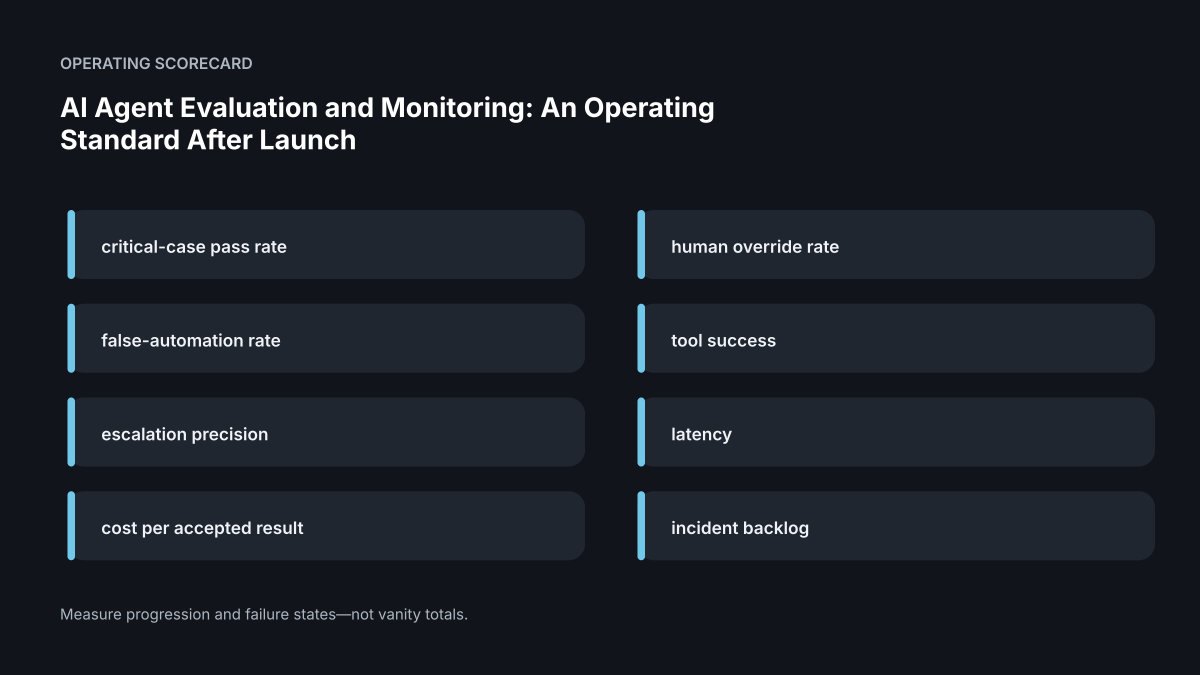
Report pass rate by critical criterion, escalation precision, false automation rate, human override rate, tool-call success, latency, cost, incident count and unresolved exception backlog. Separate high-consequence errors from ordinary quality variance.
Averages can hide dangerous tails. A 96% task score can still be unacceptable if the remaining 4% includes unauthorized customer-facing actions.
Operating scorecard#
| Measure | Why it matters |
|---|---|
| critical-case pass rate | Turns the operating state into a measurable signal that can drive a decision. |
| human override rate | Turns the operating state into a measurable signal that can drive a decision. |
| false-automation rate | Turns the operating state into a measurable signal that can drive a decision. |
| tool success | Turns the operating state into a measurable signal that can drive a decision. |
| escalation precision | Turns the operating state into a measurable signal that can drive a decision. |
| latency | Turns the operating state into a measurable signal that can drive a decision. |
| cost per accepted result | Turns the operating state into a measurable signal that can drive a decision. |
| incident backlog | Turns the operating state into a measurable signal that can drive a decision. |
Common mistakes to avoid#
Do not grade only textual style, do not let reviewers use inconsistent standards, do not continuously rewrite the benchmark until every release looks better, and do not deploy because a new model scores higher on generic public benchmarks.
Evaluation should represent the actual workflow, tools, policy and business consequence.
Founder decision questions#
Ask what would make the business stop or constrain the agent tomorrow. If the answer is only “when users complain,” monitoring is too weak. Define observable stop conditions before deployment: unacceptable high-consequence error, sustained tool failure, missing required data, abnormal escalation patterns or a meaningful drop in task-specific quality.
Ask who owns the evaluation set and who is allowed to change the rubric. A benchmark that is quietly rewritten to fit each new release cannot protect the operation. Stable reference cases and documented rubric changes create continuity across model and prompt updates.
Procurement brief#
Require an evaluation pack containing frozen baseline cases, edge cases, escalation cases and incident-derived cases. Each criterion should distinguish critical failure from ordinary quality variance. Production monitoring should tie traces to configuration versions and produce an operator-facing report of exceptions, overrides, cost and outcome quality.
The implementer should demonstrate one rollback or disable procedure and one post-incident learning cycle. The goal is to prove not just that the agent can be improved, but that it can be operated safely while improvement is happening.
Deep-dive: maintain the evaluation system as production changes#
An evaluation set loses value when it stays frozen while the business process changes. Keep a stable core of high-value cases so releases remain comparable, but add cases when incidents reveal a new failure mode, when tools change, when policy changes or when a new customer path is introduced. The goal is not to maximize the number of tests. It is to preserve representative evidence for the decisions the agent is allowed to make.
Separate at least three groups of cases. Core cases protect stable business behavior. Edge cases capture rare but consequential conditions. Incident cases reproduce failures that have actually occurred. This structure prevents a release from looking healthy simply because common easy cases dominate the average score.
Worked scenario: support triage after a routing change#
Assume an agent classifies incoming support requests and either answers a narrow class of questions or routes the request to a specialist queue. A new routing prompt improves categorization on common requests, but a production sample reveals that messages mentioning both billing and account access are now routed inconsistently.
The correct response is not merely to tweak the prompt until those two examples pass. First, add representative mixed-intent cases to the evaluation set. Define the expected routing and whether the agent may answer at all. Rerun the previous core set to ensure the fix does not create a regression elsewhere. Then release the change to a bounded traffic slice or assisted mode and inspect traces before restoring full authority.
If the same class of failure appears again, the issue may not be prompt wording. The taxonomy, routing policy or tool interface may be ambiguous. Evaluation should therefore inform system design, not become a ritual for tuning model output.
Use weighted release gates instead of one average#
A single average can hide a critical failure. Release gates should distinguish blocking cases from informative metrics. For example, an incorrect answer on a low-risk formatting task may reduce a quality score, while an unauthorized account action should block release regardless of the average. Define these blocking conditions before the team sees the new results.
Keep the gate understandable to operators. Record which cases are critical, which measures are trend indicators, and what threshold triggers assisted mode, rollback or investigation. When thresholds are changed, record why. Otherwise teams can unintentionally move the goalposts to approve a preferred release.
Production sampling should be risk weighted#
Do not sample only random successful-looking runs. Include high-consequence tasks, new configurations, cases with low confidence or unusual tool paths, escalations, retries and customer complaints. Review enough normal traffic to detect broad drift, but deliberately oversample the cases where failure costs more.
A sampled review should capture the expected outcome, observed outcome, configuration version, relevant tool activity, reviewer judgement and resulting action. When the review discovers a novel failure, decide whether it belongs in the permanent evaluation set, a temporary watch list or a system redesign backlog.
Monitor the evaluator too#
Human review can drift. Reviewers may interpret categories differently, approve outputs because they are familiar, or focus on style while missing operational errors. Periodically compare reviewer decisions on the same small sample and clarify ambiguous criteria. When the evaluation uses another model, version its prompt and configuration and periodically compare its judgement with human review on consequential cases.
The evaluation process should make disagreement visible rather than silently averaging it away. High disagreement is itself a signal that the task definition or acceptance criteria may be unclear.
Incident-to-test workflow#
After an incident, preserve the minimum evidence needed to reproduce the failure safely. Create a sanitized test case, state the expected behavior, confirm that the old configuration reproduces the defect where appropriate, and verify that the candidate fix passes both the new case and the stable regression set. Link the test to the incident record so future maintainers understand why it exists.
This closes the operating loop: production monitoring finds a meaningful failure, the failure becomes a reproducible evaluation asset, the fix passes a release gate, and post-release sampling confirms the behavior in the real system.
Evaluation governance questions for a monthly review#
A monthly review should ask whether the task definition changed, whether new tools or permissions were introduced, whether the core evaluation set still represents current work, whether incident cases were added after failures, and whether stop conditions were actually exercised. It should also compare the volume of escalations, retries and human overrides with the previous configuration. These questions keep evaluation connected to operations instead of letting it become a static dashboard.
The review should name one person who can stop or roll back a release. When responsibility is diffuse, teams can recognize a regression without acting on it. Record the decision, evidence reviewed and any accepted risk so later operators can understand why the configuration remained in service.
What to archive with every material release#
Preserve the configuration identifier, model and tool versions, evaluation-set version, blocking-case results, sampled production evidence from the prior version, known limitations, rollback target and approver. The archive does not need to contain sensitive raw prompts or customer data if those are stored elsewhere under controlled access; it needs reliable pointers and hashes or version identifiers where practical.
This creates a lineage from release decision to production evidence. When a later incident occurs, the team can compare what was known at release time with what appeared in production and update the evaluation system accordingly.
Keep a retirement rule#
Evaluation should also identify when an agent or workflow should be retired rather than endlessly tuned. If the task definition is unstable, the cost of review remains higher than the value produced, critical failures recur despite redesign, or a simpler deterministic process now performs the job more reliably, decommissioning can be the correct operating decision. Preserve the final evidence and handover notes so the business can explain why the system was withdrawn.
Buyer checklist#
Before approving the work, confirm:
- The team can state the offline evals condition in plain language.
- The release gate evidence is inspectable rather than assumed.
- Ownership for production traces is named.
- A failure involving human sample has a defined response.
- The stop condition signal is measured after release.
- The team knows how incident learning is restored or handed over.
Release / acceptance gate#
| Gate | Evidence required before calling the work complete |
|---|---|
| Benchmark | A stable core evaluation set exists. |
| Critical cases | High-consequence failures have explicit blocking criteria. |
| Versioning | Prompt, model, tools and routing versions are recorded. |
| Sampling | Production outcomes are reviewed on a risk-weighted cadence. |
| Stop conditions | The workflow can pause or degrade safely. |
| Learning | Incidents produce reproducible tests, not only one-off patches. |
A release should stop when critical evaluation cases regress or production stop conditions cannot be enforced.
Related Sazvara guidance#
- /services/
- /contact/
- /insights/ai-workflow-readiness-tests/
- /insights/automation-success-vs-business-success/
- /insights/technical-handover-standard/
Editorial note#
The linked sources support the evaluation, monitoring and governance concepts used here. The weighted gates, sampling model and incident-to-test loop are Sazvara analysis; example outcomes are illustrative rather than benchmarks or client performance claims.
Sources and further reading#
- OpenAI Agents API
- OpenAI Agents SDK evolution
- OpenAI agent tooling overview
- NIST AI RMF
- NIST AI resource center
- NIST generative AI profile
- OWASP LLM application risks
- Microsoft human-AI guidance
- Microsoft responsible agents guidance
- OWASP logging
Next step#
Request an AI evaluation and control review. Start with the highest-consequence path described in this guide, capture a baseline, and require observable acceptance evidence before expanding the scope.
Have a system that is stuck, manual or difficult to ship?
Sazvara diagnoses the system before prescribing the technology. Bring the constraints, failure modes and current state.