Updated: September 20, 2026 Author: Sajjad Farajollahi Primary intent: automation ROI / operational validation Audience: small-business owners, operators, agencies, product teams and technical leads responsible for automation outcomes
The short answer#
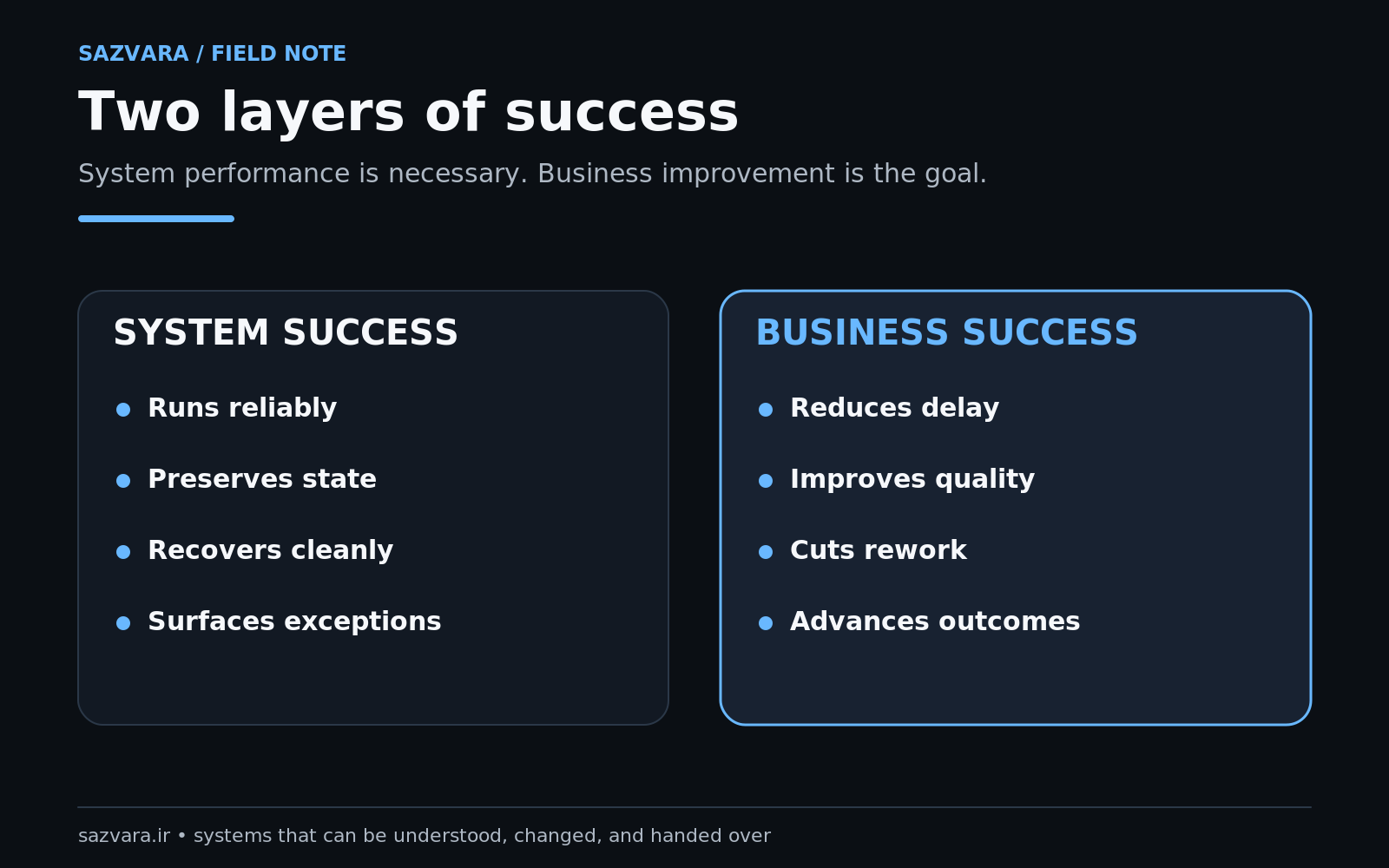
An automation is not successful because the workflow completed. It is successful when the business process performs better under real operating conditions and the improvement can be demonstrated without hiding new costs or risks. A useful validation therefore measures two layers at the same time: system performance—errors, retries, latency, duplicate actions, recovery—and business performance—cycle time, staff effort, completion rate, revenue-critical handoffs, customer delay, rework and control.
The practical rule is: define the business outcome before building the workflow, capture a baseline, instrument the critical path, test failure and exception cases, then compare production results against the baseline over a meaningful period. If the automation saves three minutes per case but creates a weekly reconciliation job, or completes 99% of runs while silently losing high-value exceptions, it may be technically healthy and commercially harmful.
That distinction matters even more as smaller firms adopt AI-assisted and agentic workflows. The OECD's 2026 D4SME survey found that strategic, targeted and secure integration remains uneven even as use rises, with time constraints, maintenance costs and skills gaps continuing to affect implementation (OECD 2026 D4SME survey). NIST's AI Risk Management Framework similarly treats measurement and ongoing production monitoring as lifecycle activities, not a one-time launch check (NIST AI RMF Core).
Why green workflow runs can still produce bad business outcomes#
Most automation tools expose an execution status. That status answers a narrow question: did the configured sequence complete according to the platform's rules? It does not necessarily answer whether the right customer was created, whether the sales team received the lead before it went cold, whether an invoice was duplicated, whether a human exception was routed correctly, or whether the cost of operating the automation is lower than the manual process it replaced.
This is the first measurement mistake: substituting platform completion for process success.
A lead workflow illustrates the difference. Imagine a website form that validates the submission, adds a record to a CRM and sends a notification. The platform reports a successful execution. But the CRM mapping places the enquiry in the wrong pipeline, the owner field is blank, and the notification goes to an inbox nobody monitors. Every technical step may have returned a success code while the commercial objective—fast, accountable lead handling—failed.
A second mistake is measuring only averages. An automation can reduce average handling time while making a small class of cases dramatically worse. If those cases are enterprise customers, regulated records or large transactions, the tail matters more than the mean. Reliability guidance from AWS makes the same conceptual point in infrastructure terms: monitoring should include key performance indicators based on business value, not only technical characteristics, because availability ultimately means delivering the intended service (AWS Reliability design principles).
A third mistake is ignoring the work that moved outside the visible workflow. Automation often shifts effort rather than removing it. Staff may spend less time entering data but more time clearing failed executions, reviewing malformed AI output, maintaining credentials, reconciling duplicates or answering customers affected by edge cases. Unless those activities are counted, the ROI model is incomplete.
A definition that is useful in operations#
In this guide, business-successful automation means a workflow that produces a defined operational outcome more reliably, quickly, economically or controllably than the prior method, while keeping residual risk inside an agreed tolerance.
That definition contains six things that a “workflow ran” metric does not:
- a defined outcome;
- a comparison point;
- a real operating context;
- cost and effort, including maintenance;
- reliability and control;
- explicit tolerance for exceptions and failure.
It also prevents a common sales problem. Vendors can demonstrate an impressive sequence in a clean demo account. Operators need to know how the system behaves on Monday morning when an API slows down, credentials expire, a user submits malformed data, a duplicate webhook arrives and the person who built the workflow is unavailable.
The Sazvara two-layer scorecard#
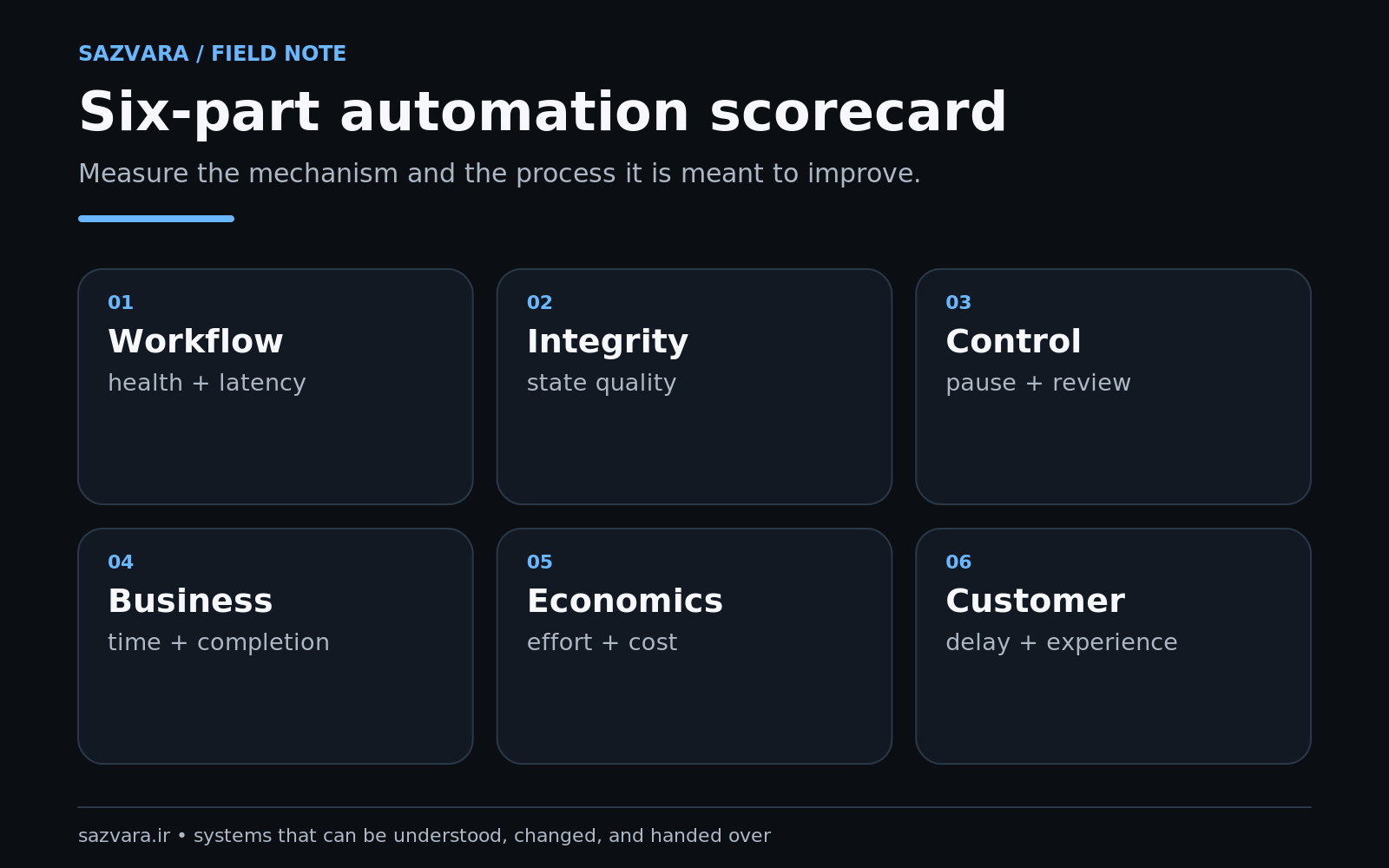
A practical automation scorecard has a workflow layer and a business layer. Neither is sufficient alone.
| Layer | Core question | Example measures | Warning sign |
|---|---|---|---|
| Workflow health | Does the mechanism run predictably? | error rate, retry rate, latency, duplicate rate, queue depth, recovery time | technically unstable process |
| Data integrity | Is the right state created once and traceably? | missing records, duplicates, field accuracy, reconciliation variance | silent corruption or drift |
| Human control | Can people see, stop and recover the process? | exception queue age, intervention time, ownership, rollback path | opaque automation |
| Business outcome | Did the process itself improve? | cycle time, completion rate, lead-response time, order accuracy | no meaningful operational gain |
| Economics | Is the improvement worth its full cost? | staff hours avoided, platform/API cost, maintenance time, incident cost | savings consumed by operation |
| Customer impact | Did the external experience improve? | time-to-response, failed handoffs, complaint rate, abandonment | internal efficiency at customer expense |
This structure is deliberately broader than an ROI spreadsheet. Financial return matters, but a workflow that reduces cost while creating unowned risk can still be a poor decision.
NIST's measurement guidance supports this wider view. The AI RMF Measure function calls for quantitative, qualitative or mixed methods, documented metrics, production monitoring and comparison against deployment context rather than relying solely on development-time tests (NIST Measure playbook). The same discipline applies even when the automation contains no AI component.
Step 1: Write the outcome before choosing the tool#
Start with one sentence that describes the desired business state without naming a platform.
Weak objective:
Automate lead intake with n8n.
Stronger objective:
Every valid website enquiry should create one complete CRM record, receive an owner within two minutes, notify the responsible team and expose any failed handoff for recovery before the next business hour.
The second version contains observable conditions. It gives the team something to test even if the implementation later moves from n8n to Zapier, Make, custom code or a CRM-native workflow.
For each automation, write:
- the trigger that begins the business process;
- the intended end state;
- the maximum acceptable delay;
- the fields or records that must remain accurate;
- the exceptions that require human judgment;
- the owner when something fails;
- the evidence that proves successful completion.
This is the first decision gate. If the team cannot describe the desired end state, it is too early to automate.
Step 2: Capture a baseline that represents real work#
A baseline is not “people say this takes a long time.” Measure a sample of the current process before replacing it.
For a repetitive administrative workflow, useful baseline fields include:
- number of cases per week;
- median and 90th-percentile handling time;
- staff minutes spent per case;
- number of handoffs;
- correction or rework rate;
- percentage completed inside the service target;
- number of cases that require escalation;
- customer waiting time;
- direct tool cost;
- failure recovery effort.
Do not over-instrument a tiny business. Twenty or thirty representative cases may be more useful than a sophisticated dashboard with no decision attached to it. The goal is to establish a credible “before” state.
The OECD's 2025 paper on SME AI adoption is useful context here because it distinguishes casual access from deeper use in core business functions. It found large adoption gaps between smaller and larger firms and reported that AI use in core business operations remained below 10% across G7 countries in 2024, underscoring that operational integration is a different challenge from individual use of an AI tool (OECD SME AI adoption paper).
Step 3: Separate leading indicators from business outcomes#
A good measurement model distinguishes what tells you the workflow is becoming unhealthy from what tells you the business is getting a result.
Leading indicators might include:
- authentication failures;
- API latency;
- queue growth;
- retry count;
- schema-validation failures;
- percentage of records sent to manual review;
- provider rate-limit events;
- webhook duplication.
Outcome indicators might include:
- lead response inside SLA;
- invoice processing time;
- percentage of orders completed without correction;
- staff hours returned to higher-value work;
- appointment no-show reduction;
- time from request to customer confirmation;
- percentage of cases completed without escalation.
AWS reliability guidance specifically warns against monitoring only technical metrics. Its workload-monitoring guidance recommends metrics that capture user experience and business function because a system can be technically alive while the service is effectively broken (AWS monitor workload resources).
The important design move is to connect the layers. A spike in retry count matters because it may predict missed lead-response targets. A queue-depth alarm matters because it may predict late order fulfilment. Monitoring becomes useful when it gives the business time to intervene before the customer becomes the alerting system.
Step 4: Define acceptance criteria for normal and abnormal cases#
Most workflow testing proves only the happy path. Production quality requires an exception matrix.
Consider a form-to-CRM automation. Normal tests might cover a valid submission and expected routing. The abnormal set should also include:
- missing optional data;
- missing required data;
- duplicate submission;
- CRM outage;
- expired credential;
- rate limiting;
- slow downstream response;
- malformed API response;
- notification failure after the CRM write succeeds;
- a replay after partial completion.
For each case, specify the acceptable behavior. Should the workflow retry automatically? Stop and alert? Create a manual-review item? Roll back? Continue with a warning? The answer depends on business impact.
This is one place where AI-enabled workflows need extra care. OpenAI's production-evaluation material emphasizes systematic evaluations as applications move from prototypes to production, and NIST's AI RMF requires ongoing testing and monitoring because behavior can change across deployment conditions (OpenAI Academy on production evals, NIST AI RMF).
A generated customer reply, classification or summary should therefore be evaluated against task-specific criteria rather than treated as correct because the API returned text.
Step 5: Instrument end-to-end evidence, not isolated steps#
A workflow log often shows component-level events. Business validation needs a trace that follows one real item from trigger to final state.
For each critical execution, preserve enough identifiers to answer:
- which business item entered the process;
- which workflow version handled it;
- which external systems were called;
- which records were created or changed;
- whether a retry occurred;
- whether a person intervened;
- what final state was reached;
- how long the path took.
That does not mean logging sensitive payloads indiscriminately. Logging should support diagnosis while respecting security and privacy. Credentials and secrets should never be copied into business audit trails. OWASP's secrets-management guidance recommends centralised handling, least privilege, lifecycle management, rotation and auditability rather than scattering credentials through scripts and configuration (OWASP Secrets Management Cheat Sheet).
A practical pattern is to generate a correlation ID at the start of the process and carry it through logs, CRM notes and exception records. The ID lets operators reconstruct what happened without treating every system as an isolated black box.
Step 6: Measure maintenance as part of the cost#
Automation business cases often count build cost and subscription cost but omit operating cost. That produces flattering but fragile ROI.
Track at least:
- platform and API spend;
- time spent reviewing exceptions;
- maintenance after upstream API or schema changes;
- credential rotation and access administration;
- time spent investigating incidents;
- rework caused by bad outputs;
- time spent updating prompts, rules or mappings;
- cost of monitoring and storage where material.
For small businesses, maintenance matters disproportionately because the same people responsible for sales or delivery may also become the unofficial automation team. OECD's 2026 SME survey explicitly identifies maintenance costs, time constraints and skills gaps among barriers to effective integration (OECD 2026 D4SME).
The right question is not “how many hours did we automate?” It is “how many net hours did we return after operating the system safely?”
Step 7: Use a before/after model that does not overclaim#
A simple comparison table is often enough.
| Measure | Before | After | Interpretation |
|---|---|---|---|
| Median handling time | measured baseline | measured production result | speed effect |
| 90th percentile handling time | baseline | result | tail-risk effect |
| Manual touches per case | baseline | result | labour effect |
| Correction rate | baseline | result | quality effect |
| Failed cases recovered within SLA | baseline | result | resilience effect |
| Monthly operating effort | baseline | result | maintenance effect |
Avoid attributing every business change to the automation. If lead volume, staffing, pricing or seasonality changed at the same time, record that. The purpose is operational truth, not a marketing claim.
When a clean experiment is possible, compare similar periods or cohorts. When it is not, state the limitations. A transparent “we reduced median handling time in a four-week operational sample, while volume remained similar” is more credible than a dramatic percentage with no denominator or context.
Worked example: a support-triage workflow#
Consider a small B2B software company receiving support requests through email and a website form. Staff manually read each message, identify the account, classify urgency, copy the issue into a ticketing tool and notify the right person.
The automation proposal is to parse the message, match the customer, suggest a category and priority, create the ticket and route it.
A shallow success metric is “tickets were created automatically.” A useful scorecard asks more:
- Did every valid request create exactly one ticket?
- Did the account match correctly?
- How often did the suggested urgency disagree with human review?
- Were high-risk categories always sent to a human before action?
- Did median time-to-owner improve?
- What happened when the ticketing API timed out?
- Could an operator replay safely without creating duplicates?
- How much weekly exception handling was introduced?
Suppose the system cuts median triage time dramatically but misclassifies a small number of security-related tickets. The overall speed improvement does not justify autonomous routing of that class. The better design may keep automated extraction and ticket creation while requiring human approval for high-risk categories.
That is not an automation failure. It is a better boundary discovered through measurement.
What to do when an automation technically succeeds but commercially fails#
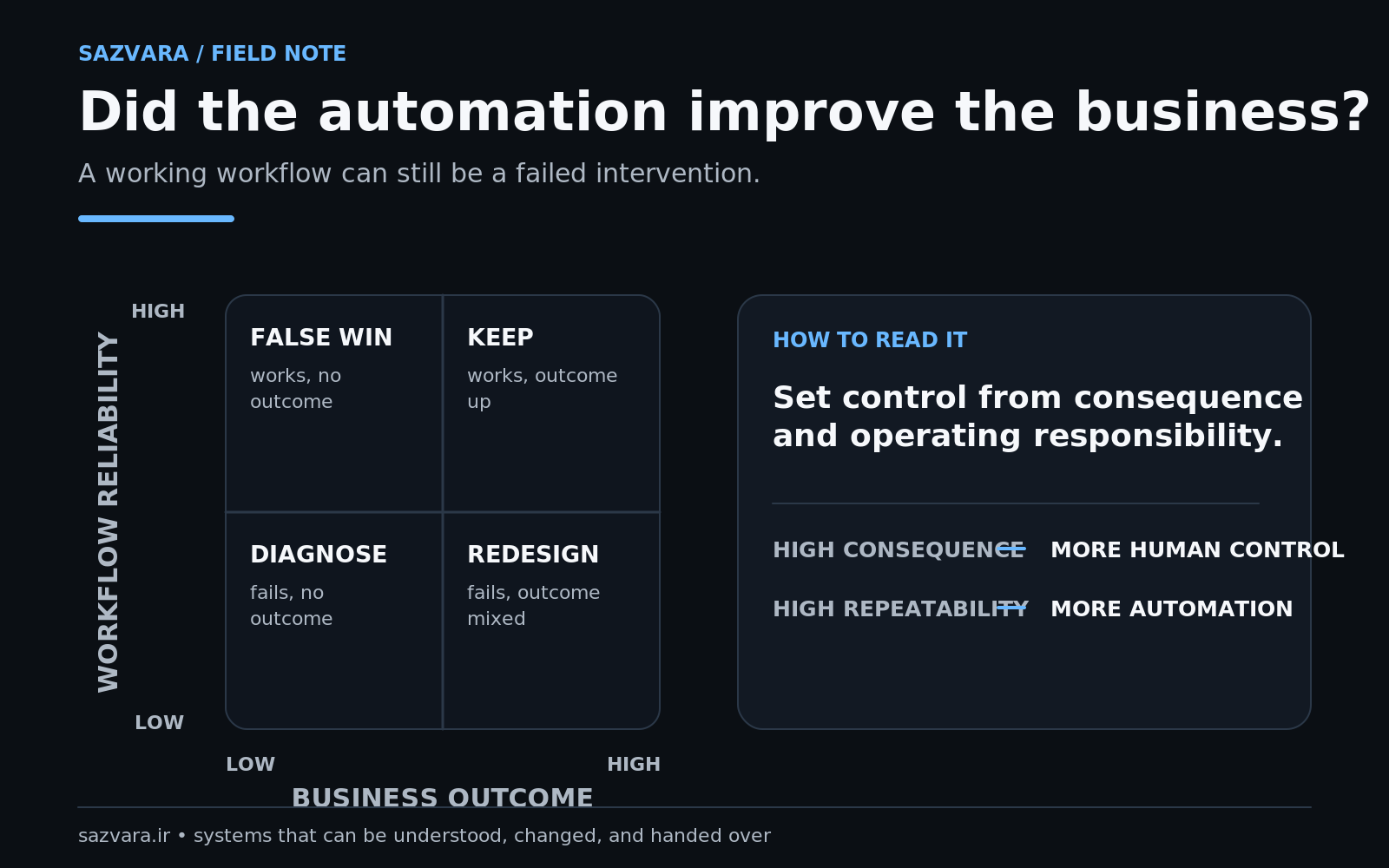
There are four broad responses.
Narrow the scope#
Keep the reliable portion and return ambiguous decisions to people. This is often the best outcome for AI classification, finance approvals, hiring-related decisions, sensitive customer communication or unusual transactions.
Change the control design#
Add validation, idempotency, approval, reconciliation, observability or a recovery queue. Many “tool problems” are actually missing control mechanisms.
Change the process before automating it#
If the underlying process has conflicting rules, unclear ownership or duplicate systems of record, automation can accelerate disorder. Fix the workflow definition first.
Remove the automation#
NIST's framework explicitly includes management options such as recalibration, impact mitigation or removal when risk or performance is not acceptable. Decommissioning a weak automation is a legitimate operational decision, not an admission of defeat (NIST AI RMF Core).
Reliability needs a stop mechanism#
Automatic retries and recovery are valuable, but unlimited autonomous recovery can amplify damage. A failed CRM write can often be retried safely. A payment capture, inventory decrement or outbound customer message may require stronger idempotency and explicit stop conditions.
AWS's current recovery guidance recommends tested, observable and reproducible automated recovery and specifically calls for a way to halt recovery when it behaves dangerously (AWS automate recovery).
For business automation, define:
- maximum automatic retry count;
- which errors are safe to retry;
- which actions must be idempotent;
- the condition that opens a manual-review item;
- the condition that pauses the workflow;
- the person who owns the pause decision;
- the data needed to resume without guessing.
This turns “error handling” into an operational policy.
A 30-day post-launch measurement cadence#
The first month should be treated as controlled production learning rather than a victory lap.
Days 1–3: inspect every critical execution; validate data mapping, ownership and notifications. Days 4–7: review failure classes, duplicate risks and manual interventions; tune only changes supported by evidence. Week 2: compare early outcome metrics to the baseline; identify whether benefits concentrate in certain case types. Week 3: test recovery paths and access/credential procedures; confirm a second person can understand the system. Week 4: calculate net operating effect, document limitations and decide whether to expand, hold or reduce the automation boundary.
Google Cloud's reliability guidance frames operations as observation, response and learning, which is a useful model here: production systems improve through continuous observation and adaptation rather than a one-time “go live” event (Google Cloud reliability framework).
The business-success release gate#
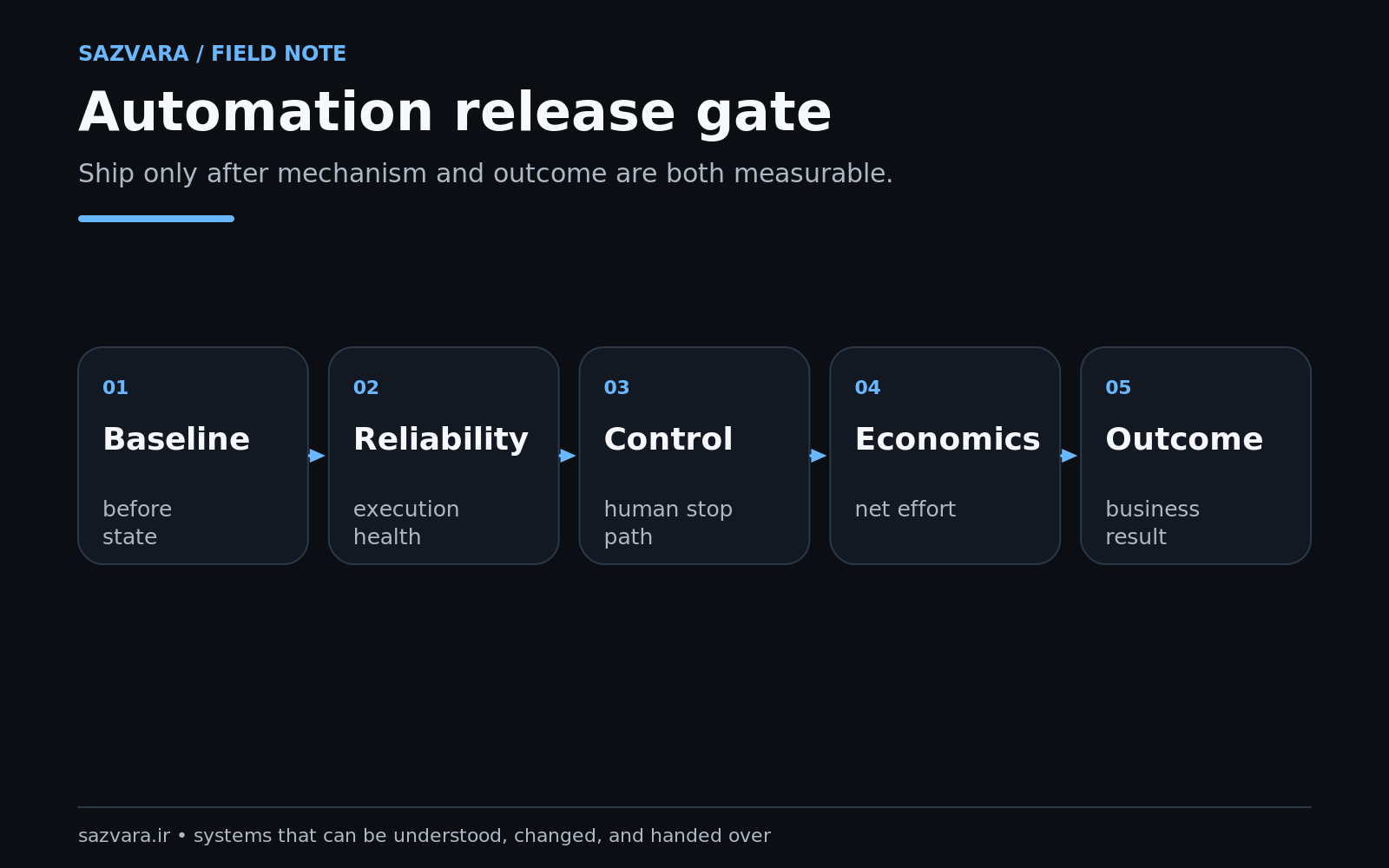
Before declaring an automation successful, Sazvara would expect evidence for five questions:
- Outcome: Is the intended business state demonstrably improving?
- Integrity: Are records and side effects complete, accurate and non-duplicative?
- Recovery: Can failures be detected, contained and recovered without improvisation?
- Economics: Does the net benefit remain positive after maintenance and exception work?
- Ownership: Does a named person understand the controls, limits and escalation path?
If one answer is unknown, the automation may still be useful, but the success claim is premature.
What this means for buyers of automation services#
When evaluating an automation proposal, ask for the acceptance criteria before asking for the platform. A strong provider should be able to explain how the workflow will be validated, what will be monitored, how partial failure is handled, what remains human-owned and what evidence will be delivered at handover.
That is the difference between buying a diagram and buying an operational capability.
If you already have automations that “work” but nobody can confidently explain their failure modes, Sazvara's services focus on diagnosing and stabilising existing systems as well as building new ones. Our work shows the engineering approach behind that process. For a bounded assessment of one workflow, use the Sazvara diagnostic route.
Sources and further reading#
- NIST AI RMF Core
- NIST AI RMF Measure Playbook
- NIST AI Risk Management Framework
- OECD: Empowering SMEs in the age of AI — 2026 D4SME Survey
- OECD: AI adoption by small and medium-sized enterprises
- OpenAI Academy: Evals and production-ready AI applications
- AWS Well-Architected: reliability design principles
- AWS Well-Architected: monitor workload resources
- AWS Well-Architected: automate recovery
- Google Cloud Well-Architected: reliability
- OWASP Secrets Management Cheat Sheet
- Google Search Central: optimizing for generative AI in Search
Editorial note#
This article was produced with an AI-assisted research workflow and reviewed as a human-authored Sazvara publication. Product and framework claims are linked to the cited source material. The operational scorecards and release gates are Sazvara synthesis, not claims that NIST, OECD, AWS, Google or OpenAI endorse Sazvara's specific implementation model. No client results or financial outcomes are invented here.
Have a system that is stuck, manual or difficult to ship?
Sazvara diagnoses the system before prescribing the technology. Bring the constraints, failure modes and current state.