Updated: September 20, 2026 Author: Sajjad Farajollahi Primary intent: AI workflow readiness / automation risk assessment Audience: small and mid-sized businesses preparing to automate a real operational process
The short answer#
A workflow is ready for AI automation only when the business can describe the objective, inputs, outputs, authority, failure modes, recovery path and measurement plan before choosing a model or automation platform. The decisive question is not whether a tool can perform the happy path. It is whether the organization can govern, observe, interrupt, recover and evaluate the complete operating process after the tool is introduced.
NIST's AI Risk Management Framework organizes risk work around governance, mapping, measurement and management, while its Generative AI Profile extends those ideas to risks specific to generative systems (NIST AI RMF, NIST Generative AI Profile). Microsoft's current responsible-agent guidance similarly treats responsible AI as a release gate and recommends human approval where actions are consequential or difficult to reverse (Microsoft responsible AI guidance). These sources point toward the same practical conclusion: readiness is an operating condition, not a software feature.
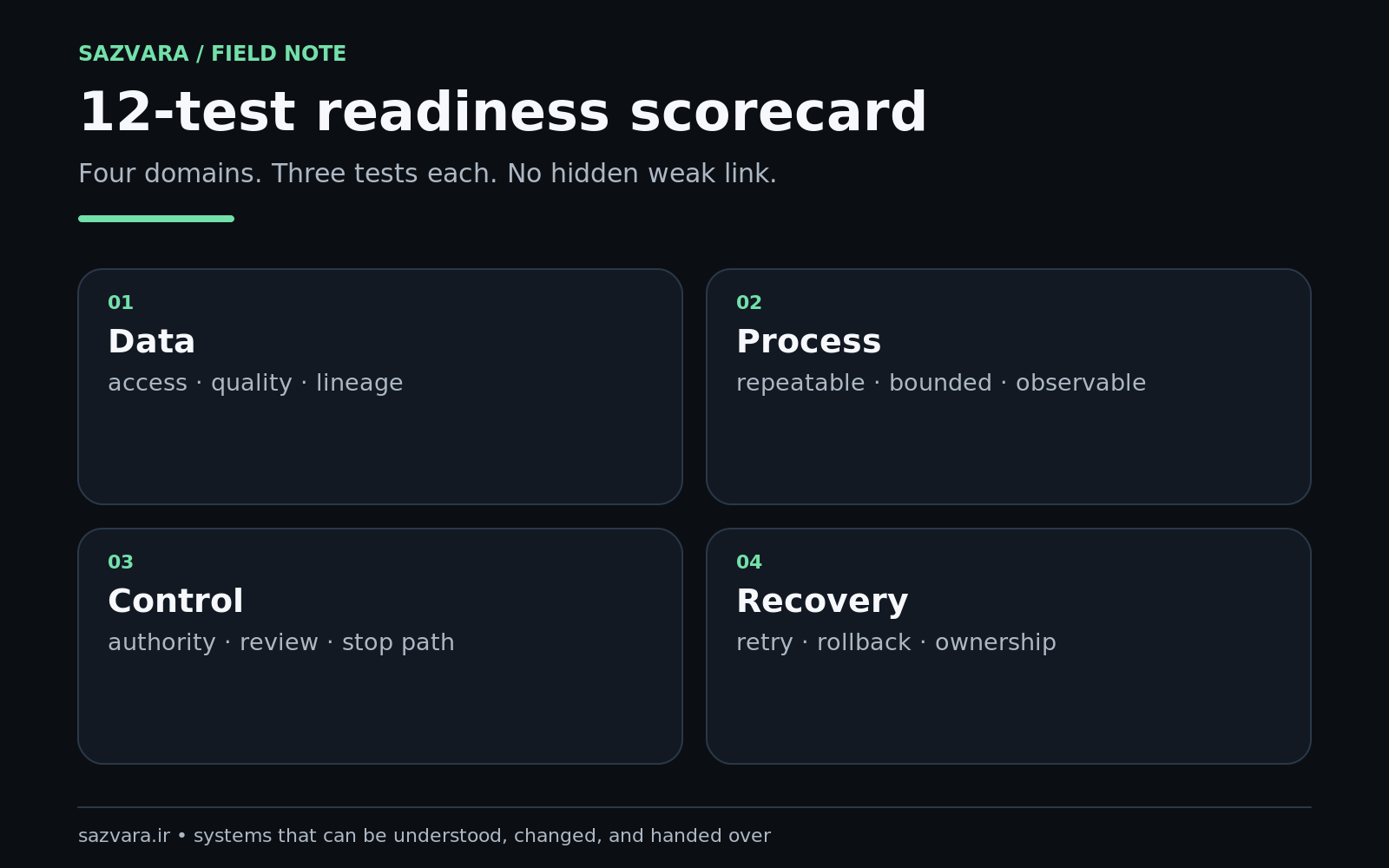
This guide converts that principle into twelve tests a business can run before committing money or staff time to automation.
What AI workflow readiness means in practical terms#
In this guide, AI workflow readiness means that a business process is sufficiently defined, controlled and observable that automation can be introduced without making ownership or failure harder to manage. Readiness does not mean every risk has disappeared. It means the organization knows which risks remain, who owns them, and what evidence will show whether the system is operating acceptably.
That distinction prevents a common mistake: automating a process that is still unstable. If the team cannot agree on the current rule, the source of truth, the escalation path or the acceptable error boundary, adding a model usually converts an organizational ambiguity into a technical ambiguity. The result can look impressive in a demo while becoming expensive in daily operations.
A useful readiness review therefore happens before platform selection. It should involve the people who understand the process, the people who own the data, the people who will operate the automation, and the person authorized to stop it. NIST's AI Resource Center emphasizes testing, evaluation, verification and validation as practical activities for operationalizing the framework (NIST AIRC). The same discipline is useful for a ten-person company as for a large enterprise; the artifacts can simply be smaller.
Test 1 — Is the business objective explicit?#
Start by writing the outcome without mentioning AI. "Use a model to classify leads" is a technical description. "Route qualified enquiries to the correct owner fast enough that no valid enquiry disappears" is an operational objective. The latter can be measured with or without AI.
Ask four questions:
- What business state should improve?
- Who benefits when it improves?
- What evidence shows improvement?
- What new cost or risk would make the automation a bad trade?
A readiness review should reject objectives based only on novelty. NIST's framework is deliberately use-case oriented rather than technology oriented, which supports evaluating the actual business context rather than treating a model as inherently useful (AI RMF 1.0 publication).
Worked example: support triage#
A small support team might propose automatic ticket categorization. A weak objective is "reduce manual categorization." A stronger objective is "place new tickets into the correct operational queue without delaying urgent cases or preventing an agent from overriding the classification." The stronger version exposes the trade: speed matters, but not at the cost of invisible misrouting.
Test 2 — Is the process boundary stable?#
Define where the workflow starts and where responsibility ends. If the process begins with a website form, does the automation own only classification, or also CRM creation, acknowledgment, task assignment and follow-up? If nobody can answer, scope is still unstable.
Draw the current process before designing the future process. Record the trigger, decision points, external systems, manual steps and final business state. A stable boundary does not require the process to be simple. It requires the team to know which part is being changed and which part remains outside the automation.
This matters because downstream effects change the risk profile. Generating an internal summary is very different from issuing a refund, sending a contractual notice or changing a customer record. Microsoft's guidance explicitly distinguishes consequential actions and recommends human review when actions affect people, money or compliance (Microsoft responsible AI guidance).
Test 3 — Are inputs available, permitted and timely?#
List every input the workflow needs. Then identify where each value comes from, who owns it, how fresh it must be, and whether the automation is allowed to access it. Do not treat "the model can read it" as equivalent to "the business may send it to this service."
For each input, capture:
| Input question | Evidence required |
|---|---|
| Source | authoritative system or document |
| Permission | business and security approval |
| Freshness | acceptable age at decision time |
| Format | expected schema or free-text range |
| Missing-data behavior | reject, ask, infer or escalate |
| Logging rule | what may and may not be retained |
The Generative AI Profile from NIST highlights information integrity, privacy and security as risk areas that must be managed across the lifecycle (NIST Generative AI Profile). Readiness therefore includes data permission and provenance, not just data availability.
Test 4 — Is the input quality measurable?#
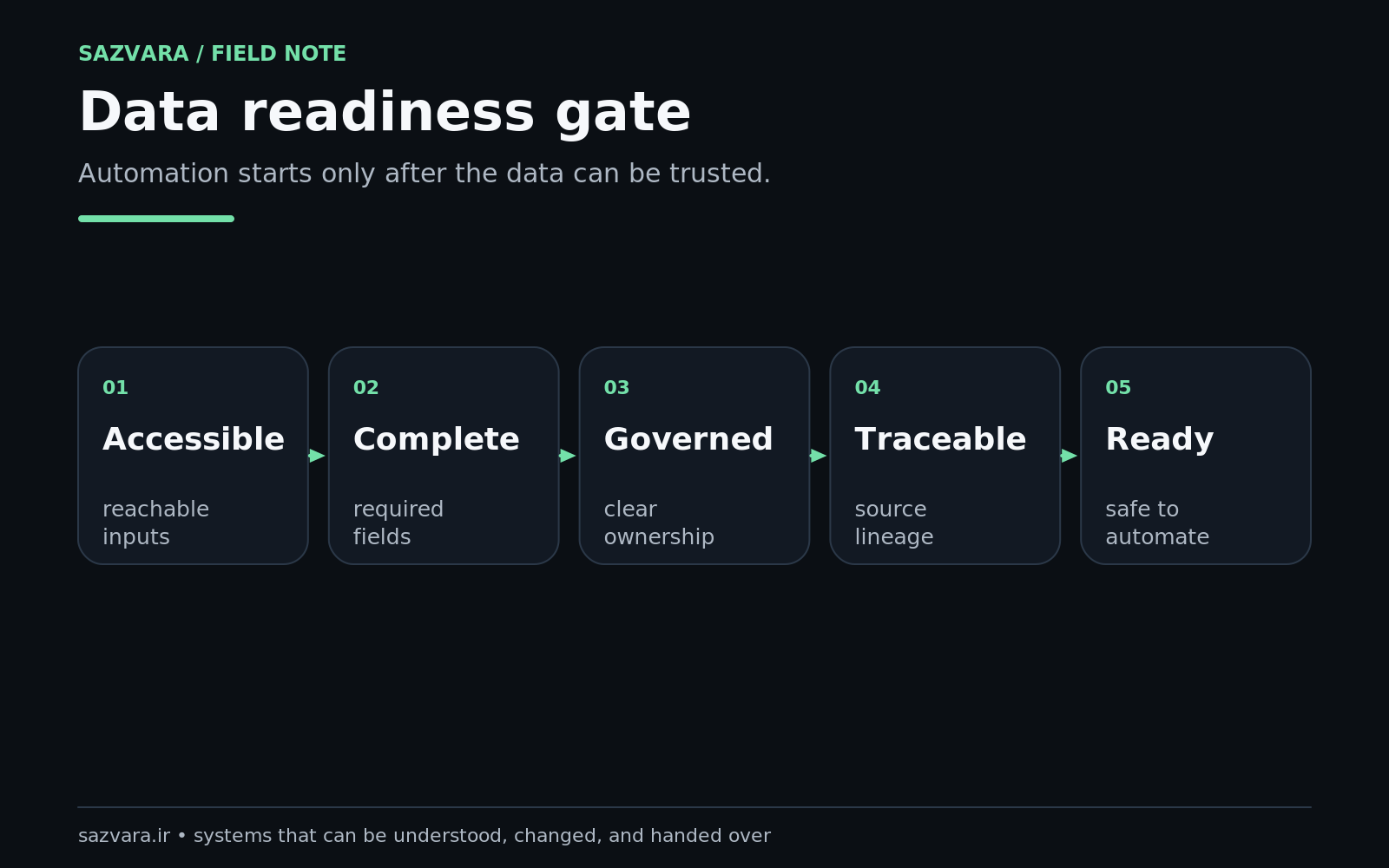
Before adding a model, inspect missing fields, duplicates, conflicting records, malformed values and the range of free-text language the system will see. If the inputs are unstable, model behavior will be difficult to evaluate because the cause of errors is unclear.
A practical approach is to sample historical cases and label the data problems separately from model-performance questions. This lets the business distinguish "the automation interpreted the case poorly" from "the source record was incomplete." That distinction matters when assigning ownership.
Do not clean data indefinitely in pursuit of perfection. The goal is to know which imperfections are routine and what the system should do when they occur. A robust workflow can often handle imperfect input safely by refusing, quarantining or escalating rather than guessing.
Test 5 — Is there a meaningful evaluation standard?#
If human reviewers cannot agree on what a good output looks like, the automation is not ready for production. Build an evaluation set from real or representative examples. For each case, define what counts as acceptable, unacceptable and ambiguous.
Evaluation should reflect the business cost of different mistakes. A false positive and false negative may have very different consequences. NIST's resource center explicitly frames testing, evaluation, verification and validation as operational practices rather than one-time research tasks (NIST AIRC).
For generative outputs, evaluation may combine structured rules with human review. For example, a drafted response could be checked for required facts, prohibited claims, tone, escalation triggers and whether cited source material actually supports the answer. The evaluation set should include difficult cases, not only obvious examples.
Test 6 — Is exception volume understood?#
Automation is strongest when the normal path is common enough to justify it and the exceptions can be identified. If every case requires nuanced judgment, the correct first step may be assistance rather than autonomous execution.
Sample a realistic period and classify cases into three groups:
- routine — clear rule and low ambiguity;
- reviewable — automation can propose, but a person should decide;
- non-automatable for now — context or authority remains too uncertain.
The point is not to eliminate exceptions. It is to know whether the proposed architecture has a place for them. A workflow without an exception path is not ready; it is merely optimistic.
Test 7 — Is failure cost classified?#
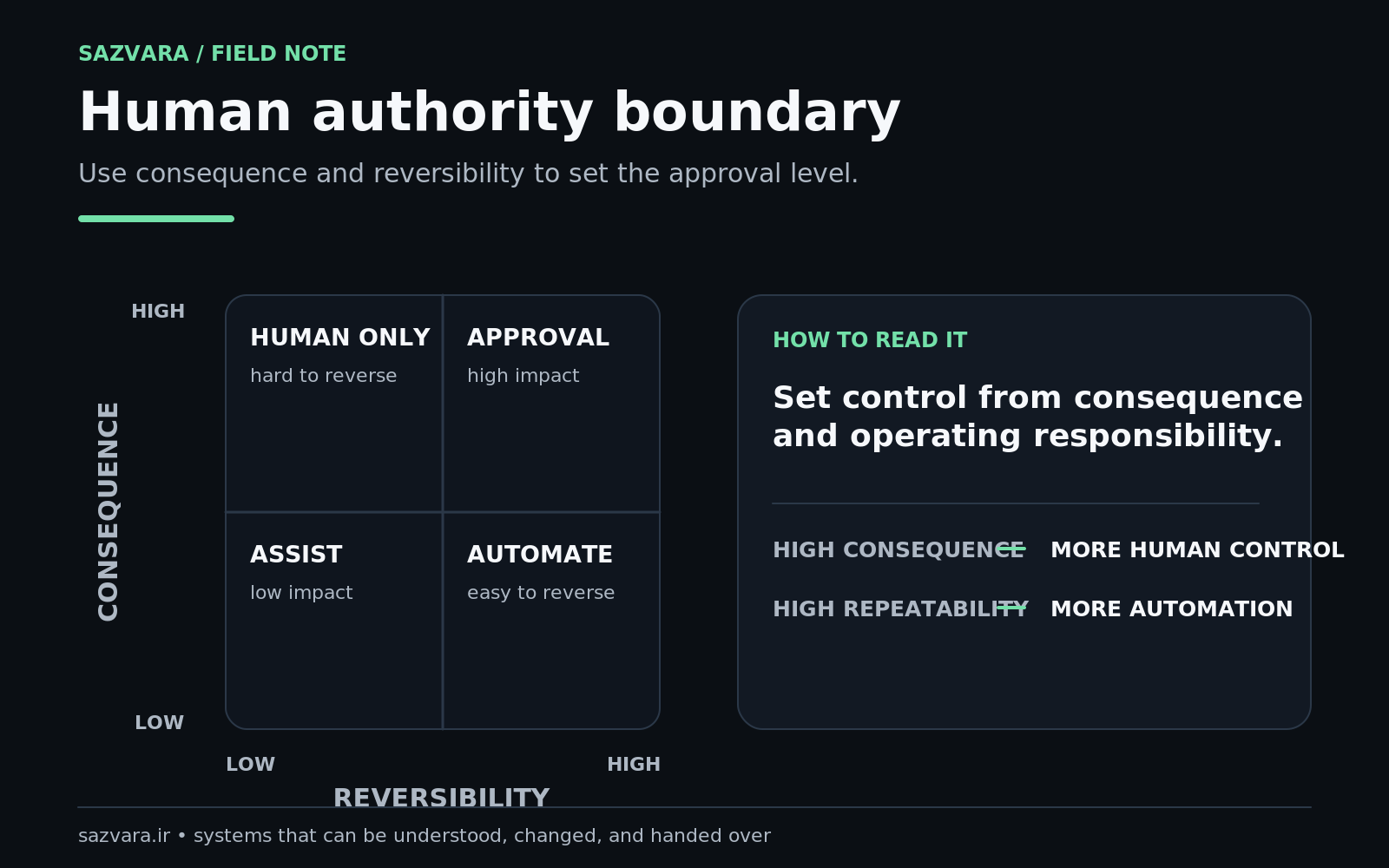
Ask what happens when the system is wrong, late or unavailable. A mistake that produces an internal draft is not equivalent to a mistake that sends money, modifies access, deletes a record or communicates externally under the company's name.
Use a simple consequence table:
| Failure class | Example | Default control |
|---|---|---|
| Low consequence | internal summarization error | sampled review |
| Moderate consequence | lead routed to wrong queue | reversible correction + monitoring |
| High consequence | financial or compliance action | mandatory human approval |
| Hard to reverse | destructive or externally binding action | explicit authorization + rollback design |
Microsoft recommends human approval for hard-to-reverse or consequential actions and visible escalation for sensitive or ambiguous cases (Microsoft responsible AI guidance). Failure classification is therefore what determines control strength.
Test 8 — Is human authority designed, not improvised?#
"Human in the loop" is too vague to be a control. Name the role, the decision, the information shown to the reviewer, the deadline, and what happens when the reviewer does nothing.
The reviewer needs enough context to make a meaningful decision. If the interface shows only the model recommendation and an Approve button, the person may become a rubber stamp. Microsoft's HAX guidelines emphasize designing for situations in which AI is wrong and supporting effective human-AI interaction over time (Microsoft HAX guidelines).
A useful review boundary therefore includes the original input, relevant source evidence, the proposed action, uncertainty or exception signals, and a clear alternative such as edit, reject or escalate.
Test 9 — Are privacy, security and credential boundaries explicit?#
Document which systems the workflow can access and what each credential allows. Avoid giving a workflow broad administrator access merely because setup is easier. Secrets should be scoped, revocable and separated from ordinary documentation.
The operating questions are concrete:
- Which data leaves the company boundary?
- Which services retain prompts, files or logs?
- Which accounts can create, modify or delete records?
- Who rotates credentials?
- What happens when a team member or supplier leaves?
- Which logs might accidentally capture sensitive data?
Security readiness is not a checkbox added after the workflow works. It shapes architecture. The NIST Generative AI Profile specifically treats privacy and information security as lifecycle concerns (NIST Generative AI Profile).
Test 10 — Is operational ownership named?#
Production automation requires an owner after the builder finishes. Name the person or role responsible for credentials, vendor changes, failed runs, evaluation drift, workflow edits and incident communication.
Ownership should be visible in the runbook and system inventory. It should also survive staff turnover. If only one contractor knows where the workflow lives or which token it uses, the business has acquired a dependency rather than an asset.
A strong ownership statement sounds like: "Operations owns daily exceptions; the marketing lead owns routing rules; the technical owner controls credentials and releases; the managing director approves changes that alter external commitments." Small teams can combine roles, but should not leave them unnamed.
Test 11 — Can the business recover without the automation?#
Every important workflow needs a fallback. The fallback may be manual processing, a queue, a replay mechanism or a rollback to the previous process. What matters is that the business can continue operating when a model, API or automation platform is unavailable.
Write the recovery procedure before launch. Include where unfinished work is visible, how duplicate processing is prevented, who decides whether to retry, and how the team knows the backlog has been cleared.
This is where recoverability differs from reliability. A system can be highly reliable and still require a recovery plan. Readiness asks whether the organization can control the inevitable exception without losing data or making the same action twice.
Test 12 — Is there a baseline and post-launch measurement plan?#
Measure the existing process before claiming improvement. Capture quantities that matter to the business: elapsed time, staff touch time, error categories, backlog, recovery effort, customer-visible delays or accepted-work rate. Choose metrics that can be collected without creating a reporting burden larger than the workflow itself.
NIST's AI RMF emphasizes measurement as part of risk management, not only as model benchmarking (AI RMF 1.0). Operational measurement should therefore include both benefit and harm indicators.
A useful launch plan specifies:
- baseline period;
- release date and version;
- expected business change;
- acceptable error and exception range;
- review cadence;
- stop condition;
- owner responsible for deciding whether to continue, modify or roll back.
The Sazvara readiness scorecard#
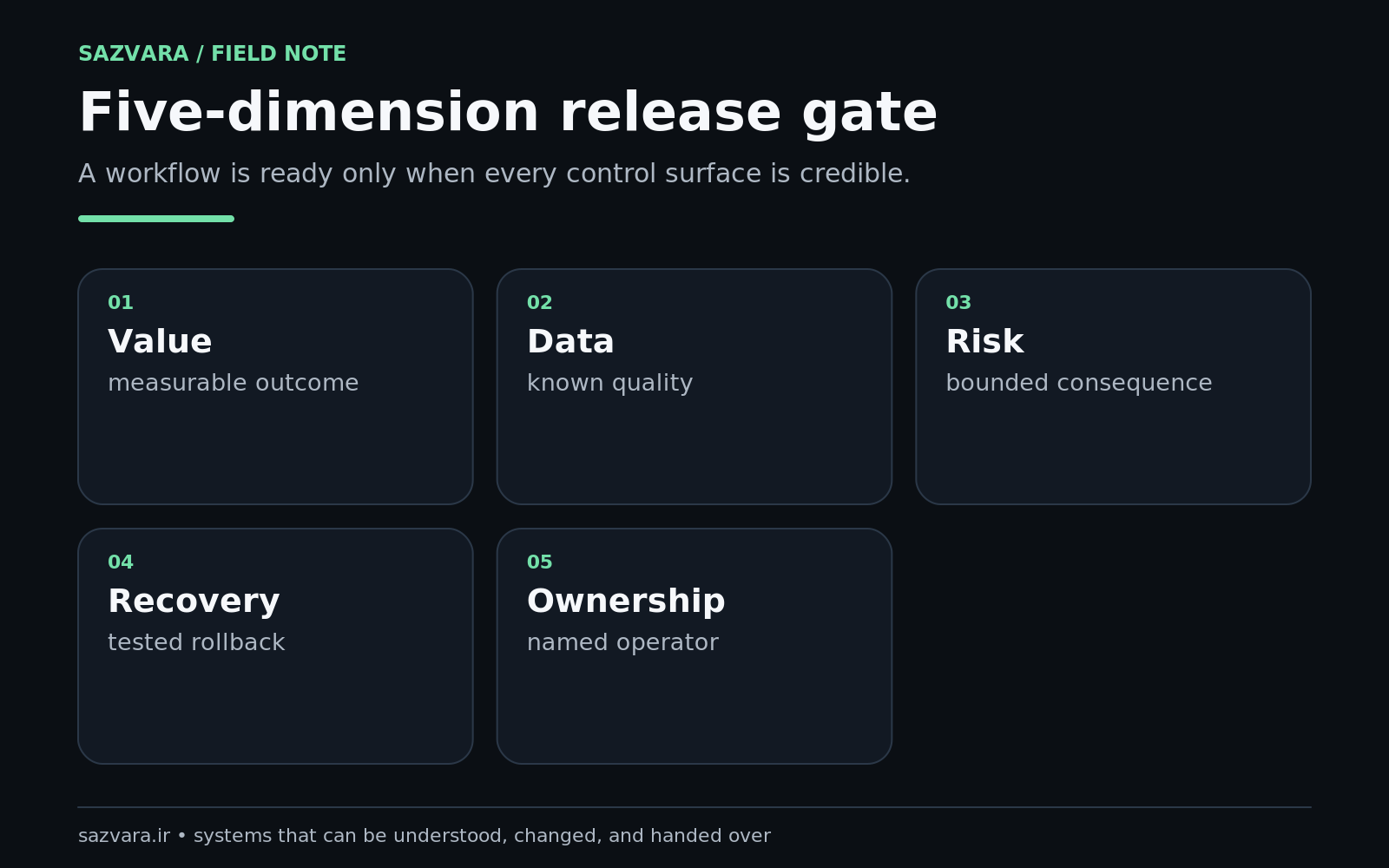
Sazvara groups the twelve tests into five release dimensions: value, stability, observability, recoverability and ownership. A workflow can be valuable and still fail the gate if nobody can detect errors. It can be technically stable and still fail if no one is authorized to stop it.
Use this decision framework:
| Dimension | Pass question |
|---|---|
| Value | Is the desired business outcome explicit and worth changing the process for? |
| Stability | Are boundaries, inputs and decision rules defined enough to automate? |
| Observability | Can the team detect success, failure and drift? |
| Recoverability | Can work continue or be replayed safely when automation fails? |
| Ownership | Are operating, approval and maintenance responsibilities named? |
Three possible outcomes#
Ready for bounded automation. The process is stable, consequence is understood, evaluation is feasible and ownership is clear. Build the smallest version that proves the operating model.
Ready for assisted work, not autonomous action. The process is useful but exceptions or consequence require regular judgment. Use AI to prepare, classify or recommend while preserving human authority.
Not ready to automate. Inputs, ownership or process rules are still too unstable. Fix the operating process first. This is not failure; avoiding premature automation is often the highest-value decision.
How to run the readiness workshop in ninety minutes#
A small business does not need a committee. Bring the process owner, one frontline user and whoever will maintain the automation. Use a real workflow, not a hypothetical one.
- Map the current trigger and final business state.
- Identify authoritative data and prohibited data.
- Review ten to twenty representative cases.
- Mark routine cases and exception classes.
- Classify failure consequences.
- Define human approval boundaries.
- Write the fallback procedure.
- Select baseline metrics.
- Assign operating and release owners.
- Decide whether the next step is automation, assistance or process repair.
The output should fit on a few pages. The value comes from making assumptions explicit before code or configuration makes them expensive.
Readiness evidence to keep with the workflow#
The readiness decision should leave behind a small evidence pack rather than disappearing into a meeting. Keep the current process map, the evaluation sample, the named owner, the fallback procedure, the launch baseline and the decision record explaining why the workflow was classified as autonomous, assisted or not ready. These artifacts make later changes easier to review because the team can compare the new proposal with the assumptions that justified the original release.
When a vendor changes a model, a connector modifies its API, or the business changes a policy, do not restart the whole exercise. Re-run the affected tests. A data-source change should trigger the input and quality tests; a new external action should trigger the consequence, human-authority and recovery tests. This turns readiness from a one-time workshop into a lightweight change-control practice.
For small teams, the strongest signal of maturity is not the size of the documentation. It is whether another competent person can look at the evidence and explain why the automation is allowed to act, how its failures become visible, and who can stop or recover it.
Frequently asked questions#
Does every AI workflow need human approval?#
No. Review intensity should follow consequence and reversibility. Low-risk internal assistance can often use sampling and monitoring. Actions affecting people, money, access, compliance or irreversible external commitments deserve stronger approval controls. Microsoft's responsible-agent guidance explicitly recommends human approval for consequential and hard-to-reverse actions (Microsoft responsible AI guidance).
Should a business automate a messy process to force standardization?#
Usually not as the first move. Automation can reveal inconsistencies, but if nobody owns the underlying rule the technical system becomes the accidental policy. Standardize enough of the process to know what the automation is supposed to preserve.
Is model accuracy enough to decide readiness?#
No. A model can perform well on an evaluation set while the workflow remains operationally unsafe because of permissions, retries, exceptions, missing recovery, or unclear ownership. Readiness is broader than model quality.
How often should readiness be reviewed after launch?#
Review after material changes to the model, data source, business rule, connected systems or consequence of the action. NIST's framework is lifecycle-oriented, and Microsoft's guidance describes responsible operation as continuous rather than a one-time launch check (NIST AI RMF, Microsoft responsible AI guidance).
What Sazvara would inspect first#
For a real engagement, Sazvara begins with the workflow rather than the tool: current process, authoritative data, exception classes, failure consequence, recovery and owner. See Sazvara services for the broader rescue and automation model, review selected work for implementation context, or request a diagnostic when an existing automation is already unreliable.
The deliverable is not a recommendation to automate everything. It is a defensible decision about what should be automated, what should remain assisted, and what must be repaired first.
Sources and further reading#
- NIST AI Risk Management Framework
- NIST AI RMF 1.0 publication
- NIST Generative AI Profile
- NIST AI Resource Center
- Microsoft Guidelines for Human-AI Interaction
- Microsoft responsible AI guidance for agents
- OECD: Empowering SMEs in the age of AI
- OWASP Generative AI Security Project
- Google Search guidance for AI features
- Bing: Elevating the Role of Grounding on the AI Web
Editorial note: This article was produced with AI-assisted research and drafting, then reviewed against Sazvara's factual, risk, originality, usefulness and release-quality controls. The twelve-test framework and five-dimension gate are Sazvara's synthesis; standards and platform claims are linked to their sources.
Have a system that is stuck, manual or difficult to ship?
Sazvara diagnoses the system before prescribing the technology. Bring the constraints, failure modes and current state.