Updated: September 20, 2026 Author: Sajjad Farajollahi Primary intent: human oversight / AI workflow design Audience: small businesses deploying AI-assisted or agentic workflows
The short answer#
Human-in-the-loop AI is useful when a system can prepare, classify or recommend faster than a person, but the business still needs human authority over ambiguous, consequential or hard-to-reverse actions. The strongest design is not "AI does everything until someone notices a mistake." It is an explicit control architecture in which the organization decides which actions are autonomous, which require approval, which must escalate, and which the AI is not allowed to perform at all.
Microsoft's current responsible-agent guidance recommends human approval for consequential actions, especially those affecting people, money or compliance, and calls for clear escalation where an agent should not resolve a case itself (Microsoft responsible AI guidance). Its HAX guidelines also treat error recovery and long-term human-AI interaction as design problems, not afterthoughts (Microsoft HAX guidelines). NIST's AI Risk Management Framework adds a broader lifecycle model for governing and measuring risk (NIST AI RMF).
For a small business, that translates into a simple rule: automate speed, not accountability.
Human-in-the-loop is an authority model, not a staffing pattern#
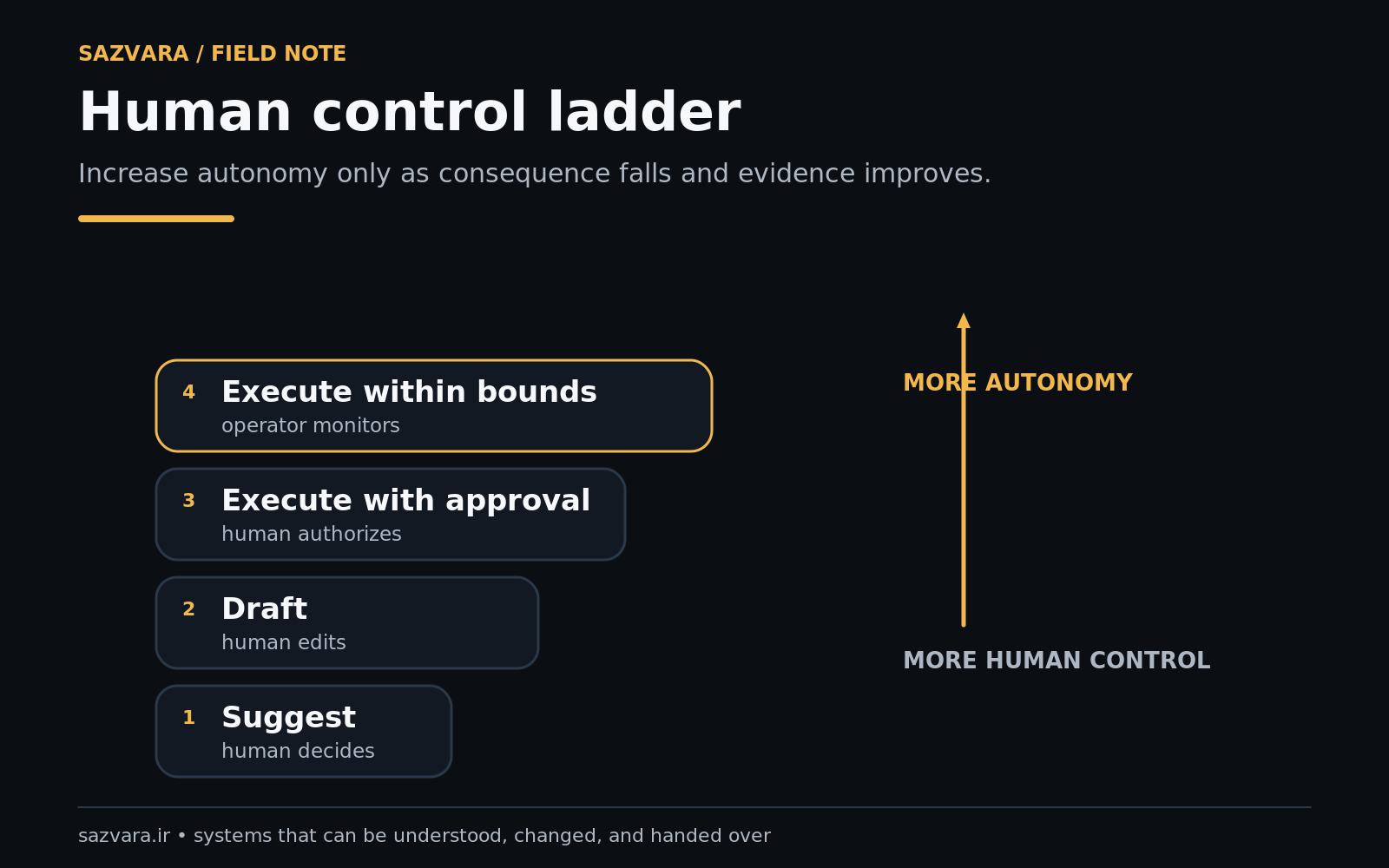
In practical terms, human-in-the-loop means that a defined person or role has an explicit decision right at a defined point in an AI-assisted process. The phrase should answer four questions: who reviews, what they decide, what evidence they see, and what happens when they disagree or do not respond.
A workflow that says "a manager can review if needed" does not have a control. It has an aspiration. A real control might say: "Refunds above the team's routine threshold remain pending until the service lead sees the customer record, policy excerpt, proposed action and model rationale; the lead can approve, edit, reject or escalate." The amount or threshold can be business-specific; the important point is that authority is designed.
Small companies benefit from this clarity because the same person may wear several roles. Naming the role still matters. It prevents a technical builder from accidentally becoming the policy owner and prevents employees from assuming the model's suggestion has already been approved by management.
Start with consequence and reversibility#
The right amount of human oversight depends less on whether a workflow uses a large model and more on what the action can do. A useful decision starts with two dimensions:
- consequence — what harm or cost can result if the action is wrong;
- reversibility — how easily the action can be corrected after execution.
An internal draft is low consequence and highly reversible. Revoking a user's access, sending a binding commercial commitment, changing a payment, or deleting a production record is different. Microsoft's current guidance explicitly recommends human approval for actions that are hard to reverse or affect people, money or compliance (Microsoft responsible AI guidance).
Use the following operating matrix:
| Consequence | Reversibility | Default pattern |
|---|---|---|
| Low | High | AI may act; sample and monitor |
| Moderate | High | AI acts within bounded rules; exceptions reviewed |
| High | Moderate | AI proposes; human approves |
| High | Low | human initiates and approves; AI supports only |
The matrix is not a legal classification. It is a design tool that forces the team to think about authority before connecting the model to external actions.
Pattern 1 — AI assists, human owns the final work#
This is the safest starting pattern for many small businesses. The model summarizes a document, drafts a reply, identifies likely categories or prepares research. A person remains responsible for the final output.
Good uses include:
- drafting a sales follow-up from verified CRM notes;
- summarizing a support thread before an agent responds;
- extracting structured fields from a document for review;
- suggesting tags or categories;
- generating a first-pass checklist from a known template.
The main design risk is automation bias: reviewers may accept suggestions simply because the system produced them. Microsoft's HAX guidelines include patterns for helping users understand what a system can do, supporting efficient correction and managing behavior when AI is wrong (HAX Design Library).
A good interface therefore makes editing natural. It should not present approval as the visually dominant path while hiding correction or source evidence.
Pattern 2 — AI recommends, human decides#
This pattern applies when the system can evaluate or prioritize cases but the decision still belongs to a person. The AI might recommend a lead priority, flag suspicious activity, propose a refund disposition or suggest whether an issue should escalate.
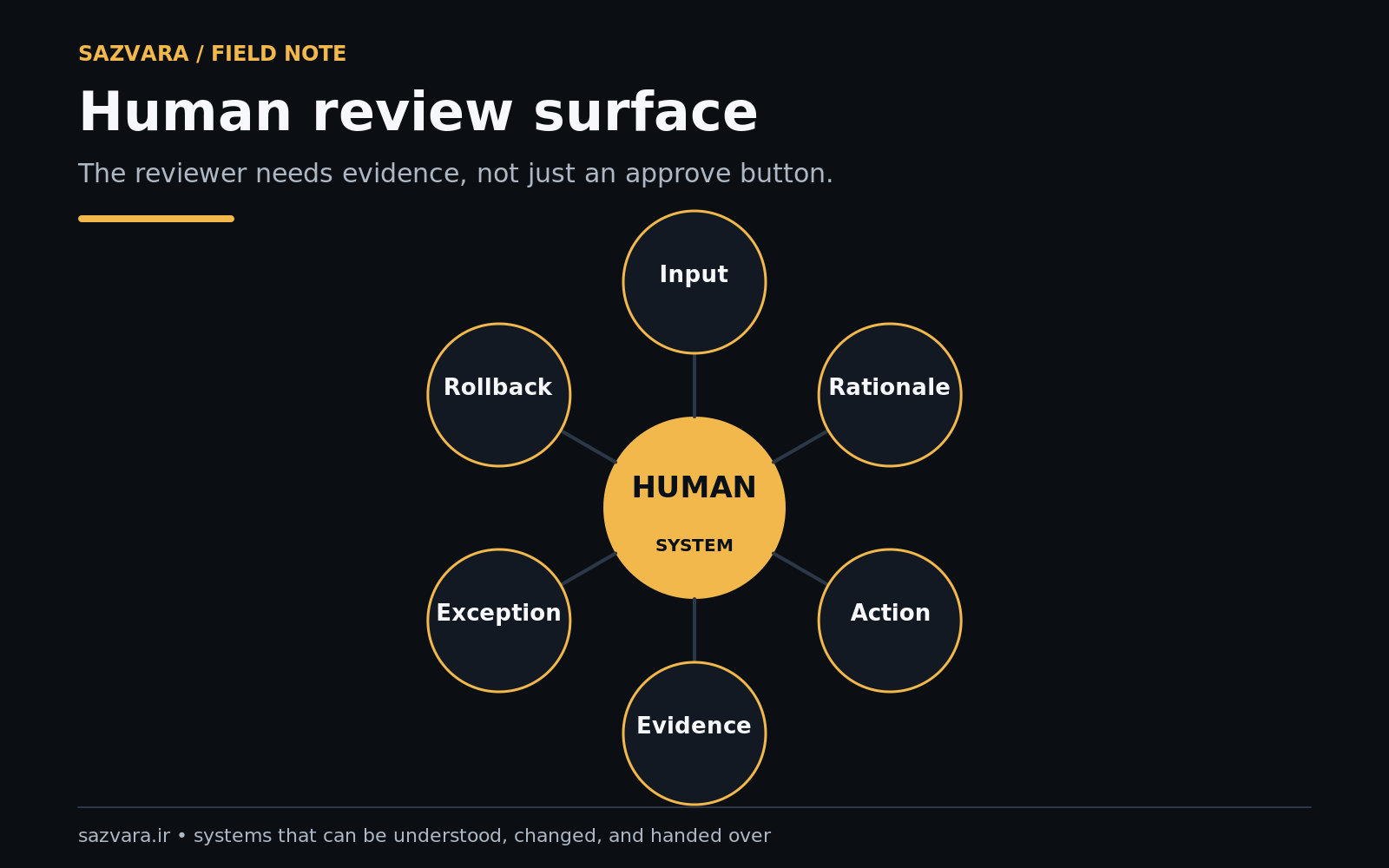
The human reviewer should see more than the conclusion. At minimum, provide:
- original input;
- relevant source evidence;
- proposed action;
- reason or structured factors;
- uncertainty or exception signal;
- available alternatives;
- audit record of the final human decision.
NIST's Generative AI Profile is useful here because it treats risks such as confabulation, information integrity and human-AI configuration as lifecycle concerns (NIST Generative AI Profile). Review is strongest when it can detect those failure modes rather than simply endorse the output.
Pattern 3 — AI acts within a bounded envelope#
Not every action needs individual approval. A business may allow the system to act automatically when the action is low-risk and constraints are explicit.
Examples include assigning an internal tag, creating a draft task, enriching a record with non-sensitive public information, or sending a routine internal notification. The key is to define the envelope:
- permitted action types;
- permitted systems;
- maximum scope of each action;
- data that cannot be used;
- conditions that force escalation;
- logging requirements;
- stop mechanism.
This design is closer to a controlled service account than an unrestricted employee. The system receives the minimum authority required for the routine path and no more.
Pattern 4 — AI pauses for approval before external effect#
For consequential external actions, the cleanest architecture is often prepare → pause → approve → execute. The automation assembles context and a proposed action, but the action is not executed until the named reviewer approves it.
This structure is useful for:
- sending sensitive client communications;
- changing access permissions;
- approving unusual discounts or refunds;
- altering records with compliance significance;
- publishing content under the company's name;
- initiating actions that are difficult to reverse.
The approval event should be recorded separately from the model's recommendation. That distinction preserves accountability: the system proposed; the person authorized.
GitHub deployment environments demonstrate the same control principle in software delivery: an environment can require a reviewer before a job proceeds, and can prevent self-review in supported configurations (GitHub deployments and environments). The technology is different, but the governance pattern is useful: sensitive execution waits for independent authorization.
Pattern 5 — AI must refuse and escalate#
Some cases should not be resolved by the automation. A refusal path is a feature, not a defect.
Escalation triggers can include:
- missing required evidence;
- conflicting source data;
- request outside policy;
- sensitive personal or financial context;
- low-confidence classification;
- repeated tool failure;
- unusual transaction size or scope;
- user explicitly asks for a person;
- action would exceed the system's permissions.
The escalation queue must have an owner and response expectation. Otherwise the system has simply moved the failure from the AI layer into an invisible backlog.
The rubber-stamp problem#
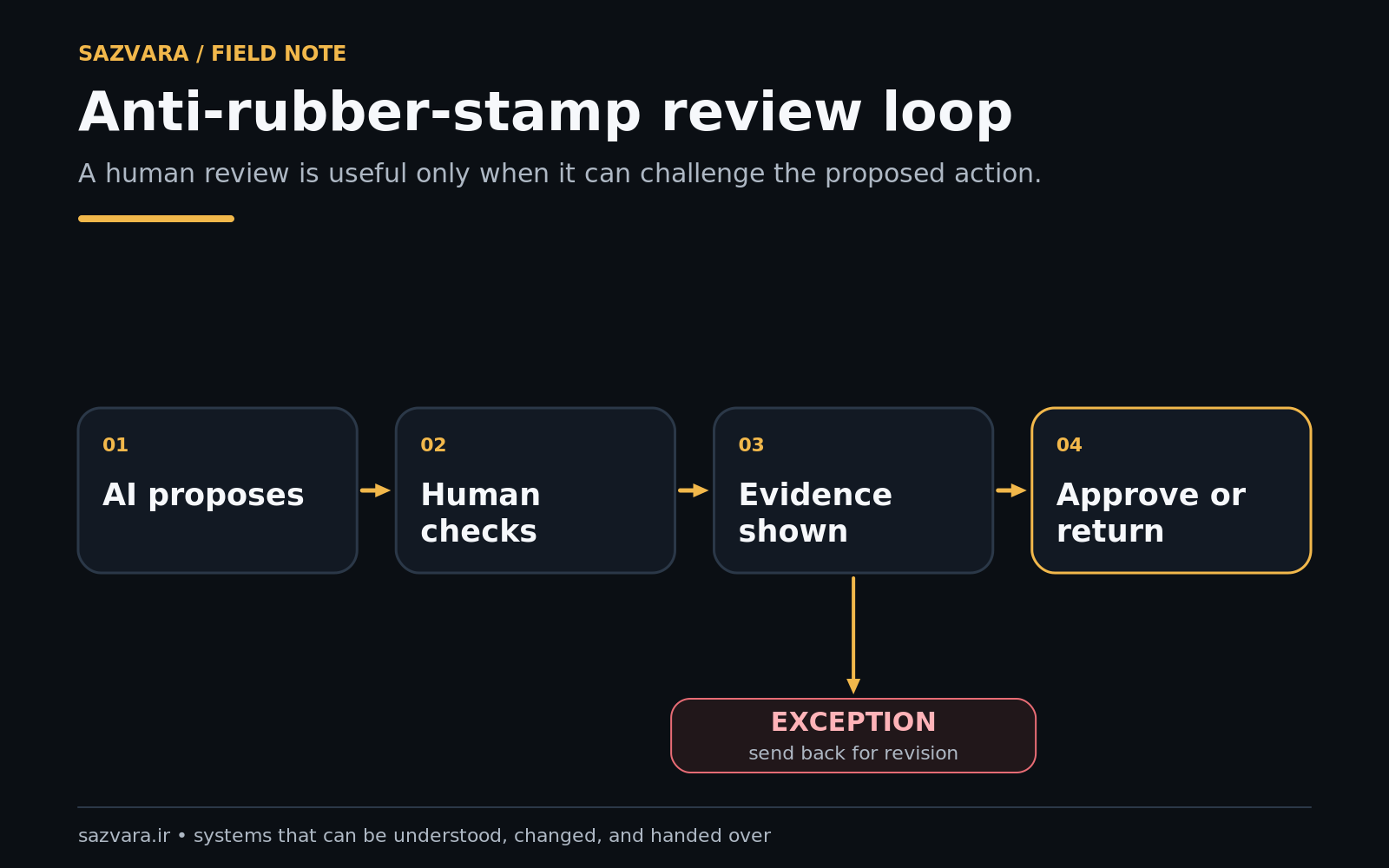
Human review can fail even when a person technically clicks Approve. If reviewers see too many low-value cases, lack enough context, or believe the model is usually right, they can become a ceremonial checkpoint.
Design against rubber stamping by improving the quality of review rather than adding more approvals:
- send routine low-risk cases through automation so humans see the cases that need judgment;
- show source evidence before the recommendation when practical;
- expose exception signals and uncertainty;
- make reject and edit actions as easy as approve;
- sample approved cases after the fact to detect systematic errors;
- rotate or review thresholds if reviewers are approving nearly everything without changes;
- measure review time and disagreement patterns.
Human review is most valuable when it introduces independent judgment. It is least valuable when it merely adds latency.
Separate policy ownership from workflow maintenance#
A subtle governance problem appears when the person who builds the automation also becomes the de facto owner of business policy. That is dangerous because technical convenience can quietly change decision rules.
Separate at least three responsibilities:
| Responsibility | Typical owner |
|---|---|
| Business policy | manager or process owner |
| Workflow implementation | technical owner or automation partner |
| Daily exceptions | operational team |
| Release approval | named authority based on risk |
One person can hold multiple roles in a small company, but the roles should still be documented. When the policy changes, the workflow implementation should be reviewed as a controlled change rather than edited casually in production.
Give reviewers context, not model theatre#
Some systems attempt to make review feel sophisticated by exposing long model explanations. More text is not necessarily more useful. The reviewer needs decision-relevant context.
A practical review packet can contain:
- customer or case identifier;
- verified source fields;
- policy or rule excerpt;
- proposed action;
- system confidence or exception reason when meaningful;
- prior related actions;
- deadline;
- buttons for approve, edit, reject, escalate;
- comment field for unusual cases.
The system should preserve the final human action and the information available at the time. That audit trail helps diagnose whether later problems came from model behavior, missing data, unclear policy or human judgment.
Design for disagreement#
A mature system assumes humans and models will disagree. The workflow should define what happens next.
If a reviewer rejects a proposed action, does the system simply discard it? Does the correction become evaluation data? Does repeated disagreement trigger a workflow review? If different reviewers make conflicting decisions on similar cases, is the policy itself ambiguous?
These disagreements are valuable signals. NIST's AI RMF emphasizes measurement and ongoing management across the lifecycle (NIST AI RMF). A business can use disagreement data as operational evidence rather than treating it as noise.
Human-in-the-loop metrics that actually matter#
Do not measure only how many cases are automated. Track whether the control system is functioning.
Useful measures include:
- proportion of cases escalated;
- reviewer edits and rejections by category;
- time waiting for human decision;
- backlog of pending approvals;
- repeated exception types;
- cases where the human reversed an automated action;
- incidents caused by an action that bypassed review;
- sampled quality of automatically completed low-risk cases.
The objective is not zero escalation. A healthy escalation rate may show that the boundary is working. If the system never escalates, the team should ask whether it is overconfident or whether the process truly contains no ambiguity.
Build a stop mechanism before launch#
A human-control architecture is incomplete if nobody can pause the system. Define how to disable triggers, revoke credentials, stop scheduled jobs, switch to manual processing and preserve unfinished work.
This is particularly important for agentic systems that can call tools. NIST's current work continues to emphasize lifecycle risk management and trustworthy deployment, and its Generative AI Profile provides actions for managing technology-specific risks (NIST AI RMF page, NIST Generative AI Profile).
The stop mechanism should be tested. A button nobody has used, owned by an account nobody can access, is not a control.
A seven-question control design workshop#
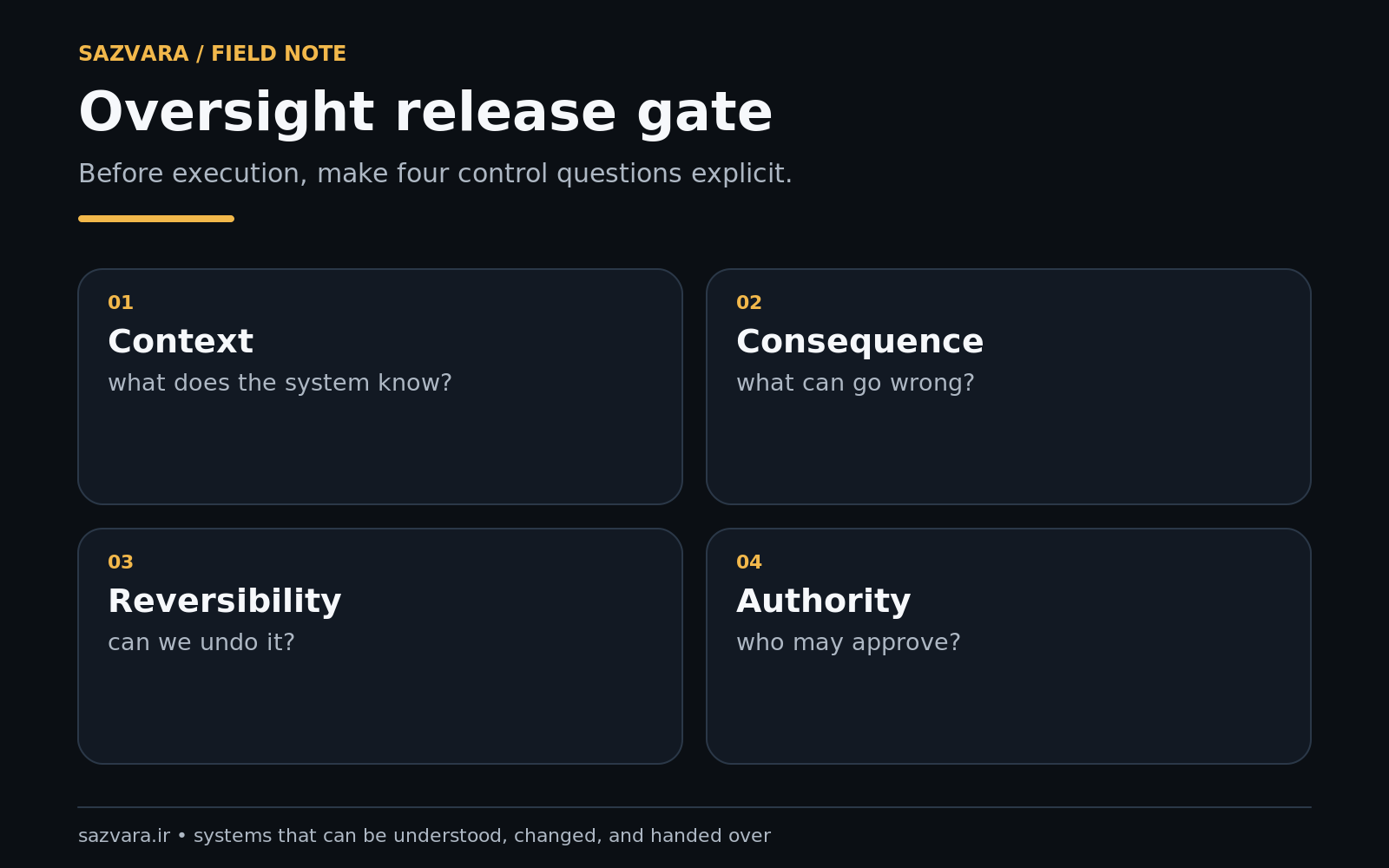
Before releasing an AI workflow, answer these questions with the actual process owner:
- What may the AI do without approval?
- Which actions require human approval before execution?
- Which cases must be refused or escalated?
- What evidence does the reviewer need?
- Who owns the pending-review queue?
- How can the system be paused or rolled back?
- Which review outcomes will be measured after launch?
If the answers are vague, the workflow is not ready to act autonomously.
Worked scenario: AI-assisted lead qualification#
Consider a service business that receives inbound leads. The company wants AI to read the enquiry, summarize needs and prioritize follow-up.
A weak design allows the system to score the lead and automatically reject low scores. That creates a customer-impacting decision based on a model without a clear appeals or review path.
A stronger design uses AI to extract needs, detect service fit and prepare a priority recommendation. High-confidence routine matches can be assigned to the correct sales queue. Ambiguous cases go to a person. The automation never silently deletes or rejects a valid enquiry. A reviewer can change the classification, and disagreement is stored for later threshold review.
This preserves speed where speed matters while keeping the final commercial boundary visible.
Design the pending-review queue as a real operational product#
Approval workflows often fail because teams focus on the AI decision and neglect the queue where unresolved work accumulates. A production review queue needs the same operational discipline as an inbox or ticket system. Cases need stable identifiers, priority, age, ownership, status and enough context that a reviewer does not have to reconstruct the entire workflow before acting.
Define service behavior for the queue. Which cases are urgent? When does an unreviewed case escalate? Can another reviewer take ownership? Does the customer receive an acknowledgment while a decision is pending? What happens outside business hours? These questions are especially important when automation creates faster upstream throughput than the human team can absorb. Without queue design, "human approval" can simply move delay to a less visible part of the process.
A useful queue separates at least four states: awaiting review, claimed by reviewer, escalated, and resolved. Resolution should record the decision type, any edits, the reviewer and the downstream action. This provides evidence for later threshold tuning and helps identify cases that should be automated more confidently or removed from automation altogether.
Calibrate trust over time instead of choosing a permanent autonomy level#
Oversight does not need to remain static. A new workflow can begin in recommendation mode, collect evidence, and earn broader autonomy for narrow case classes after the business observes stable performance. The reverse should also be possible: incidents, policy changes or data drift can move a workflow back toward mandatory review.
Think of autonomy as a permission that is earned per action type, not a single label attached to the whole system. A lead-classification workflow might automatically create internal tags while still requiring approval before rejecting an enquiry. A support workflow might draft replies automatically but require a person to approve messages involving refunds, access or legal commitments.
This staged approach prevents two extremes: keeping humans in low-value loops forever, or granting broad autonomy before the organization has operational evidence. The team can review disagreement rates, exception patterns and incident history at a regular cadence and deliberately expand or contract the automation boundary.
Make the reviewer independent enough to disagree#
The person approving an action should not be forced to trust the same evidence path that produced the model recommendation. Where consequence is meaningful, give the reviewer access to authoritative source records, relevant policy and prior history. Independence does not require a separate department; it requires a review path that can challenge the proposal.
If the workflow generates both the recommendation and the only summary the reviewer sees, a source omission can propagate through both layers. Showing the underlying record, cited material or structured facts creates a better chance of detecting the error. This is particularly important when generative output sounds confident.
The operational test is simple: can a reviewer reasonably reject the recommendation without leaving the review surface and rebuilding the case from scratch? If not, the human checkpoint is likely to be slow, shallow or both.
Frequently asked questions#
Is human-in-the-loop always safer?#
Not automatically. Poorly designed human review can create false confidence, delays and rubber stamping. The control must give the reviewer useful evidence and real authority.
Can low-risk tasks be fully automated?#
Yes, when the action is bounded, observable and reversible. The organization should still monitor performance and maintain a stop path.
Should the model show its chain of reasoning to reviewers?#
The business usually needs decision-relevant evidence, source context and structured factors rather than hidden model reasoning. Design the review surface around information a person can verify.
Who is accountable when a human approves an AI recommendation?#
Accountability remains an organizational question. The workflow should record the model proposal and the human authorization separately so responsibility and process quality can be investigated later.
Where this fits in Sazvara's operating model#
Sazvara treats human oversight as part of workflow architecture, not as an emergency patch. See Sazvara services for automation and rescue work, selected work for delivery context, or request a diagnostic if an existing workflow is taking consequential actions without a clear review or stop boundary.
The goal is not to keep humans clicking forever. It is to place human judgment exactly where the business needs authority, context and accountability—and let automation handle the rest.
Sources and further reading#
- NIST AI Risk Management Framework
- NIST AI RMF 1.0
- NIST Generative AI Profile
- NIST AI Resource Center
- Microsoft Guidelines for Human-AI Interaction
- Microsoft responsible AI guidance for agents
- GitHub deployments and environments
- GitHub managing environments
- OWASP Generative AI Security Project
- Google Search guidance for AI features
- Bing grounding guidance
Editorial note: This article was produced with AI-assisted research and drafting, then reviewed against Sazvara's factual, human-control, originality, usefulness and release-quality controls. The control ladder and operating patterns are Sazvara's synthesis; standards and platform claims are linked to their sources.
Have a system that is stuck, manual or difficult to ship?
Sazvara diagnoses the system before prescribing the technology. Bring the constraints, failure modes and current state.