Updated: September 20, 2026 Author: Sajjad Farajollahi Primary intent: automation audit / workflow prioritisation Audience: owners and operators of small service businesses, agencies, ecommerce teams and lean internal operations teams
The short answer#
The best small-business automation candidate is usually not the task people complain about most. It is the task that is repetitive enough to standardise, frequent enough to matter, bounded enough to test, low enough in judgment risk, and expensive enough in delay or manual effort that improvement is visible.
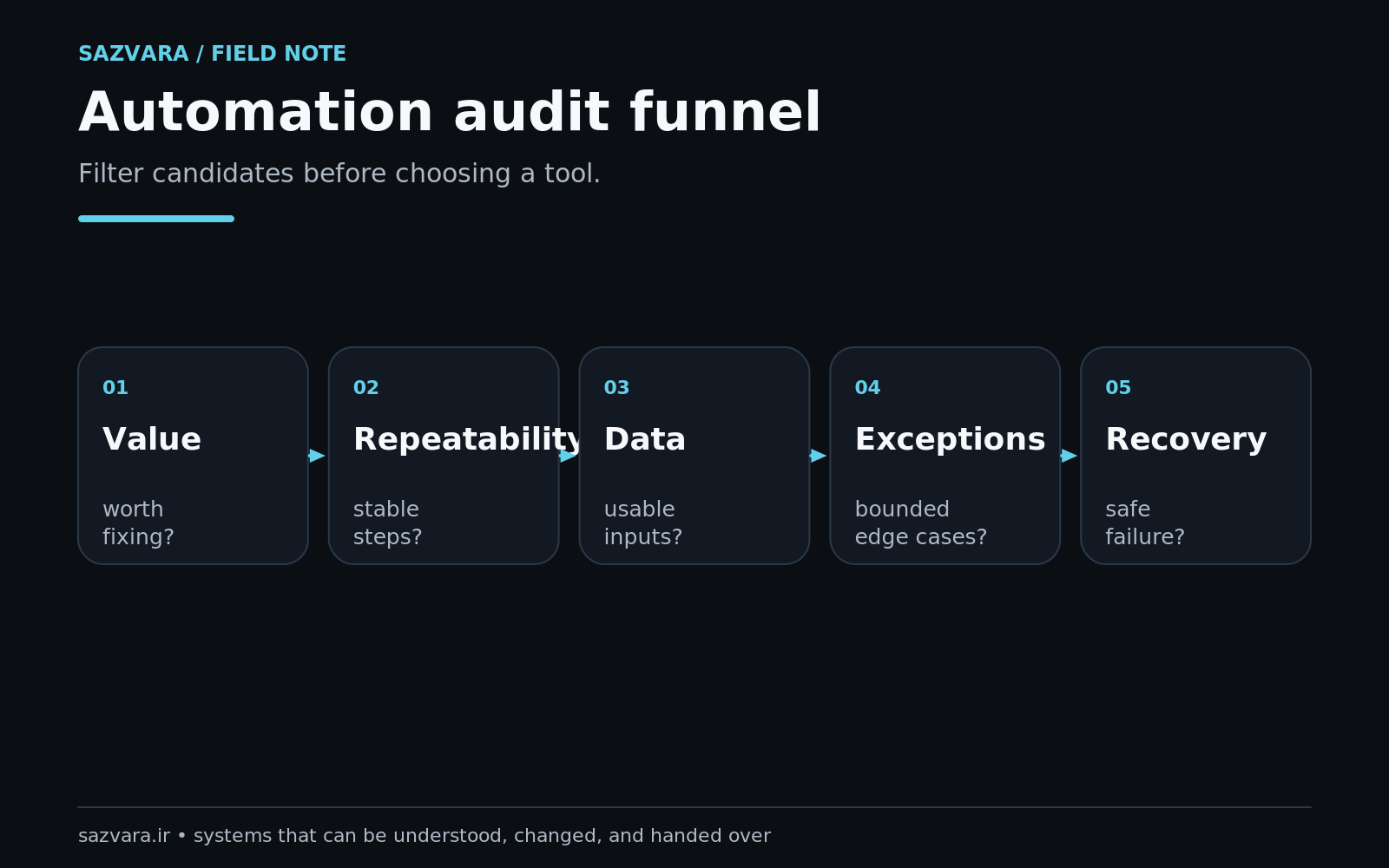
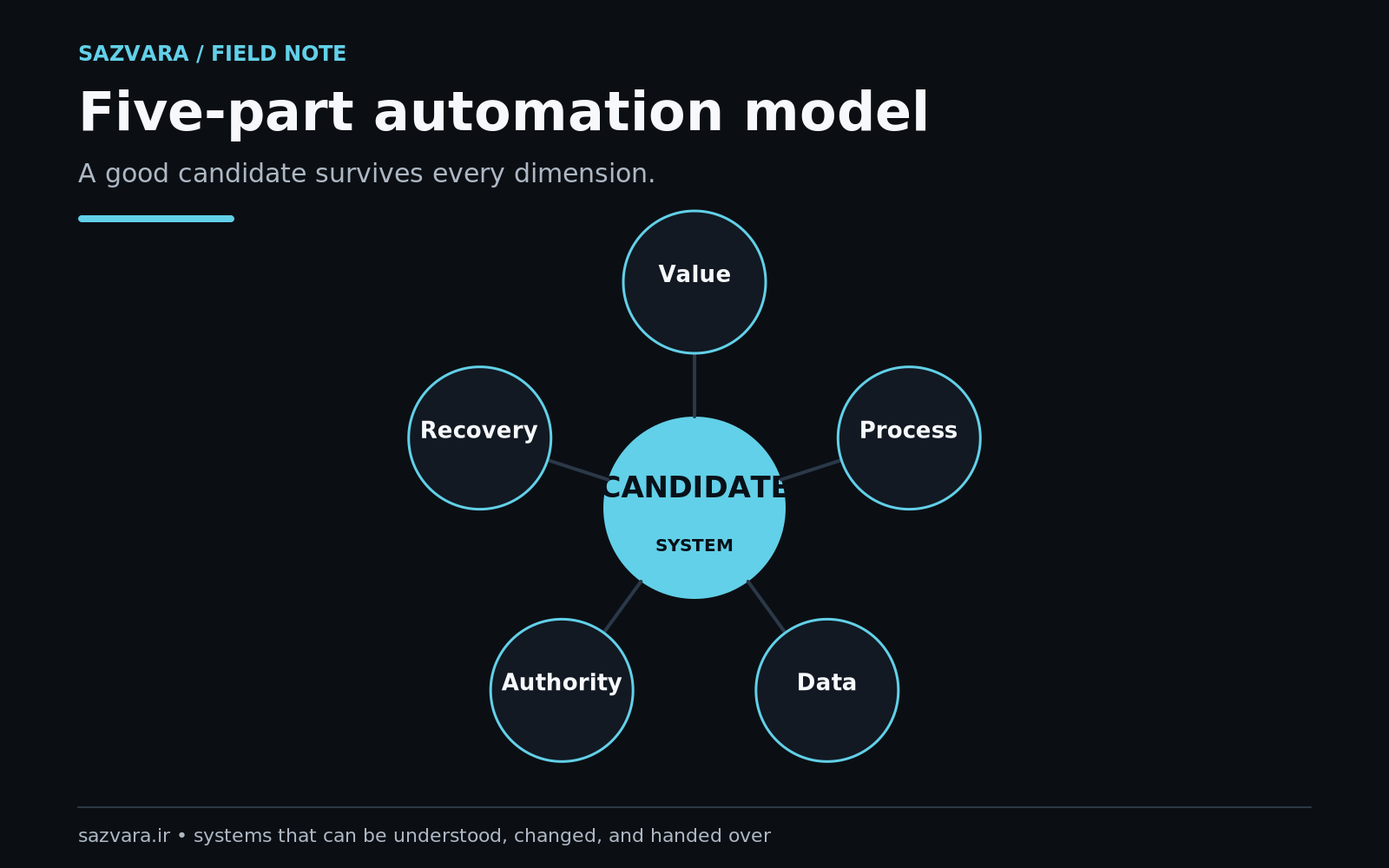
A practical audit should therefore score each workflow on five dimensions: value, repeatability, data readiness, exception risk and recoverability. Processes with high value and high repeatability but weak data quality should be cleaned before automation. Processes with high judgment or irreversible consequences should retain a human decision even if the surrounding data movement is automated. Processes with low volume and low business impact should often stay manual.
This approach matters because SME adoption is rising faster than deep operational integration. The OECD's 2026 survey reports sustained use of off-the-shelf AI tools while strategic, secure integration remains uneven, with time, maintenance cost and skills constraints still limiting effective implementation (OECD D4SME 2026). An automation audit should prevent a small company from replacing one visible manual burden with a less visible system burden.
Start with a process inventory, not a tool wishlist#
Small businesses often encounter automation through products: a CRM introduces workflows, an email platform adds AI, a consultant demonstrates n8n, or a team member discovers a connector. That can create a backwards planning sequence: choose the tool first, then search for something to automate.
An audit reverses the order. Build a process inventory first.
For one week, capture recurring work under simple headings:
- lead intake and qualification;
- quoting and proposal preparation;
- customer onboarding;
- scheduling and reminders;
- order or project handoff;
- document collection;
- invoice creation and payment follow-up;
- support routing;
- reporting and reconciliation;
- content and approval flows;
- employee administration;
- vendor and procurement tasks.
For each process, write the trigger, the people involved, the systems touched, the output, approximate frequency, typical delay and common exceptions. Do not optimise the wording. The purpose is to make invisible coordination work visible.
A useful inventory might reveal that a company spends more time copying lead data from email into a CRM than on the visibly annoying monthly report. The audit gives priority to repeated business friction rather than the loudest complaint.
The five-part automation-readiness framework#
Sazvara uses five audit dimensions because each exposes a different failure mode.
| Dimension | Key question | High score means | Low score means |
|---|---|---|---|
| Value | Does improving this process matter? | material time, revenue, quality or customer effect | little business impact |
| Repeatability | Does the process follow stable rules? | common path is predictable | every case is bespoke |
| Data readiness | Are inputs available and structured enough? | reliable fields, identifiers and systems | missing, duplicated or ambiguous data |
| Exception risk | What happens when the normal rule is wrong? | exceptions are bounded and detectable | rare mistakes can cause serious harm |
| Recoverability | Can failure be seen and corrected safely? | logs, ownership, replay or manual fallback | silent or irreversible side effects |
The highest-value automation candidates score well across all five. A low score does not automatically mean “never automate.” It tells you what must be changed first.
1. Value: quantify the friction before solving it#
Value has several forms. Staff time is the easiest to see, but delay, error and lost opportunity can matter more.
Estimate:
- cases per week or month;
- manual minutes per case;
- waiting time between handoffs;
- correction rate;
- customer-visible delay;
- number of people interrupted;
- revenue or service consequences when the process fails;
- compliance or reputational consequence where relevant.
Do not pretend precision you do not have. A range is enough at this stage. “Forty to sixty enquiries per week, roughly six minutes of copying and assignment each” is actionable. “This wastes hundreds of hours” without observation is not.
A small task becomes attractive when frequency multiplies modest friction. Four minutes saved once a month is irrelevant. Four minutes saved on 500 monthly transactions may justify engineering and monitoring.
2. Repeatability: map the rule before automating the action#
Automation performs best when the team can describe the normal path and identify exceptions.
Ask three people who perform the process to explain it independently. If their rules differ significantly, the business may have a process-definition problem rather than an automation opportunity.
For a lead-routing workflow, the normal rule might be:
- accept form submission;
- reject obvious spam;
- identify service category;
- match geography;
- create CRM record;
- assign owner;
- notify owner and acknowledge customer.
Then list exceptions: existing customer, missing phone number, international enquiry, request outside service area, high-value strategic account, suspected abuse.
This distinction matters because low-code tools can make complicated routing easy to draw while leaving policy ambiguity unresolved. The diagram becomes more sophisticated but the business rule remains disputed.
3. Data readiness: automation magnifies data problems#
A workflow cannot reliably match customers if names are inconsistent and there is no stable identifier. It cannot route invoices correctly if the source document does not distinguish legal entity, project and purchase order. It cannot produce trustworthy reporting if the underlying systems disagree about status definitions.
Audit the inputs for:
- required fields;
- consistent identifiers;
- duplicate records;
- stale records;
- free-text fields carrying hidden business logic;
- inconsistent date/time formats;
- unclear system of record;
- data that should not leave a particular system;
- credentials or personal data embedded in ad hoc spreadsheets.
NIST's AI Risk Management Framework calls for mapping context, data and risk before measurement and management, while its Measure function emphasises testing under conditions similar to deployment (NIST AI RMF Core). For ordinary automation, the lesson is direct: poor input state should be treated as a design constraint, not something the workflow will magically clean.
When data quality is weak, automate validation first. A modest workflow that detects incomplete records and assigns them for correction can be more valuable than an ambitious end-to-end automation built on unreliable inputs.
4. Exception risk: distinguish assistance from authority#
The most important audit question may be: what is the cost of the automation being confidently wrong?
Some tasks are reversible and low-risk: creating an internal draft, tagging a record, preparing a summary, collecting attachments or notifying a staff member. Others can create consequential side effects: charging a card, rejecting a candidate, cancelling service, changing inventory, sending legal language, issuing refunds or publishing customer-facing claims.
This is where a human-in-the-loop boundary becomes a design tool rather than a philosophical preference.
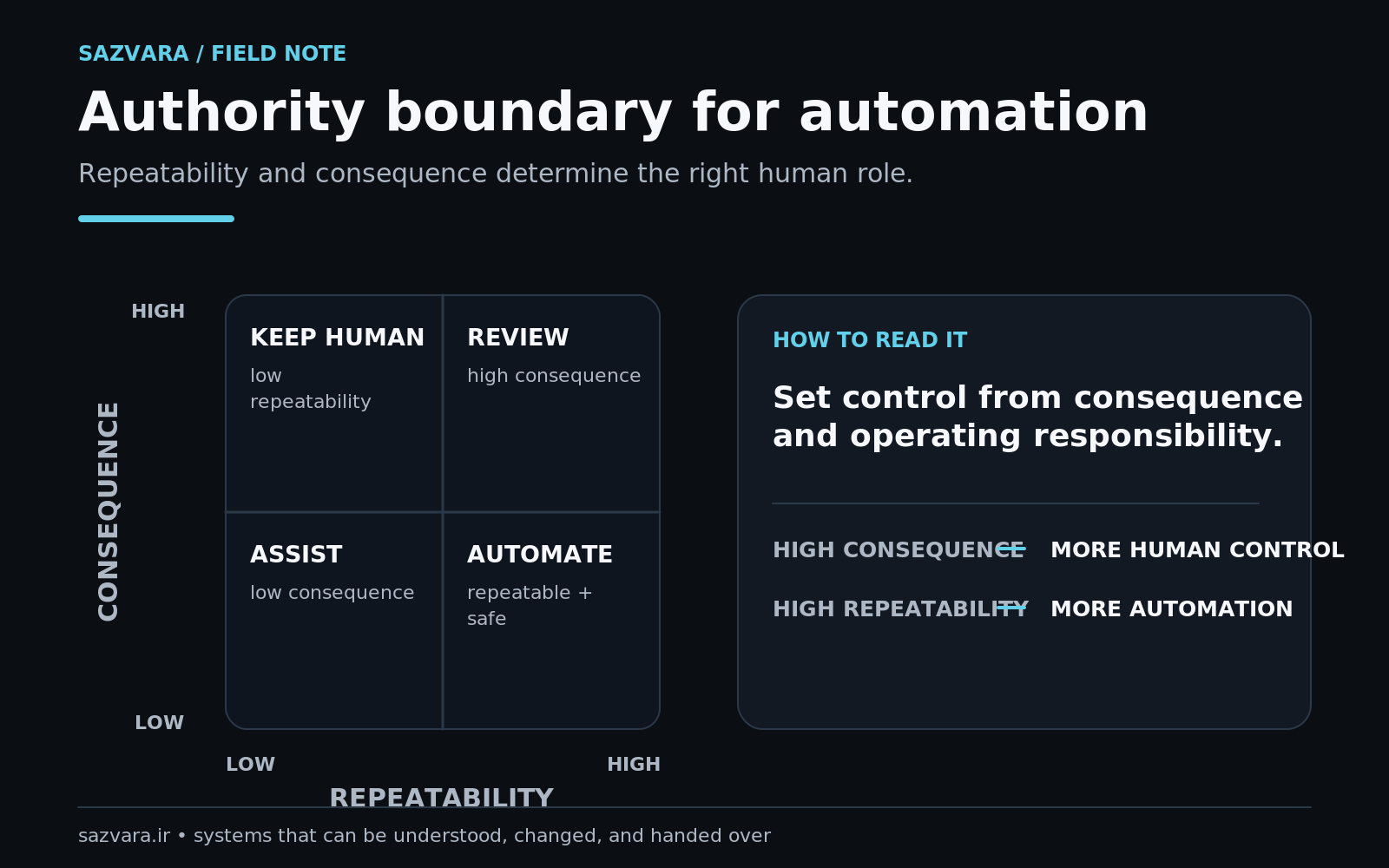
Use four categories:
- Automate: predictable, reversible, low-risk actions.
- Automate with review: machine prepares; person approves consequential action.
- Assist: system provides context or suggestion; human remains decision-maker.
- Keep manual: low-volume, highly bespoke or high-stakes work where automation adds little value.
For AI-assisted tasks, NIST's Generative AI Profile exists specifically because generative systems introduce distinctive risk-management needs, and the broader AI RMF emphasises continuous monitoring and human accountability (NIST Generative AI Profile).
The audit outcome should therefore include authority boundaries: what the workflow may do, what it may recommend, and what it must never do without approval.
5. Recoverability: test how the process fails before estimating ROI#
A workflow that has no safe recovery path is not production-ready.
Ask:
- Where can an operator see failed runs?
- Is the original input preserved?
- Can a failed item be retried without duplicating earlier actions?
- Which steps are irreversible?
- Can the workflow be paused quickly?
- What happens when an external API is unavailable?
- Who owns the exception queue?
- How long can an item remain stuck before the business notices?
- Is there a manual fallback?
Current automation platforms expose very different recovery mechanics. Zapier provides run history, replay and custom error-handling options, but replay behavior has conditions and limitations (Zapier troubleshooting, Zapier replay). Make can preserve failed state through incomplete executions and offers retry/error-handler behavior that changes how the scenario continues (Make incomplete executions, Make error handling). n8n exposes execution history and retry of failed workflows, including retry with current or original workflow state (n8n executions).
The point is not that one mechanism is universally better. The audit needs to confirm that the chosen mechanism matches the business consequence of partial failure.
A simple prioritisation matrix#
After scoring the five dimensions, place each process into a decision matrix.
| Process profile | Recommended action |
|---|---|
| High value + repeatable + ready data + low exception risk | automate now |
| High value + repeatable + poor data | clean/standardise, then automate |
| High value + judgment-heavy | automate preparation, keep approval human |
| High value + fragile recovery | design controls before launch |
| Low value + high complexity | defer |
| Low volume + highly bespoke | keep manual unless strategic reason exists |
This protects the team from automation theatre: elaborate systems attached to work that never justified the operating cost.
Worked example: enquiry intake for a professional-services firm#
Suppose a ten-person consultancy receives enquiries from a website, referrals and email. A coordinator checks whether the company fits the firm's geography and service areas, creates a CRM record, assigns a partner and sends an acknowledgement.
The process scores:
- Value: high because slow response loses opportunities.
- Repeatability: high because most routing follows a stable rule.
- Data readiness: medium because referral emails lack structured fields.
- Exception risk: medium because strategic accounts should not be auto-rejected.
- Recoverability: high if the workflow logs inputs and routes failures to a visible queue.
The correct first automation may be narrower than expected:
- structure website enquiries automatically;
- create or match CRM records using deterministic identifiers;
- suggest service/geography classification;
- route uncertain or strategic accounts to a person;
- send acknowledgements only after CRM creation succeeds;
- expose failures in one owned queue.
The referral-email path can remain assisted until its data is more consistent. The audit avoids forcing every input channel into the same technical pattern.
Worked example: invoice approval#
A second scenario is accounts payable. The business receives vendor invoices by email, staff copy details into accounting software and managers approve payment.
It is tempting to automate the entire sequence. The audit may instead conclude:
- attachment collection and field extraction are strong automation candidates;
- vendor matching can be automated when identifiers are reliable;
- duplicate detection should be deterministic;
- cost-centre suggestions can be assisted;
- approval should remain human above a threshold or when vendor/bank details change;
- payment execution requires an explicit control boundary.
This preserves the high-value repetitive work while keeping authority aligned with financial risk.
Security belongs inside the audit, not after it#
Every automation creates connections between systems. Those connections carry credentials, data and authority.
For each proposed workflow, inventory:
- accounts and API keys required;
- permissions granted to each connection;
- whether a dedicated service account can be used;
- who can edit the workflow;
- whether sensitive data appears in execution logs;
- retention of workflow history;
- secret rotation and revocation method;
- what happens when an employee leaves.
OWASP recommends centralised secrets management, least privilege, rotation, revocation and logging rather than hardcoding credentials in scripts or spreading them through configuration (OWASP Secrets Management). n8n also provides a self-hosted security audit that can report unused credentials, risky nodes, unprotected webhooks and instance-security issues (n8n security audit).
A workflow that saves ten minutes a day but introduces a shared administrator credential across several services is not an obvious improvement.
Observability is a business feature#
Small teams sometimes avoid monitoring because it sounds like enterprise overhead. The opposite is often true. A five-person business cannot afford invisible failures because there may be no dedicated operator watching the system.
Minimum viable observability can be simple:
- one execution history;
- one alert destination;
- one exception queue;
- one owner;
- one daily or weekly reconciliation metric;
- one documented manual fallback.
Google Cloud's reliability guidance emphasises observation, response and learning as core principles rather than assuming prevention eliminates failures (Google Cloud reliability).
The audit should therefore reject any critical workflow whose only failure signal is “a customer eventually complains.”
Estimate net benefit, not gross labour saved#
A basic business case can use:
net monthly benefit = avoided manual effort + avoided error/delay cost − platform cost − API cost − maintenance effort − exception-handling effort
Do not force every benefit into currency if the estimate becomes fictional. Some benefits are better expressed as service-level improvement, reduced backlog, lower correction rate or improved auditability.
Also include setup cost and expected change frequency. A workflow connected to a stable CRM and form may need little maintenance. A workflow scraping changing websites or depending on unstable schemas may carry ongoing cost that overwhelms the initial labour saving.
Map dependencies before selecting the pilot#
A process can look small while depending on half the business. Before choosing the first pilot, draw a one-page dependency map. Put the trigger on the left, the final business state on the right, and every system, person and credential boundary between them. Mark which dependency is authoritative for customer identity, status, money, inventory or approval.
This exercise often changes the priority order. A report that appears easy to automate may depend on four inconsistent spreadsheets and an undocumented export. A lead-routing flow may touch only a form and CRM and therefore be far easier to validate. The dependency map reveals where an automation would become a new system of record by accident.
For each dependency, capture:
- owner and escalation contact;
- authentication method;
- expected input and output;
- rate or usage limits that can interrupt the flow;
- whether the step is reversible;
- how an operator confirms success independently;
- the manual fallback if the dependency is unavailable.
The result should influence pilot scope. If the workflow crosses a fragile or poorly owned dependency, either remove that dependency from the first version or make its failure path a first-class acceptance test. This is especially important for small teams because the person who knows a legacy spreadsheet, mailbox rule or vendor portal may be the only person who can explain it. Capturing that dependency knowledge is part of the automation project, not administrative cleanup after launch.
The red flags that should stop an automation project#
Pause or redesign when you find:
- nobody owns the business process;
- staff disagree on the rules;
- there is no authoritative system of record;
- the workflow must use broad administrator credentials unnecessarily;
- a failed action can create irreversible duplicate side effects;
- exceptions are common but undocumented;
- the process changes every week;
- the only justification is “we should use AI”;
- success cannot be measured;
- there is no manual recovery route for a critical process.
These are not reasons to abandon automation permanently. They are prerequisites to fix.
The 90-minute audit workshop#
A small team can perform the first pass without buying software.
Minutes 0–20: list recurring processes and select the ten with the most visible friction. Minutes 20–40: map trigger, systems, output, frequency and exceptions. Minutes 40–60: score value, repeatability, data, exception risk and recoverability. Minutes 60–75: identify security/access requirements and manual fallback. Minutes 75–90: choose one bounded pilot with measurable acceptance criteria.
The workshop should end with one pilot, not a transformation roadmap containing twenty automations. The fastest learning comes from operating a bounded workflow in production and feeding its evidence back into the next decision.
The Sazvara audit release gate#
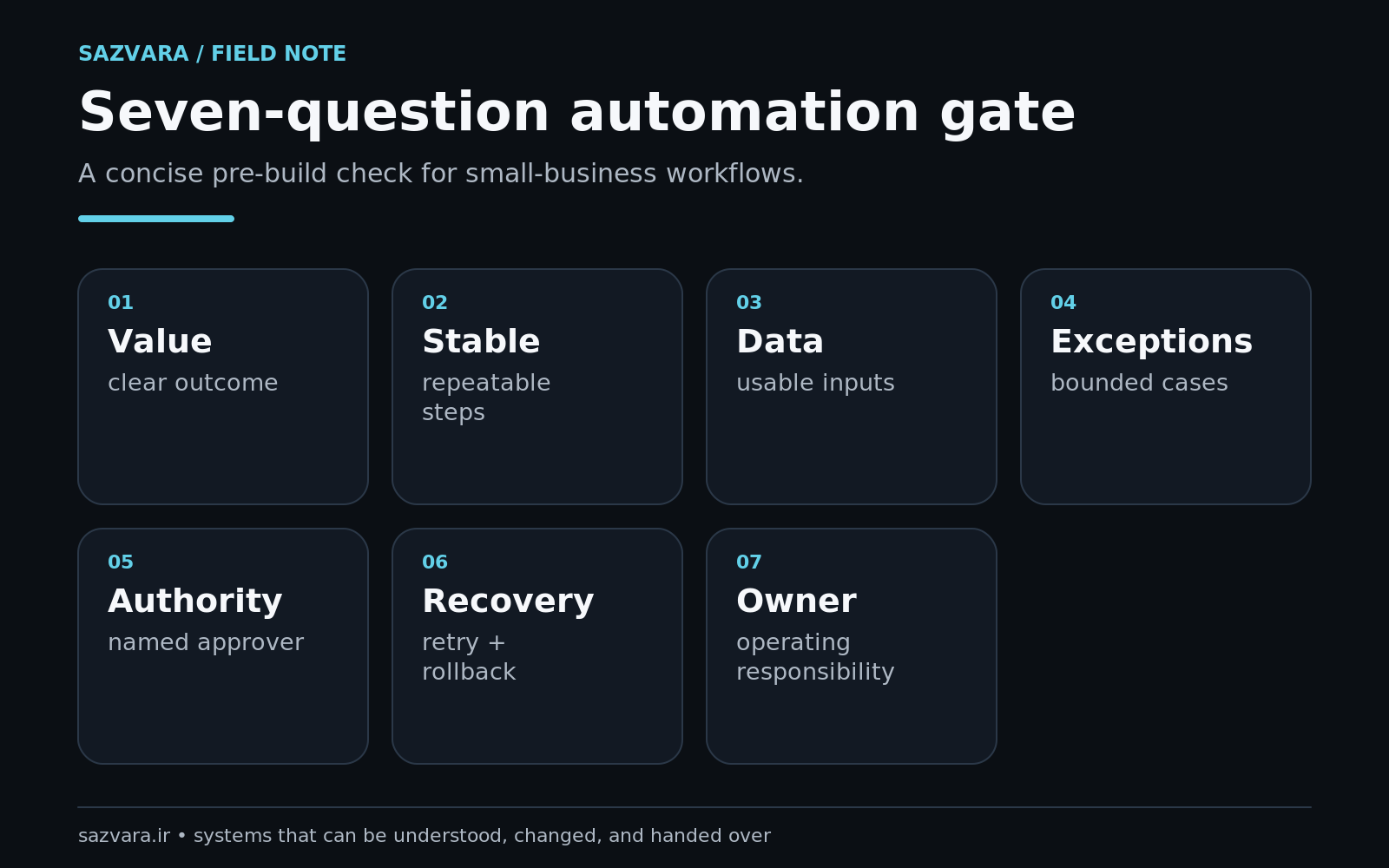
Before Sazvara would recommend building a workflow, the candidate should pass these questions:
- Is the business outcome observable?
- Is the normal process stable enough to encode?
- Are input data and system ownership sufficiently clear?
- Are exceptions known and given an explicit human/automated boundary?
- Can failure be detected and recovered without creating duplicate or irreversible damage?
- Are credentials and permissions proportionate to the task?
- Is the net benefit plausible after maintenance and exception work?
If several answers are “not yet,” the first engagement should be process cleanup or system diagnosis, not automation implementation.
What to automate first#
For many service businesses, strong first candidates are mundane: lead routing, structured intake, reminders, document collection, status notifications, internal handoffs, reconciliation and reporting preparation. They have clear triggers, clear outputs and visible time cost.
They are often better starting points than autonomous customer communication or complex agent systems because the business can learn monitoring, exception handling and ownership on a lower-risk process.
If you want one workflow assessed rather than a broad “digital transformation” programme, Sazvara's services include system diagnostics, rescue and automation work. The work archive shows the engineering orientation behind the process, and the diagnostic route is designed for a bounded problem statement.
Sources and further reading#
- OECD: Empowering SMEs in the age of AI — 2026 D4SME Survey
- OECD: AI adoption by small and medium-sized enterprises
- NIST AI RMF Core
- NIST Generative AI Profile
- OWASP Secrets Management Cheat Sheet
- n8n security audit
- n8n execution history and retry
- Zapier workflow troubleshooting
- Zapier replay behavior
- Make incomplete executions
- Make error handling overview
- Google Cloud Well-Architected reliability guidance
Editorial note#
This is an AI-assisted, human-reviewed Sazvara research article. Platform behavior described here was checked against current official documentation on September 20, 2026. The five-part audit model, prioritisation matrix and seven-question gate are Sazvara synthesis. They should be adapted to the actual legal, security and operational context of a business rather than treated as universal compliance rules. No client outcome, testimonial or savings figure is fabricated.
Have a system that is stuck, manual or difficult to ship?
Sazvara diagnoses the system before prescribing the technology. Bring the constraints, failure modes and current state.