Updated: September 20, 2026 Author: Sajjad Farajollahi Primary intent: automation architecture / no-code vs code / workflow reliability Audience: small businesses, agencies and technical operators using n8n, Zapier, Make or similar workflow tools
The short answer#
No-code becomes fragile when the workflow's operational complexity grows faster than the team's ability to understand, test, recover and change it safely. The trigger is not a certain number of steps. A 40-step visual workflow can be healthy; a six-step workflow that moves money, mutates shared state and cannot be replayed safely can be dangerous.
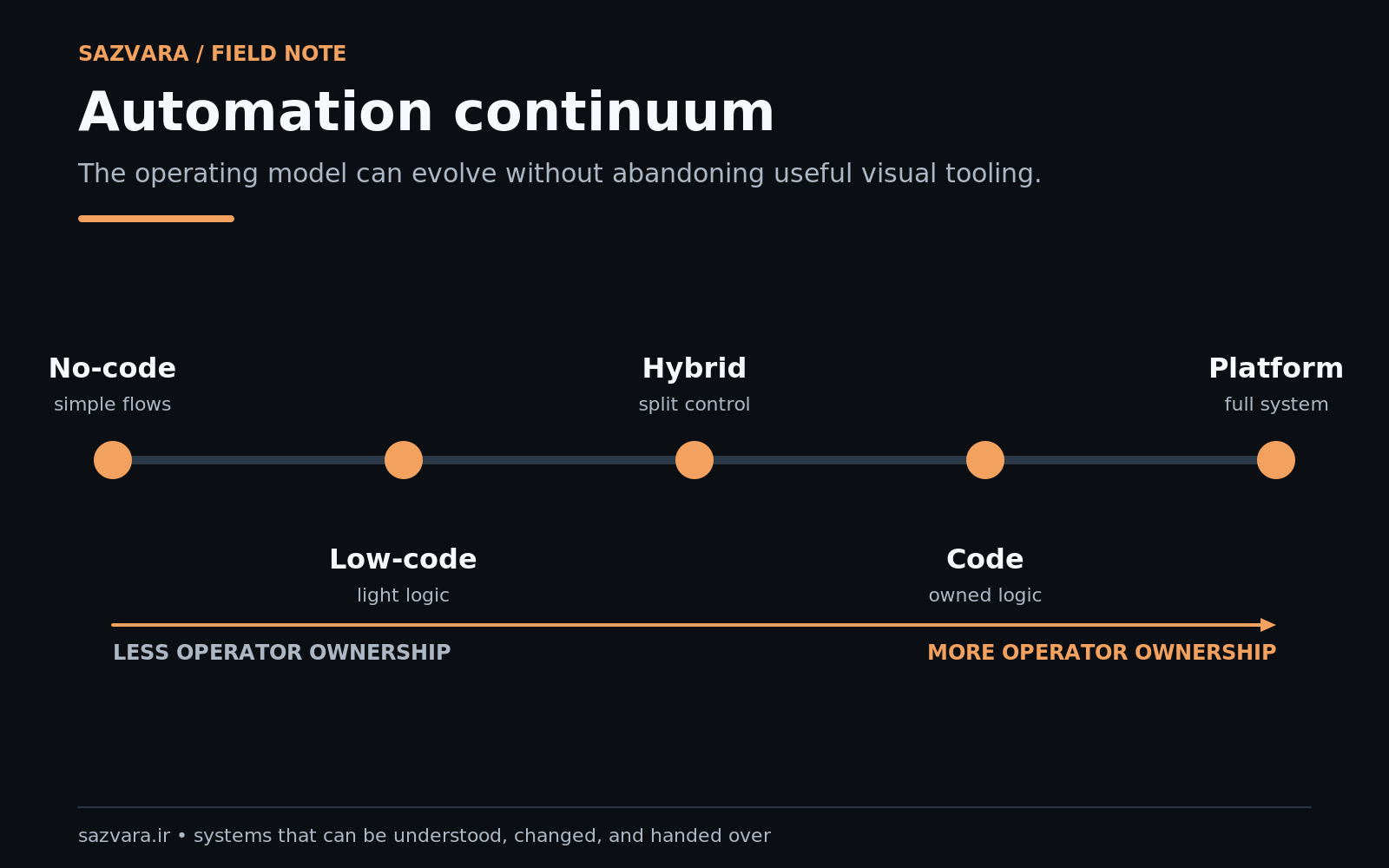
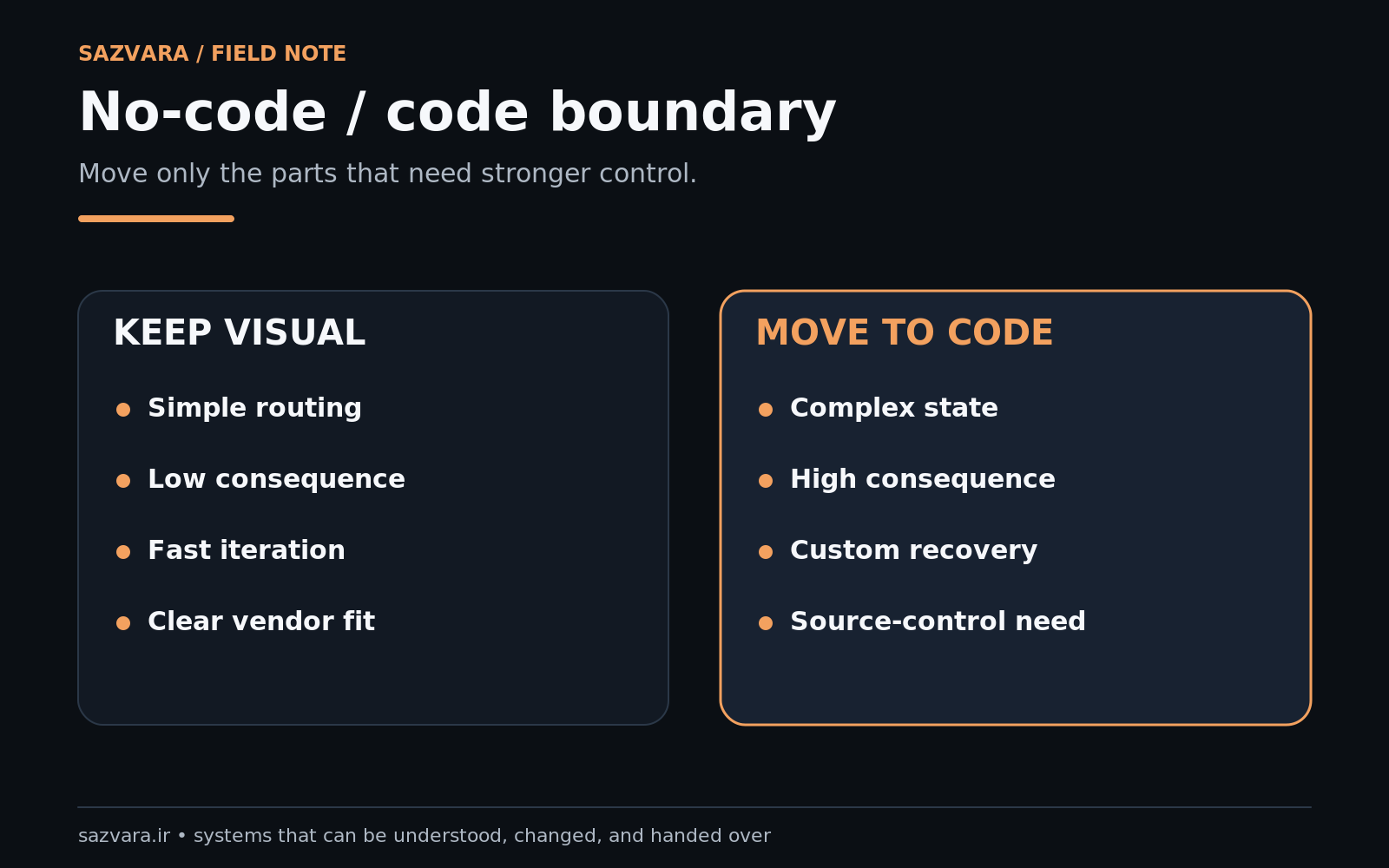
Stay no-code when the process is transparent, low-risk, observable and easy to reverse. Move to a hybrid design when visual orchestration is still useful but critical transformations, tests, secrets, state or business rules deserve code. Move core logic into software when correctness, concurrency, data integrity, version control, deployment discipline or performance become first-class requirements.
This is not an argument against automation platforms. Their own documentation makes the trade-offs visible. Zapier limits workflow steps and applies task and code-step limits (Zap limits, Code by Zapier rate limits). Make exposes incomplete executions and multiple error-handling strategies because failures require explicit operating decisions (Make error handling, Incomplete executions). n8n documents source-control environments, scaling controls and security audits for teams that need stronger production discipline (n8n environments, n8n security audit).
The decision is therefore not "no-code or code?" It is where should orchestration stop and engineered software begin?
No-code is strongest when the process is boring#
The ideal workflow for a visual automation platform is repetitive, easy to inspect and forgiving when delayed.
Examples:
- copy a qualified lead from a form into a CRM;
- notify a team when a row changes;
- create a task from a tagged email;
- synchronize a small number of non-critical fields;
- enrich a record using a stable API;
- generate a draft for human review.
These jobs benefit from fast configuration and visible orchestration. The business does not gain anything by turning every integration into a custom application.
The mistake is assuming that because a workflow started simple, the same architecture remains appropriate after years of additions. A visual flow can quietly become the company's order router, pricing engine, notification bus and exception handler without anyone deciding to make it production software.
Define fragility as an operating property#
In this guide, fragility means a workflow is difficult to change, diagnose or recover without a meaningful chance of causing unintended business effects.
That definition matters because a workflow can run successfully every day and still be fragile. Fragility shows up when:
- one credential expires;
- two events arrive at the same time;
- the same event is delivered twice;
- an API changes a field;
- one branch produces unexpected null data;
- someone edits production directly;
- a team member leaves;
- an execution must be replayed;
- volume jumps suddenly;
- a downstream system becomes unavailable.
The architecture should be judged by what happens outside the happy path.
The six pressure signals#
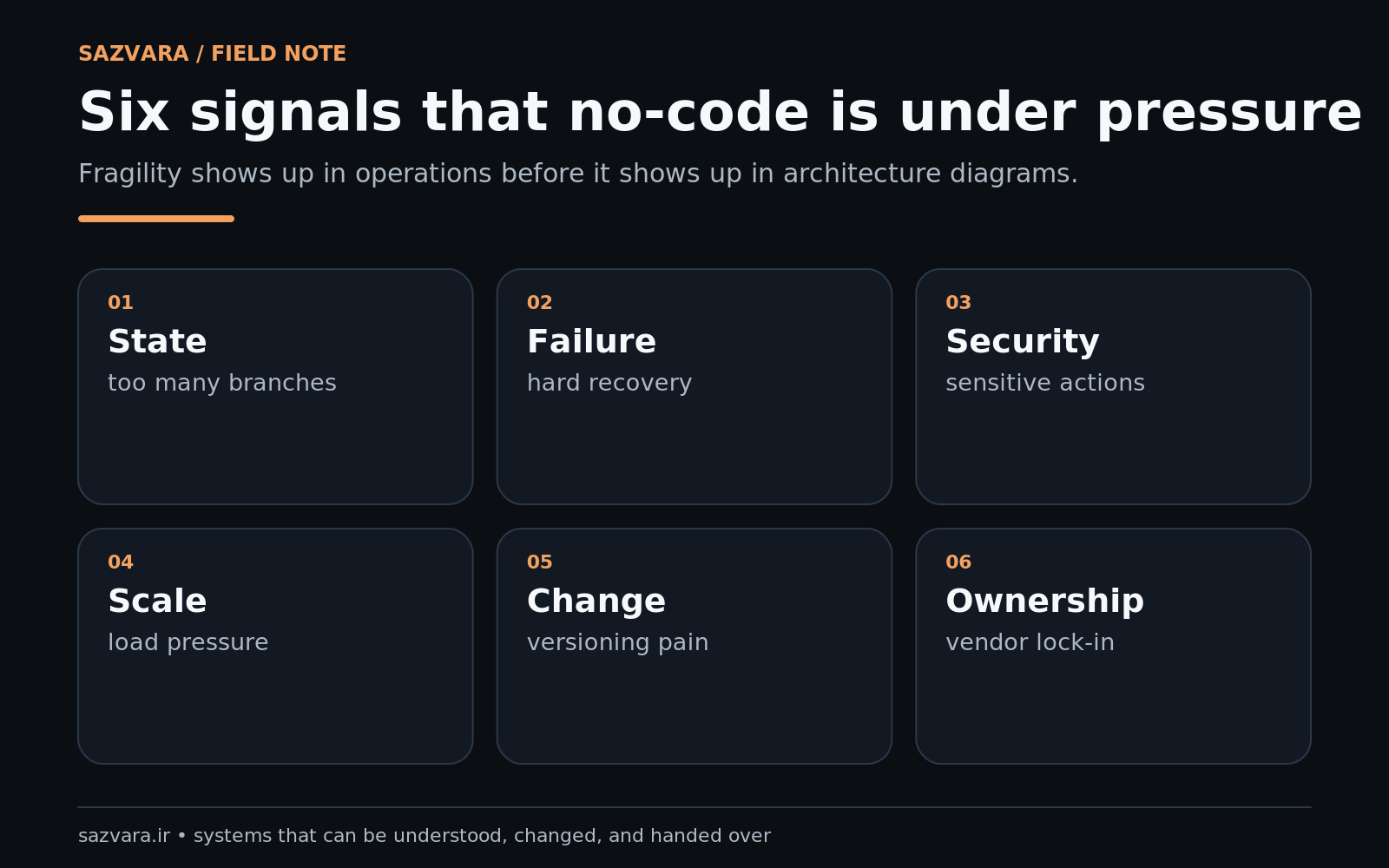
Sazvara uses six signals to decide whether visual automation is approaching its useful limit.
| Pressure | Question | Warning sign |
|---|---|---|
| State | Does correctness depend on previous events? | scattered data stores and hidden state |
| Concurrency | Can multiple runs affect the same record? | duplicate or out-of-order effects |
| Failure cost | What happens when one step fails? | manual cleanup or customer impact |
| Rule density | How much business logic lives in branches? | hard-to-review visual spaghetti |
| Change frequency | How often do rules/integrations change? | fear of editing production |
| Scale/limits | Are platform quotas shaping design? | artificial delays, split workflows, cost spikes |
None of these automatically requires custom software. The combined pressure is what matters.
Signal 1: state is becoming a hidden database#
Visual tools are comfortable when each run can be understood mostly from its inputs. They become harder when correctness depends on a growing amount of persistent state.
Examples include:
- has this customer already received the offer?;
- which version of a contract was approved?;
- has this invoice already been reconciled?;
- which partial steps completed before the crash?;
- what is the current retry count?;
- did event B arrive before event A?;
- which workflow owns the authoritative status field?
If these answers live across platform storage, spreadsheets, CRM properties and ad hoc lookup steps, the automation is acting like an application without having an application's explicit data model.
A hybrid approach often helps: keep triggers and simple app connectors in the visual platform, but move state transitions into a small service or database-backed function with tests and explicit constraints.
Signal 2: concurrency can produce harmful races#
Two executions running simultaneously are harmless when they post independent notifications. They are dangerous when both update the same inventory, booking slot, payment, account balance or lifecycle state.
The question is not merely whether the platform can run in parallel. It is whether the business operation is safe under concurrency.
Make's documentation explains that instant-trigger scenarios can run in parallel by default and exposes "process data in order" for cases where ordering matters (Make error-handling overview). n8n's production feature set includes concurrency and scaling controls, reflecting the same general issue: once throughput rises, execution coordination becomes architecture rather than convenience (n8n source-control/environments documentation).
If correctness depends on locks, transactions, optimistic concurrency, serialized queues or compare-and-swap behavior, the critical state transition usually deserves code or a database mechanism designed for those guarantees.
Signal 3: replay is no longer obviously safe#
Every production automation needs a recovery story.
Zapier allows failed runs to be replayed but documents limits on replay behavior (Zapier replay). Make can retain incomplete executions and retry or resolve them. These are valuable features—but they expose an architectural question:
What happens if this action runs twice?
For harmless notifications, duplicate delivery may be annoying. For payments, refunds, account creation, stock updates or customer-facing messages, repeated actions can be materially harmful.
A workflow becomes fragile when operators are afraid to press "retry" because they do not know which side effects already occurred.
The engineering remedy is idempotency: persist operation identifiers, check whether the effect already happened, and design retryable boundaries. This can sometimes be configured visually. When the rules become complicated, code often makes the contract easier to test.
Signal 4: branches have turned into business software#
A few filters are readable. Dozens of nested branches implementing pricing, eligibility, taxes, service tiers or contractual rules are different.
Ask a simple question: could a second person review the business rule and confidently tell whether a new change is correct?
If the answer requires clicking through many branches and comparing scattered formulas, the rule has exceeded the maintainability advantage of no-code.
This is a strong hybrid boundary:
Visual platform: trigger, orchestration, connector actions, notifications. Code module/service: dense decision logic with unit tests and version control.
The result is not "more technical for its own sake." It creates one inspectable place for rules that deserve review.
Signal 5: secrets and privileges are spreading#
Each connector introduces credentials. As the number of automations grows, teams often accumulate API keys, personal accounts and broad permissions.
OWASP recommends centralizing secrets, applying least privilege, rotating credentials and documenting how they are managed (OWASP Secrets Management Cheat Sheet). n8n's security audit can flag unused credentials, unprotected webhooks, risky nodes and missing security settings (n8n security audit).
Fragility appears when nobody can answer:
- which workflows use this token?;
- what breaks if it is rotated?;
- why does this workflow have administrator access?;
- who can export or edit the workflow?;
- does a former employee still control a connection?;
- are production and test credentials mixed?
Moving a critical integration into code does not automatically fix security. But mature code delivery often makes it easier to pair secret stores, environment separation and deployment controls with the integration.
Signal 6: platform limits are distorting the business process#
Every managed platform has limits. That is normal. The warning sign is when the business process is redesigned mainly to work around them.
Zapier documents monthly task allowances and a general 100-step workflow limit, as well as separate rate limits for Code steps (Zap limits, Code rate limits). Zapier webhooks also have defined request limits and may delay processing during high activity (Webhook rate limits).
Limits alone do not mean "rewrite it." They mean model the economics and operational requirement honestly.
If a workflow runs a few hundred times per month, a managed platform may remain much cheaper than custom infrastructure. If it processes high-volume events, large payloads or latency-sensitive operations, code or a queue-backed service may become both cheaper and more predictable.
The no-code / hybrid / code decision matrix#
Use this matrix as a first pass.
| Condition | Stay no-code | Move hybrid | Move core to code |
|---|---|---|---|
| Simple linear workflow | ✓ | ||
| Human reviews final action | ✓ | ✓ | |
| Dense business rules | ✓ | ✓ | |
| Critical idempotency | ✓ | ✓ | |
| High-value financial effects | ✓ | ✓ | |
| Shared mutable state | ✓ | ✓ | |
| High event volume | ✓ | ✓ | |
| Strict latency target | ✓ | ||
| Complex test matrix | ✓ | ✓ | |
| Frequent developer-led changes | ✓ | ✓ | |
| Non-technical team owns process | ✓ | ✓ | |
| Strong need for versioned review | ✓ | ✓ |
The matrix is intentionally asymmetric. Hybrid architecture is often the right answer because connectors and triggers remain faster to manage visually while risky logic becomes testable code.
A worked example: lead qualification that grows into pricing and provisioning#
Stage 1 — healthy no-code#
A form submission creates a CRM contact, posts a Slack notification and starts a human follow-up task.
Keep it visual. The process is easy to inspect, retry and change.
Stage 2 — hybrid pressure#
The workflow now enriches company data, checks territory, scores the lead, chooses a service package and routes to different teams.
Keep orchestration visual, but move the scoring logic into a versioned function. Store the rule version on the lead so future audits can explain why a decision occurred.
Stage 3 — code-first core#
The same flow now calculates contractual pricing, reserves capacity, creates billable resources and updates multiple systems that must remain consistent.
At this point the business operation has become a stateful application. A queue, database transaction model, explicit API and tested code are easier to reason about than a growing chain of connector steps.
The visual platform may still trigger the operation and notify humans. The core state transition belongs somewhere designed to guarantee it.
Example: a content workflow that should stay no-code#
Consider a weekly process that gathers approved article URLs, creates a reporting row, sends a summary to a team channel and opens a review task. Every action is reversible, the source data remains available elsewhere, volume is low, and a human reviews the output. Moving this into a custom service would add hosting, deployment and maintenance without materially improving the business outcome.
This example matters because architecture discipline includes knowing when not to engineer more. The right comparison is not visual elegance versus code elegance; it is total operating cost versus the guarantees the process actually needs.
Example: provisioning where the core should become software#
Now consider a workflow that sells a service package, checks available capacity, reserves a slot, creates a customer environment, charges or invoices the customer and records entitlement. Two concurrent runs can compete for the same capacity, and a replay can create a second environment or duplicate commercial action.
The trigger and notifications may remain in an automation platform, but the reservation and provisioning transition deserves a transactional service with explicit idempotency, tests and versioned deployment. This is exactly the kind of boundary where software-development controls become economically useful rather than ceremonial. NIST's Secure Software Development Framework describes secure and reliable development as lifecycle practices that should be integrated into an organization's software process (NIST SSDF project, NIST SP 800-218).
Add engineering controls in proportion to business consequence#
When core logic moves into code, do not merely replace visual nodes with a script running on somebody's laptop. The migration should add the controls that justified it: versioned source, reviewed changes, repeatable tests, protected secrets, environment separation, deployment records, observability and a named owner.
NIST's SSDF organizes software practices around preparing the organization, protecting software, producing well-secured software and responding to vulnerabilities. The point for a small business is not to implement a federal-scale compliance program. It is to recognize that once an automation becomes business-critical software, development and operation need an explicit lifecycle.
A hybrid design therefore has a useful test: does the new code make the risky part easier to reason about and operate? If code simply hides the workflow behind a custom endpoint with no tests, logs or ownership, the migration has moved the complexity rather than reduced it.
Version control is an operating capability, not a developer preference#
As workflow importance rises, teams need a reliable answer to "what changed?"
Git-based delivery provides a reviewable history and supports protected branches or approval rules. GitHub lets teams require reviews or status checks before merge (GitHub protected branches). n8n's source-control environments similarly describe development and production instances tied to Git branches, with controlled push/pull flows (n8n source-control environments).
No-code platforms increasingly add their own history and environment features because production change control matters regardless of interface.
If a critical workflow can be edited live with no review, backup or obvious diff, add governance before adding more business logic.
Test business rules where they are easiest to prove#
Visual platforms usually provide test execution, run history and sample data. That is enough for many integrations.
Code becomes attractive when you need a large matrix of repeatable assertions such as:
- every tax region maps correctly;
- every product/service combination has a permitted price;
- invalid state transitions are rejected;
- retries do not duplicate effects;
- policy changes preserve old decisions;
- boundary values behave consistently;
- concurrent requests cannot oversell capacity.
These are software tests because the business rule is software.
A useful architectural heuristic is:
Put the rule where it is cheapest to prove correct.
Sometimes that is a visual filter. Sometimes it is a 40-line function with fifteen unit tests.
Do not rewrite simply because the workflow looks ugly#
Aesthetics are not a migration reason.
Rewriting a functioning workflow introduces its own risk. Custom software must be hosted, monitored, patched, documented and owned. If the process is low-risk and rarely changes, a visually messy but understandable automation may be economically rational.
Before rewriting, ask:
- What concrete failure are we fixing?
- What control will code add?
- Who will own the code after delivery?
- What deployment and monitoring infrastructure will it require?
- Can a smaller refactor remove the actual fragility?
- Can the visual platform remain the orchestration layer?
If those questions do not produce a clear business benefit, refactor rather than rebuild.
The Sazvara migration sequence#
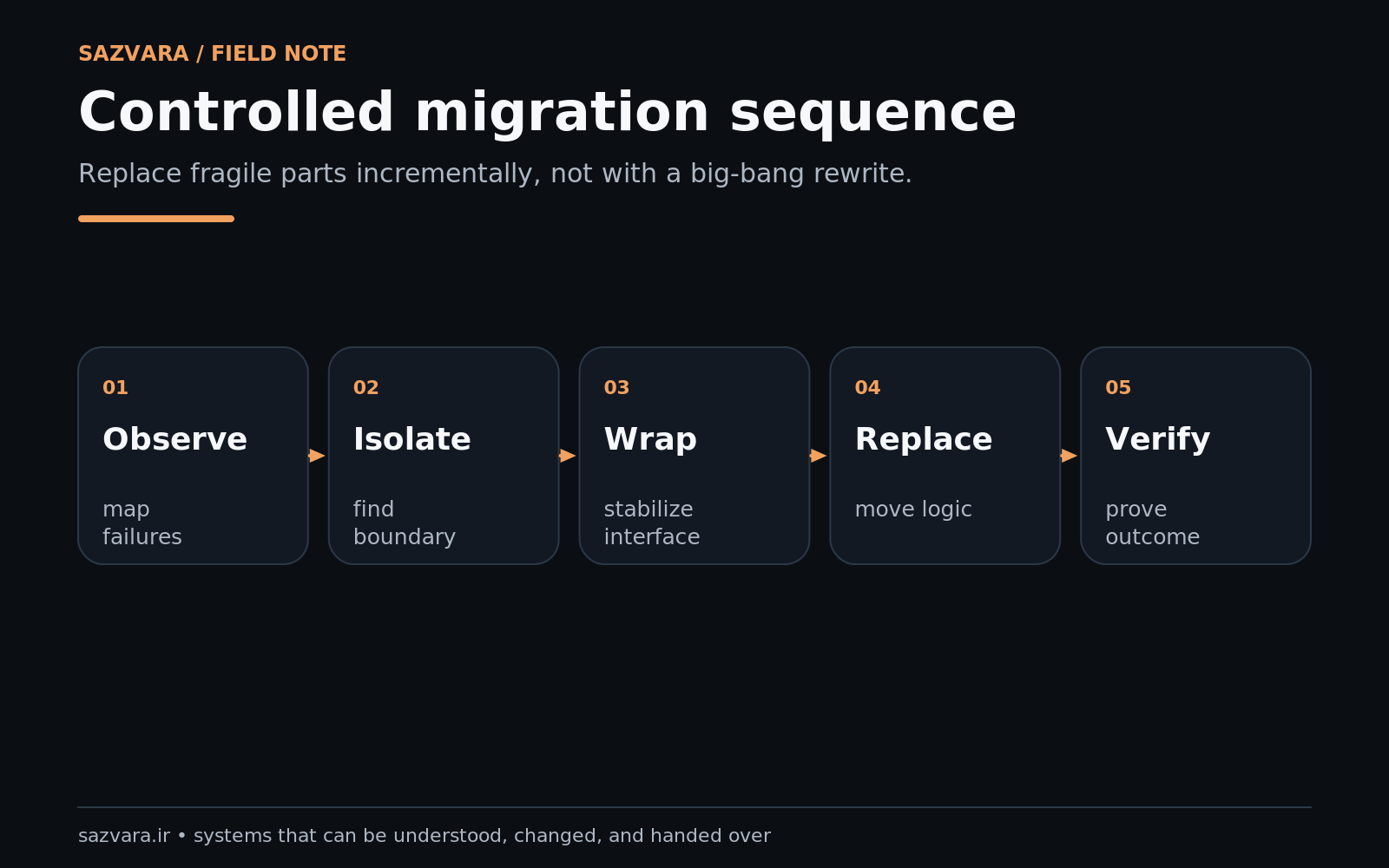
When an automation genuinely needs stronger engineering, migrate incrementally.
Step 1 — inventory#
Map triggers, credentials, side effects, stores, branches and downstream dependencies.
Step 2 — identify the dangerous boundary#
Find the part that creates business risk: state mutation, pricing, payment, eligibility, duplicate-sensitive actions or high-volume transformation.
Step 3 — wrap that boundary#
Create a small API/function/module with a clear input/output contract.
Step 4 — add tests#
Prove the business rules before rerouting production traffic.
Step 5 — keep visual orchestration where it helps#
Do not move email notifications and simple connectors into code merely for consistency.
Step 6 — add operational evidence#
Log requests, outcomes, correlation IDs and recoverable errors.
Step 7 — migrate traffic gradually#
Run comparison tests or a staged rollout before deleting the original path.
A 15-question fragility audit#
Score each answer as low, medium or high concern:
- Can a run safely execute twice?
- Can two runs update the same object concurrently?
- Is there one clear system of record?
- Can a new operator understand the workflow without the original builder?
- Are credentials revocable and documented?
- Can you distinguish test and production configuration?
- Is every important failure visible?
- Can failed work be resumed without manual data reconstruction?
- Are business rules reviewable in one place?
- Can you test edge cases repeatedly?
- Do platform limits affect process design?
- Is the monthly cost predictable at expected volume?
- Is there version history or rollback?
- Does one workflow now own several unrelated business functions?
- Would a bad execution create material customer, financial or compliance impact?
A few medium concerns do not require migration. Multiple high concerns around state, replay, security and failure cost usually justify a hybrid or code-first redesign.
Where Sazvara fits#
Sazvara can audit an existing n8n, Make, Zapier or custom automation estate and identify which parts should remain visual, which parts need stronger controls, and which business rules belong in tested code. The aim is not to sell a rewrite. It is to reduce failure and ownership risk while preserving the speed advantages of the tools already working.
See Sazvara services for automation and rescue work, review Sazvara work for engineering context, or request a diagnostic if your automation has become difficult to change safely.
Sources and further reading#
- Zapier Zap limits
- Zapier Code rate limits
- Zapier webhook rate limits
- Zapier replay
- Make error handling
- Make incomplete executions
- n8n source-control environments
- n8n security audit
- n8n workflow sharing / production feature index
- OWASP Secrets Management Cheat Sheet
- GitHub protected branches
- GitHub deployment controls
- NIST Secure Software Development Framework project
- NIST SP 800-218 Secure Software Development Framework
Editorial note: This article was produced with AI-assisted research and drafting, then reviewed against Sazvara's technical, originality, usefulness and release-quality controls. The decision framework is Sazvara's synthesis; platform-specific behavior and limits are linked to current official documentation.
Have a system that is stuck, manual or difficult to ship?
Sazvara diagnoses the system before prescribing the technology. Bring the constraints, failure modes and current state.