A practical architecture for moving website enquiries into CRM ownership without duplicate records, silent failures, lost notifications or unassigned leads. 
Editorial promise#
The architecture in this guide is platform-neutral. Examples use common CRM and automation patterns, but the design goal is traceable business state rather than dependence on a particular vendor.
The Sazvara framework#
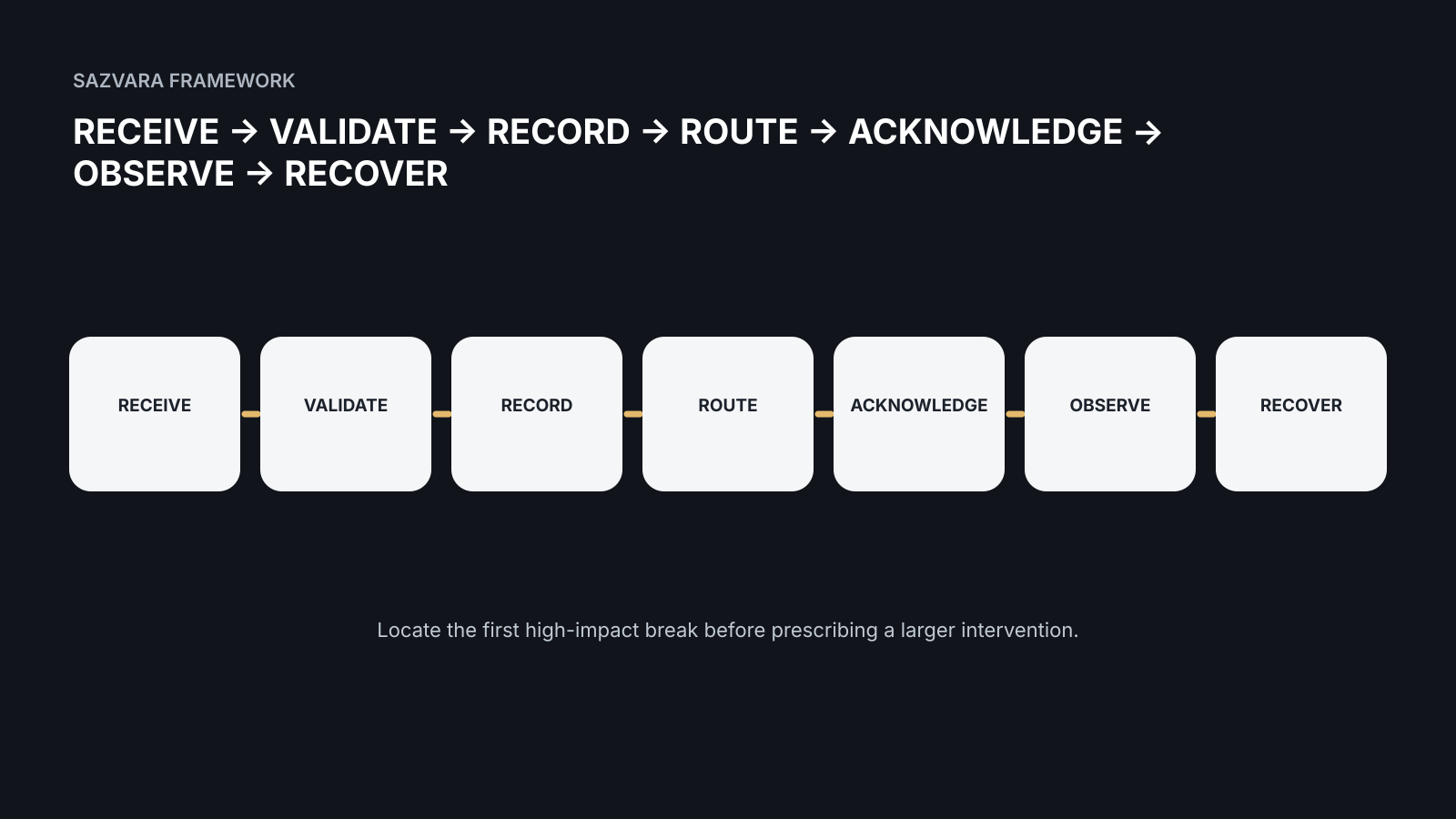
RECEIVE → VALIDATE → RECORD → ROUTE → ACKNOWLEDGE → OBSERVE → RECOVER
The short answer#
Reliable lead routing is a transaction, not a notification. The system should be able to prove that an enquiry was received, validated, recorded, assigned, acknowledged and recoverable if any downstream step fails.
The most common design mistake is to send directly from a website form into several external systems and treat the absence of an error as success. A better design creates a durable receipt first and then performs routing with observable states.
Evidence anchors#
- OWASP input validation — Server-side validation protects the receiving system and improves data quality.
- OWASP logging — Structured logs should support traceability without exposing unnecessary sensitive content.
- MDN POST semantics — Form intake commonly uses POST semantics and should treat repeated requests intentionally.
- W3C forms — Usable form design includes labels, instructions and collecting only what the process needs.
- Salesforce assignment rules — CRM assignment rules are explicit business logic and need ownership.
- HubSpot form automation — Form-triggered automation should be designed as downstream processing, not proof of durable receipt.
- AWS reliability pillar — Reliable systems anticipate dependency failure and recovery.
- Google Cloud reliability framework — Reliability includes observability, recovery planning and operational readiness.
- Zapier replay guidance — Replay capability is useful only when repeated effects are understood.
- Make error handling — Automation platforms expose retry and error-handling mechanisms that still require process design.
Receive before you integrate#
The website should accept the submission through a controlled server-side boundary rather than trusting browser-side behavior alone. Rate limits, bot controls and input validation belong here.
The intake endpoint should return a truthful response. Do not tell the visitor that the sales team has received the enquiry if the system only knows that a browser request was attempted.
Validate twice#
Client-side validation improves usability; server-side validation protects the system. Normalize fields, reject malformed input and avoid trusting hidden fields or client-generated values for important routing decisions.
Validation rules should be strict enough to preserve data quality but not so rigid that legitimate enquiries are rejected.
Create a durable receipt#
Store the submission, or an appropriate durable event, before calling the CRM, email or automation platform. This turns downstream outages from data-loss events into retryable operational events.
The durable record should include an identifier, timestamp, source and processing state. Sensitive data should be minimized and handled according to the business's privacy requirements.
Make duplicate behavior explicit#
Browsers retry, users double-click and network failures create ambiguity. Design an idempotency strategy so the same logical enquiry does not accidentally create multiple opportunities or trigger repeated follow-ups.
The correct key depends on the system. Do not blindly deduplicate by email address if the same person can submit distinct enquiries.
Route with business rules#
Write routing rules as explicit logic: geography, service line, account ownership, product, urgency or other legitimate company-level criteria. Keep a default queue for records that do not match cleanly.
Every rule should have an owner and change history. Hidden routing logic spread across multiple automation tools becomes difficult to audit.
Separate acknowledgement from sales ownership#
A customer acknowledgement can be automated, but it should not imply a human has reviewed the request. Internally, assignment should create a named owner or queue with a clear service expectation.
Notifications can support ownership but should not substitute for it.
Instrument every boundary#
Capture success and failure around the intake endpoint, durable record, CRM write, assignment, acknowledgement and alerting. Logs should help answer: what happened to submission X, what is pending, and what can be safely retried?
Avoid logging secrets or unnecessary personal data. Observability must respect privacy and security.
Design retries for safety#
Retry only operations that are safe to repeat or have idempotency protection. Blind retries can create duplicate contacts, repeated messages or conflicting state.
Use bounded retries with a dead-letter or manual-review path for persistent failures.
Plan for CRM downtime#
The website should not have to lose a lead because the CRM is unavailable for twenty minutes. A durable receipt allows the intake layer to accept valid submissions and process them when the dependency recovers.
Communicate truthfully to the user and create an internal alert if the queue grows beyond an expected threshold.
Test synthetic enquiries#
Create known test submissions that exercise normal routing, invalid data, duplicate behavior and dependency failures. Synthetic testing can detect drift before a real customer exposes it.
Keep test records identifiable so they do not pollute sales reporting.
Measure operational outcomes#
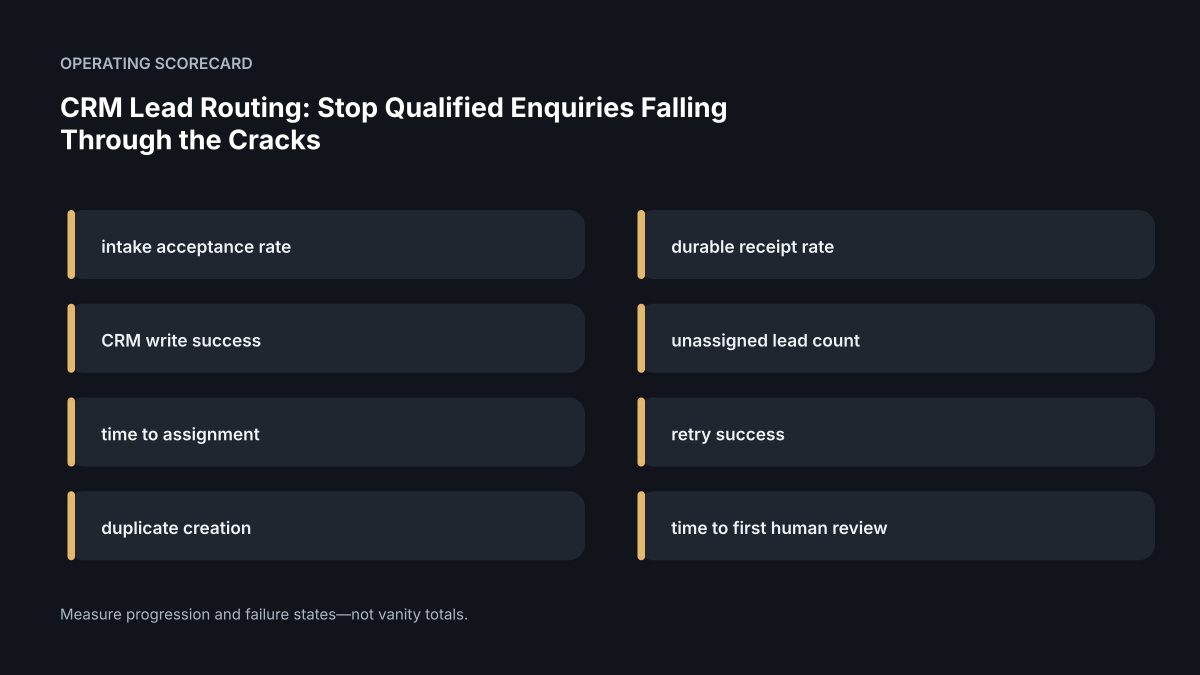
Useful measures include intake success rate, downstream processing success, time to assignment, retry volume, unassigned lead count, duplicate rate and time to first human review.
These metrics reveal whether the system supports sales, not merely whether automation steps are running.
Change control#
Treat lead routing as production software even when it is implemented in a visual automation tool. Document rules, review changes, separate test and production where possible, and preserve a rollback route.
A small workflow can still be revenue-critical.
Where Sazvara fits#
This is a strong fit for Sazvara when website, automation and operations overlap. The work can begin as a narrow diagnostic: trace one submission through the full chain, identify silent-failure points, and define the smallest reliable architecture.
The result may be a repair of the existing stack rather than a wholesale platform replacement.
What good looks like in practice#
A reliable intake system can answer the status of any accepted enquiry without relying on mailbox archaeology. The submission receives a durable identifier, downstream processing changes explicit states, routing has a default path, and repeated processing cannot create harmful duplicate effects. When the CRM is unavailable, valid intake is preserved and the backlog becomes visible to an operator.
Good systems are also boring to operate. A sales or operations owner can see what is waiting, what failed, what has been assigned and what needs manual review. The recovery procedure is written in business terms rather than buried in a workflow editor. That operational clarity is usually more valuable than adding another connector or notification channel.
Decision table#
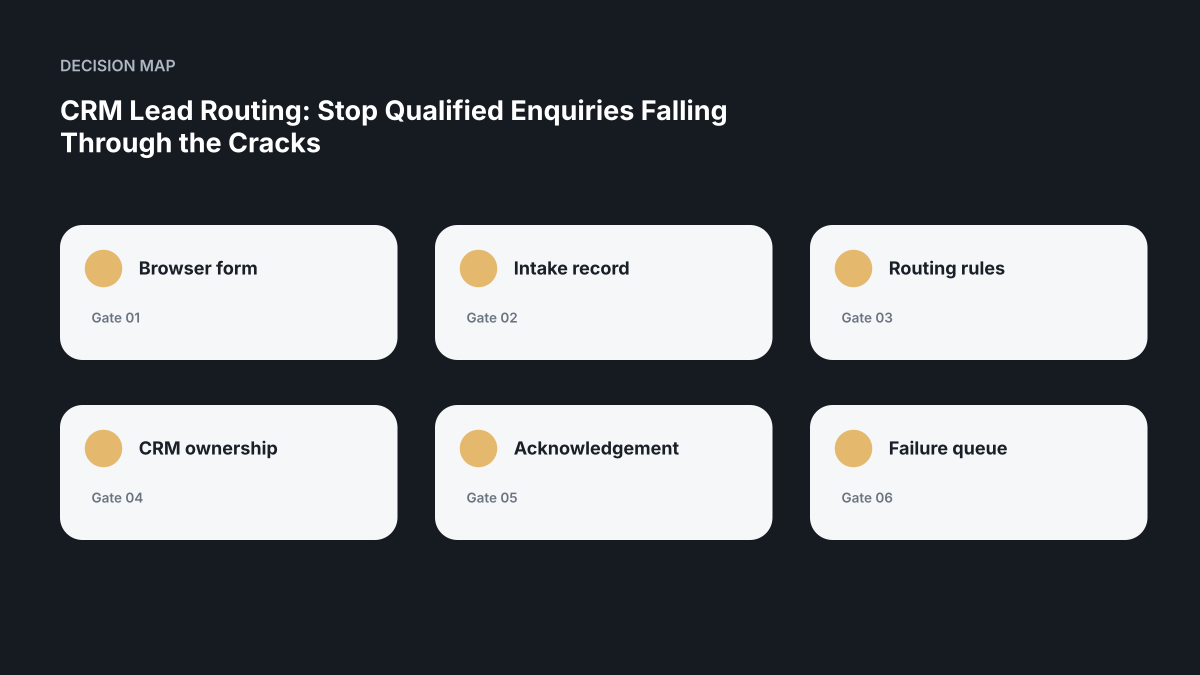
| Signal | What it usually means | First action |
|---|---|---|
| No durable record before CRM call | Data-loss risk | Create an intake receipt before external processing. |
| Retries can create duplicate leads | Idempotency risk | Define a logical submission key and safe replay behavior. |
| Routing logic is spread across branches | Change-control risk | Centralize or document business rules and default queues. |
| Notifications exist but no owner is assigned | Ownership risk | Make assignment state explicit; notification is only a signal. |
| CRM outage blocks user submission | Dependency risk | Queue valid intake and process when the CRM recovers. |
| No one can trace one enquiry end to end | Observability risk | Add correlation IDs and state transitions. |
Worked scenario#
A website form posts directly to an automation platform. The workflow creates a CRM contact, sends an internal email and replies to the prospect. It works in normal testing. During a CRM outage, however, the automation marks the run as failed after the acknowledgement email has already been sent. The prospect believes the request was received, but there is no durable lead record and no one notices until the prospect follows up.
A more reliable architecture accepts and validates the form, creates a durable intake record with a unique identifier, then processes CRM assignment and acknowledgement as downstream states. The CRM outage becomes a visible queue instead of data loss. When service resumes, pending records can be retried safely.
Implementation sequence#
Instrument the existing path before replacing it. Add correlation IDs and record where submissions disappear or duplicate. Next, create a durable intake boundary and route one service line through it. Test normal, invalid, duplicate and CRM-down cases. Once the new path is proven, migrate remaining routes.
Keep the routing table and ownership rules explicit. Changes to territory, service ownership or qualification should be reviewed like production configuration.
Measurement plan#
Measure accepted submissions, durable receipts, downstream success rate, queue age, retry count, duplicate creation, unassigned leads, time to assignment and time to first human review. Segment by source only when it changes an operational decision.
Set alerts on business impact: an unassigned high-value queue is more important than a single transient API timeout that recovered automatically.
Operating scorecard#
| Measure | Why it matters |
|---|---|
| intake acceptance rate | Turns the operating state into a measurable signal that can drive a decision. |
| durable receipt rate | Turns the operating state into a measurable signal that can drive a decision. |
| CRM write success | Turns the operating state into a measurable signal that can drive a decision. |
| unassigned lead count | Turns the operating state into a measurable signal that can drive a decision. |
| time to assignment | Turns the operating state into a measurable signal that can drive a decision. |
| retry success | Turns the operating state into a measurable signal that can drive a decision. |
| duplicate creation | Turns the operating state into a measurable signal that can drive a decision. |
| time to first human review | Turns the operating state into a measurable signal that can drive a decision. |
Common mistakes to avoid#
Do not treat email delivery as the system of record. Do not retry non-idempotent writes blindly. Do not hard-code routing across multiple disconnected automation branches. Do not expose sensitive payloads in logs merely to make debugging easier.
Also avoid a “perfect” architecture that the team cannot operate. Reliability controls should match consequence and team capacity.
Founder decision questions#
Before funding a new CRM, automation platform or form plugin, ask: Where is the first durable record created? Can the team prove what happened to one specific enquiry? Which system is authoritative for ownership? What happens when the CRM is unavailable? Can a retry create a duplicate? Who sees records that do not match a routing rule? How quickly would anyone notice a growing queue? Can the current operator recover a failed item without the original builder?
These questions expose architectural risk faster than comparing connector lists. If the answers are unclear, platform replacement is premature. First make the existing state visible. A small tracing exercise often shows whether the real problem is unreliable receipt, hidden branching, weak assignment, brittle notifications or insufficient operating ownership.
Procurement brief#
A lead-routing improvement brief should name the current form surface, system of record, routing rules, acknowledgement behavior, failure states, required integrations and expected reporting. Require the implementer to demonstrate normal intake, invalid input, duplicate behavior and a simulated downstream outage before release. Ask for a short operator runbook covering retry, manual assignment and failure escalation.
The final acceptance test should use synthetic enquiries that are identifiable but otherwise realistic. Verify not only that the automation platform reports success, but that the CRM contains the correct record, the correct owner is assigned, the acknowledgement is truthful, and the event appears in measurement. This closes the gap between “workflow ran” and “business process worked.”
Deep-dive: model lead routing as a state machine#
Reliable lead routing becomes easier to reason about when every enquiry moves through explicit states instead of disappearing into a chain of loosely connected notifications. A simple state model might include received, validated, accepted, assigned, acknowledged, failed-retryable, failed-terminal and resolved. The labels are less important than the rule that every transition is observable and owned.
The first durable state should occur as close as practical to the website boundary. If the browser shows success before the business has any durable receipt, the customer and the operator can hold contradictory views of the same event. A durable receipt does not require a complex platform; it requires a record that can be correlated with subsequent CRM writes, notifications and assignment actions.
Worked scenario: CRM API outage after form acceptance#
Suppose a qualified buyer submits a project enquiry at 10:12. The website validates the request and creates receipt lead-8f31. The CRM API is temporarily unavailable. A fragile implementation may return an error to the visitor, send a generic email, or silently lose the request after several automatic retries. A reliable implementation separates receipt from downstream delivery.
The visitor can receive a truthful acknowledgement because the enquiry is durably stored. The routing worker records the CRM failure against the same receipt, classifies it as retryable, and schedules a bounded retry. If the retry budget is exhausted, the item moves to an exception queue and alerts a named owner. When the CRM recovers, the same idempotency key prevents a duplicate opportunity from being created. The operator can then see the full history from website receipt through CRM assignment.
This example shows why “the form sent successfully” is not an adequate acceptance test. The commercially important state is not the browser response alone; it is whether the organisation can prove that a valid enquiry became owned work or a visible exception.
Separate routing rules from transport mechanics#
Business rules such as geography, service type, existing-account ownership or deal size should be inspectable independently of the connector that moves data. When routing rules are buried inside a single automation step, a future change to the CRM or automation platform can accidentally change sales logic. Represent the rule set in a form the business can review, version and test.
For each routing rule, define the expected owner, fallback owner and conflict behavior. If two rules match, decide which wins. If no rule matches, route to a visible default queue rather than discarding the lead. If the assigned owner is unavailable, define reassignment or escalation behavior instead of relying on informal inbox forwarding.
Operational measures that matter#
A routing dashboard should answer a small set of business questions: how many valid enquiries were received; how many reached an assigned state; how long assignment took; how many entered retry or exception states; how many duplicates were prevented; and how many remained unresolved beyond the agreed service window. These measures describe reliability without inventing a universal conversion benchmark.
A useful weekly review samples a handful of normal journeys and all terminal failures. Check whether receipts can be traced end to end, whether error classifications still make sense, whether routing rules reflect current commercial ownership and whether alerts lead to action. Reliability decays when exceptions become familiar and stop being investigated.
Recovery drill#
Periodically simulate a downstream outage in a safe environment. Confirm that the website can still create a durable receipt, the retry mechanism does not create duplicates, unresolved items become visible, and the operator can replay them after recovery. Document the evidence produced by the drill. A system that has never demonstrated recovery should not be described as resilient merely because retries are configured.
Handover requirement#
The handover packet should include the state model, routing rules, receipt identifier format, retry limits, exception-queue location, alert destinations, credentials ownership, test cases and replay procedure. This turns lead routing from an opaque automation into an operational system that another person can support.
Questions to answer before increasing lead volume#
Before paid campaigns or a major traffic increase, verify the maximum safe intake rate, retry behavior under dependency slowdown, exception ownership, CRM API limits, duplicate controls and alert thresholds. A routing flow that appears reliable at low volume may fail differently when many submissions arrive close together or when the CRM throttles requests.
Run a bounded load test in a safe environment using synthetic identities. Confirm that every accepted item reaches exactly one final state and that the test data can be removed cleanly. If the production CRM cannot accept synthetic records, test the receipt and routing layers separately and document the limitation.
Make sales ownership visible to operations#
Routing reliability does not end at record creation. The system should expose whether a lead has an owner and whether the owner acknowledged it where the business process requires that. This does not mean monitoring employee behavior intrusively; it means making the commercial state explicit enough to detect orphaned work. A lead that exists in the CRM but belongs to nobody is still a routing failure from the customer's perspective.
Buyer checklist#
Before approving the work, confirm:
- The team can state the browser form condition in plain language.
- The intake record evidence is inspectable rather than assumed.
- Ownership for routing rules is named.
- A failure involving crm ownership has a defined response.
- The acknowledgement signal is measured after release.
- The team knows how failure queue is restored or handed over.
Release / acceptance gate#
| Gate | Evidence required before calling the work complete |
|---|---|
| Receipt | Every accepted enquiry has a durable identifier. |
| Validation | Invalid input is rejected consistently on the server. |
| Routing | Every valid record becomes assigned or enters a visible review queue. |
| Retry | Repeated processing cannot create harmful duplicate effects. |
| Alerting | Persistent failure or backlog growth reaches a named owner. |
| Recovery | An operator can safely replay or resolve a failed item. |
A routing release should stop when accepted enquiries can become unassigned, duplicated or untraceable.
Related Sazvara guidance#
- /services/
- /contact/
- /insights/website-form-to-revenue/
- /insights/when-no-code-becomes-fragile/
- /insights/technical-handover-standard/
Editorial note#
Standards and vendor documentation support the technical behaviors referenced in this guide. The state model, recovery drill and operating measures are Sazvara synthesis; the scenarios are illustrative and do not represent undisclosed customer results.
Sources and further reading#
- OWASP input validation
- OWASP logging
- MDN POST semantics
- W3C forms
- Salesforce assignment rules
- HubSpot form automation
- AWS reliability pillar
- Google Cloud reliability framework
- Zapier replay guidance
- Make error handling
Next step#
Request a lead-routing reliability review. Start with the highest-consequence path described in this guide, capture a baseline, and require observable acceptance evidence before expanding the scope.
Have a system that is stuck, manual or difficult to ship?
Sazvara diagnoses the system before prescribing the technology. Bring the constraints, failure modes and current state.