A buyer's guide to technical diagnostics: what should be inspected, what evidence should be produced, what should not be promised, and how the output should turn into a prioritized implementation decision. 
Editorial promise#
The article defines a good diagnostic by decision value rather than report length. It explicitly allows the correct recommendation to be a small repair—or no major project at all.
The Sazvara framework#
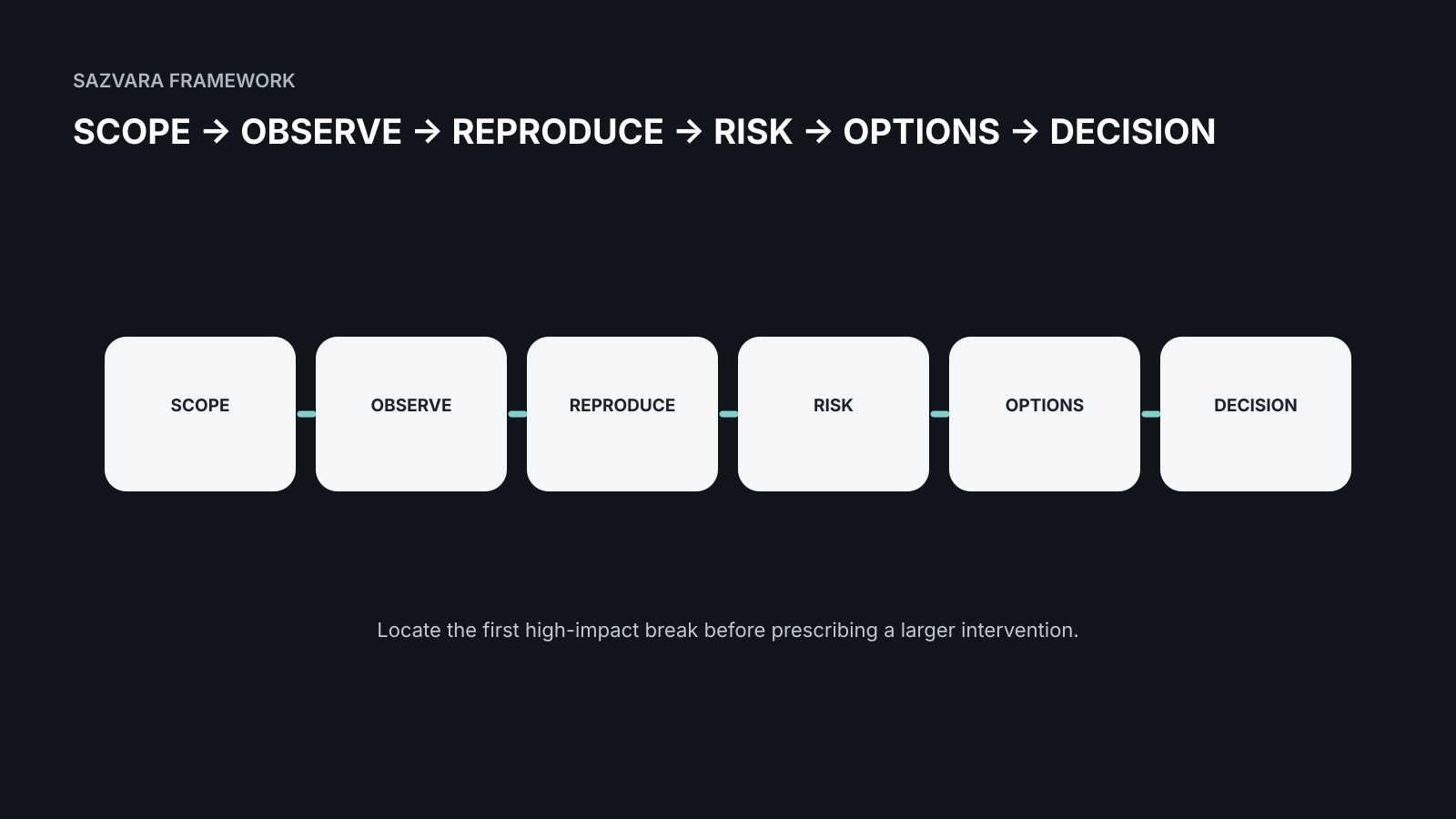
SCOPE → OBSERVE → REPRODUCE → RISK → OPTIONS → DECISION
The short answer#
A high-quality technical diagnostic should reduce uncertainty. It should define the problem boundary, inspect the live system safely, reproduce important failures, collect evidence, classify risk, compare realistic options and end with a decision-ready plan.
It should not be a generic automated report, a sales document disguised as an audit, or a list of every imperfection on the website.
Evidence anchors#
- NIST SSDF — Secure software practice emphasizes defined process, verification and controlled change.
- WordPress backups — Diagnostics that may touch production need a recovery position.
- OWASP logging — Logs and event evidence help distinguish observed facts from guesses.
- OWASP input validation — Input behavior should be tested at the server boundary, not only in the browser.
- Core Web Vitals — Performance findings should use repeatable user-centered measures where relevant.
- NIST AI RMF — AI workflow diagnostics should connect system behavior to context and consequence.
- Google helpful content — Website audits should preserve useful content and avoid reducing quality to mechanical SEO checks.
- Google canonical guidance — Canonical configuration is one technical signal when diagnosing crawl/indexing issues.
- GitHub protected branches — Change control can be part of the remediation path after diagnosis.
- AWS reliability pillar — Recovery, observability and failure management are core reliability concerns.
Start with the business-critical path#
The audit should identify which process matters most: lead intake, checkout, content publishing, an inherited WordPress release path, CRM routing, an AI workflow or another operational boundary.
Depth on the highest-consequence path is usually more valuable than shallow scanning of the entire stack.
Define safe inspection rules#
Agree on read-only versus change permissions, production constraints, sensitive data handling and who can authorize interventions. Diagnostics often happen on fragile systems, so the inspection method matters.
When active testing is required, use a controlled test surface or clearly bounded production test.
Reproduce the reported failure#
A useful diagnostic does not jump straight to fixes. It attempts to reproduce the business symptom and records the conditions under which it occurs.
This prevents teams from solving a plausible technical problem that is not actually causing the commercial failure.
Build a dependency map#
Map the systems touched by the critical path: browser, CMS, API, automation platform, database, CRM, email, analytics and third-party services.
The map can be simple, but it should reveal where ownership and state change.
Collect evidence#
Evidence may include request traces, logs, configuration snapshots, performance measurements, screenshots, sample records and reproducible test cases.
The output should distinguish observed facts from hypotheses and recommendations.
Classify risk#
Not every issue deserves immediate work. Classify by consequence, likelihood, detectability and recoverability. A rare cosmetic defect and a silent lead-loss path should not sit in the same priority bucket.
Explain the business consequence in plain language.
Present options, not a predetermined rebuild#
For each major issue, compare realistic paths such as repair, containment, modernization or rebuild. Include dependencies, risks and what evidence would justify the larger intervention.
An audit should be allowed to conclude that the current stack is good enough.
Define acceptance criteria for the chosen path#
Recommendations become actionable when they specify how completion will be verified. Examples include successful synthetic lead routing, restored page performance, predictable deployment, correct redirects or an AI workflow that passes a defined evaluation set.
This converts the audit from commentary into an implementation contract.
Include recovery and rollback#
If recommended work touches production, the plan should explain how to recover from a failed release. This is especially important for inherited systems and revenue-critical automation.
The recovery plan can be lightweight but should be real.
Make ownership visible#
List which accounts, credentials, repositories and external services are involved and who should own them. Diagnostics frequently expose organizational risk that is not visible in code.
Client ownership should be strengthened as part of remediation.
Avoid false precision#
Do not turn uncertain estimates into guaranteed ROI. A diagnostic can estimate effort, risk and potential business impact, but revenue depends on factors outside the technical system.
State assumptions and confidence clearly.
The final deliverable#
A useful deliverable includes: executive summary, critical-path map, verified findings, evidence, risk classification, prioritized actions, options, acceptance criteria, dependencies, recovery notes and a short implementation sequence.
The founder should be able to use it to approve work, reject work or compare providers.
Where Sazvara fits#
Sazvara's strongest commercial entry point is a bounded diagnostic because it creates evidence before a larger commitment. It is particularly suited to inherited WordPress sites, unreliable lead paths, fragile automations and production AI workflows.
The objective is not to maximize project size. It is to identify the smallest safe intervention that produces a measurable improvement.
What good looks like in practice#
A strong diagnostic changes the buyer’s decision state. Before the work, the problem may be “our website is unreliable” or “we think the CRM is losing leads.” Afterward, the buyer should know which failure is verified, where it occurs, what evidence supports it, what the realistic intervention options are and how completion will be accepted.
Good diagnostics are therefore opinionated about priority but modest about certainty. They can recommend a small repair when the evidence supports one, or a rebuild when structural constraints are genuinely blocking safe change. Findings that remain hypotheses are labeled as such. The final output is useful to the buyer even if another provider implements the work, because the system map, evidence and acceptance criteria stay with the client.
Decision table#
| Signal | What it usually means | First action |
|---|---|---|
| Scanner finds many low-impact issues | Noise | Prioritize by business consequence and evidence. |
| Reported failure cannot be reproduced | Uncertainty | Improve instrumentation before prescribing a large fix. |
| One dependency explains the symptom | Bounded cause | Repair and verify before considering rebuild. |
| Multiple structural constraints block safe change | Systemic risk | Compare containment, modernization and rebuild options. |
| Provider recommends only its biggest service | Bias risk | Require alternatives and explicit assumptions. |
| Audit output cannot guide acceptance | Decision gap | Add measurable criteria and implementation sequence. |
Worked scenario#
A founder reports that website enquiries are inconsistent and suspects the CRM. A weak “audit” runs automated scanners, lists 47 issues and recommends a redesign. A stronger diagnostic traces a real test enquiry, confirms the website accepts it, discovers that an automation branch drops records without a required industry field, and shows that no alert exists for the unmatched state.
The correct intervention is a routing repair, durable intake record and monitoring—not a rebuild. The value of the diagnostic is the avoided project as much as the recommended one.
Implementation sequence#
Define one business-critical question, agree on safe inspection rules, gather a baseline, reproduce the issue, map dependencies, rank verified findings, and present two or three realistic intervention paths. Write acceptance criteria before estimating implementation.
Keep the final report concise enough that a founder can use it as a decision document.
Measurement plan#
A diagnostic should report evidence quality, affected volume where known, failure consequence, detectability and recoverability. For implementation, define the operational measures that will prove repair: successful synthetic transactions, reduced stuck records, improved performance, correct redirects or evaluation pass rates.
Avoid translating uncertain technical findings directly into guaranteed revenue.
Operating scorecard#
| Measure | Why it matters |
|---|---|
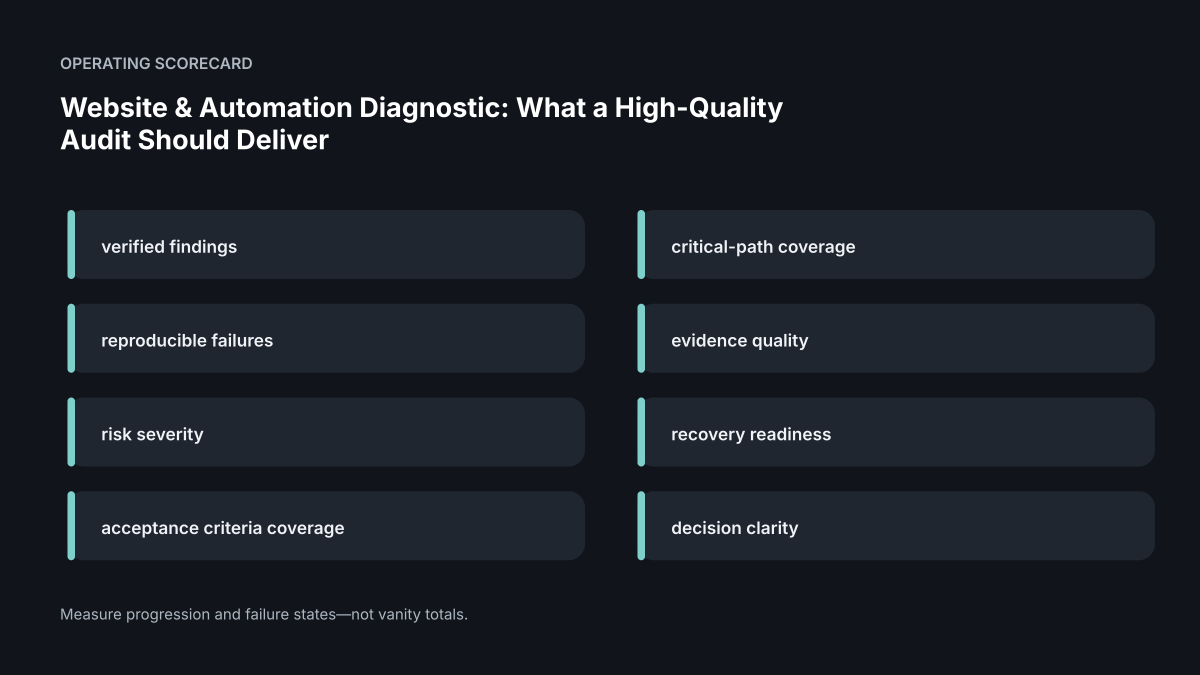
| verified findings | Turns the operating state into a measurable signal that can drive a decision. |
| critical-path coverage | Turns the operating state into a measurable signal that can drive a decision. |
| reproducible failures | Turns the operating state into a measurable signal that can drive a decision. |
| evidence quality | Turns the operating state into a measurable signal that can drive a decision. |
| risk severity | Turns the operating state into a measurable signal that can drive a decision. |
| recovery readiness | Turns the operating state into a measurable signal that can drive a decision. |
| acceptance criteria coverage | Turns the operating state into a measurable signal that can drive a decision. |
| decision clarity | Turns the operating state into a measurable signal that can drive a decision. |
Common mistakes to avoid#
Automated scanner output is not a diagnosis. A long issue list is not prioritization. A recommendation that always leads to the provider's largest service is not neutral analysis. Another warning sign is failing to distinguish observed facts from hypotheses.
The audit should leave the buyer with more control and clearer options, even if they choose another implementer.
Founder decision questions#
Ask what decision the diagnostic is meant to unlock. Are you deciding whether to repair or rebuild, why leads are disappearing, whether an automation is production-ready, or where performance is constrained? A diagnostic without a decision target often becomes a long list of observations with no priority.
Ask the provider to state which findings are verified, which are inferred and which require further testing. This distinction is one of the clearest markers of a serious audit.
Procurement brief#
Define the critical question, allowed inspection methods, systems in scope, sensitive-data constraints and expected deliverable before work begins. Require a concise evidence appendix rather than screenshots without interpretation. The final document should identify the smallest safe intervention, alternatives, dependencies and acceptance criteria.
A diagnostic should be independently useful even if the buyer chooses another implementer. That means accounts, findings and evidence remain with the client; the recommendations are understandable; and the next decision does not depend on purchasing an undefined larger project.
Deep-dive: a diagnostic should reduce uncertainty before it increases scope#
A high-quality diagnostic is not a disguised proposal for the largest available project. Its first job is to turn a vague symptom into an evidence-backed problem statement with clear uncertainty. The output should distinguish what was directly observed, what was inferred, what remains unverified and what would require additional access or testing.
This distinction matters because the same symptom can have several causes. A missing lead could result from browser validation, server rejection, spam filtering, an automation failure, CRM authentication, routing logic or notification delivery. A diagnostic that jumps directly to “rebuild the form” may fix the wrong boundary and destroy useful evidence.
Worked scenario: intermittent lead loss#
Suppose a company reports that some website enquiries never reach sales. The first step is to define the business path: submission, server receipt, validation, durable storage if present, automation handoff, CRM creation, assignment and notification. Reproduce a normal case and a controlled failure where safe. Correlate timestamps or identifiers across the boundaries.
The investigation discovers that the website receives the request successfully and the automation runs, but CRM writes sometimes fail during token refresh. The workflow retries without an idempotency key, so a small number of leads are duplicated while others end in an unmonitored error state. The correct recommendation is not a website redesign. It is a bounded reliability repair: durable receipt, explicit retry state, idempotent CRM write, exception visibility and an acceptance test that simulates authentication failure.
The diagnostic should show the evidence supporting that conclusion and state what remains outside scope. If no failure can be reproduced, say so and propose the next evidence-gathering step instead of inventing certainty.
Separate severity from confidence#
Severity describes the consequence if the finding is real; confidence describes how strong the evidence is. Keep them separate. A potentially severe security or revenue issue with weak evidence may justify containment or deeper testing, but it should not be reported as confirmed. A low-severity issue with strong evidence may be safe to schedule later.
A useful finding therefore contains the affected path, observed evidence, likely consequence, confidence, immediate containment if needed, repair options and verification method. This format helps a buyer compare findings without treating every item as equally urgent.
Give options with trade-offs#
For each meaningful problem, present the smallest safe repair, a more durable improvement where appropriate, and the consequences of doing nothing. Include dependencies and rollback considerations. The buyer should be able to see why a full rebuild is or is not justified.
Avoid false precision in effort estimates when the diagnostic has not inspected enough of the system. State assumptions and identify what could change the estimate. This is more useful than a confident number built on hidden uncertainty.
Make the evidence portable#
The buyer should receive artifacts that another qualified operator can inspect: dependency map, screenshots or logs where appropriate, affected URLs or workflow identifiers, configuration versions, reproduction steps, test results and source links. Sensitive values should be redacted or referenced through secure ownership rather than copied into a report.
Portable evidence reduces lock-in. The client can use the diagnostic to commission Sazvara, another provider or an internal team without repeating the entire discovery process.
Include a verification contract#
A recommendation is incomplete until success can be tested. Define the normal case, important invalid cases, dependency-failure behavior, recovery behavior and observable evidence. For a lead-intake repair, that may mean a valid enquiry receives a durable identifier, produces exactly one CRM record, reaches an owner, survives a simulated CRM outage and can be replayed without duplication.
The verification contract should match the consequence of the issue. A cosmetic defect may need a screenshot and cross-device check. A production data or automation defect needs stronger evidence.
What the final diagnostic package should contain#
At minimum, provide an executive summary, scope and access boundaries, system/dependency map, findings with evidence and confidence, risk classification, repair options, acceptance criteria, recovery considerations, unresolved questions and recommended sequence. Include enough technical detail for implementation without forcing the founder to read raw logs to understand the decision.
The best diagnostic leaves the buyer with less uncertainty, clearer ownership and a smaller set of justified next actions—even when the conclusion is that no large project is required.
How to compare two diagnostic proposals#
Compare the inspection scope, evidence methods, access model, safety controls and deliverables rather than only price or page count. One proposal may promise a long report but provide no reproduction work, while another may focus on a smaller business-critical path and include logs, dependency mapping and acceptance tests. The second can be more useful even if the document is shorter.
Ask whether the provider will distinguish observation from inference, preserve a rollback position before active testing, avoid destructive changes during diagnosis, and return portable evidence. Also ask what the provider will do when the issue cannot be reproduced. A mature answer should describe further evidence collection, not pressure to approve a rebuild.
Diagnostic depth should follow consequence#
A low-risk cosmetic issue may need only browser reproduction and a small compatibility check. Intermittent payment, authentication, lead-routing or data-integrity failures deserve deeper tracing, dependency inspection and recovery testing. Match the depth of investigation to the potential impact and uncertainty instead of applying the same checklist to every issue.
After the diagnostic, preserve the baseline#
Keep the report, evidence references, relevant configuration versions and acceptance criteria even if no repair is commissioned immediately. They form a baseline for later changes. If a future incident occurs, the team can compare the new state with what was previously observed instead of restarting discovery from zero.
A useful diagnostic ends with ownership#
Every material finding should end with a named next owner even when the recommendation is to defer work. Without ownership, a good report becomes an archive rather than an operating tool. Record who will decide, who will implement, who will verify and what evidence closes the item. This makes the diagnostic actionable without turning it into an automatic sales proposal.
Buyer checklist#
Before approving the work, confirm:
- The team can state the scope boundary condition in plain language.
- The observed evidence evidence is inspectable rather than assumed.
- Ownership for reproduction is named.
- A failure involving risk class has a defined response.
- The options signal is measured after release.
- The team knows how decision gate is restored or handed over.
Release / acceptance gate#
| Gate | Evidence required before calling the work complete |
|---|---|
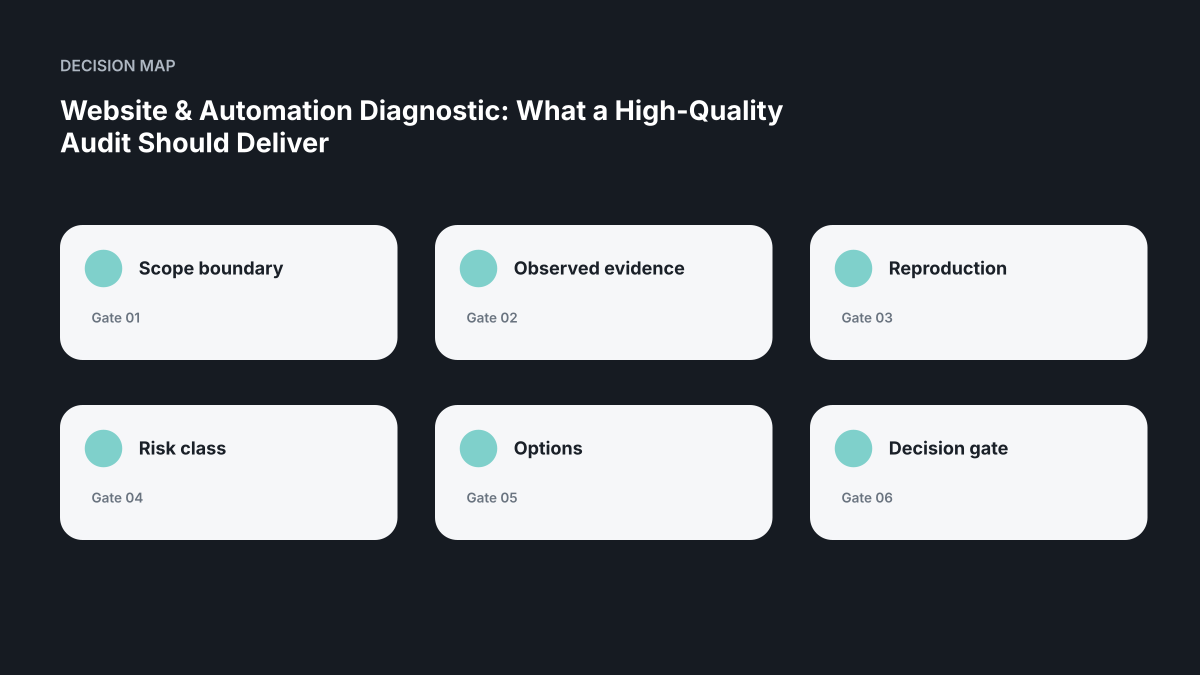
| Scope | The diagnostic question and systems in scope are explicit. |
| Safety | Inspection permissions and production constraints are defined. |
| Evidence | Findings distinguish observed facts from hypotheses. |
| Risk | Priority reflects consequence, detectability and recoverability. |
| Options | Repair, containment and rebuild are compared where relevant. |
| Decision | The output supports an approve/reject/sequence decision. |
A diagnostic should not be accepted when the major recommendation cannot be traced back to evidence and criteria.
Related Sazvara guidance#
- /services/
- /work/
- /contact/
- /insights/inherited-wordpress-rescue/
- /insights/small-business-automation-audit/
Editorial note#
External sources support the diagnostic, security, recovery and web-system facts referenced here. The evidence ladder, severity/confidence separation and example findings are Sazvara operating synthesis; they are not a substitute for inspecting a specific production system.
Sources and further reading#
- NIST SSDF
- WordPress backups
- OWASP logging
- OWASP input validation
- Core Web Vitals
- NIST AI RMF
- Google helpful content
- Google canonical guidance
- GitHub protected branches
- AWS reliability pillar
Next step#
Request a bounded website and automation diagnostic. Start with the highest-consequence path described in this guide, capture a baseline, and require observable acceptance evidence before expanding the scope.
Have a system that is stuck, manual or difficult to ship?
Sazvara diagnoses the system before prescribing the technology. Bring the constraints, failure modes and current state.