A practical migration and launch playbook for business websites that preserves URLs, measurement, forms, integrations and a tested rollback route. 
Editorial promise#
The article distinguishes hosting moves from URL-changing migrations and avoids promising zero ranking fluctuation. Search visibility can move temporarily even when a migration is technically correct.
The Sazvara framework#
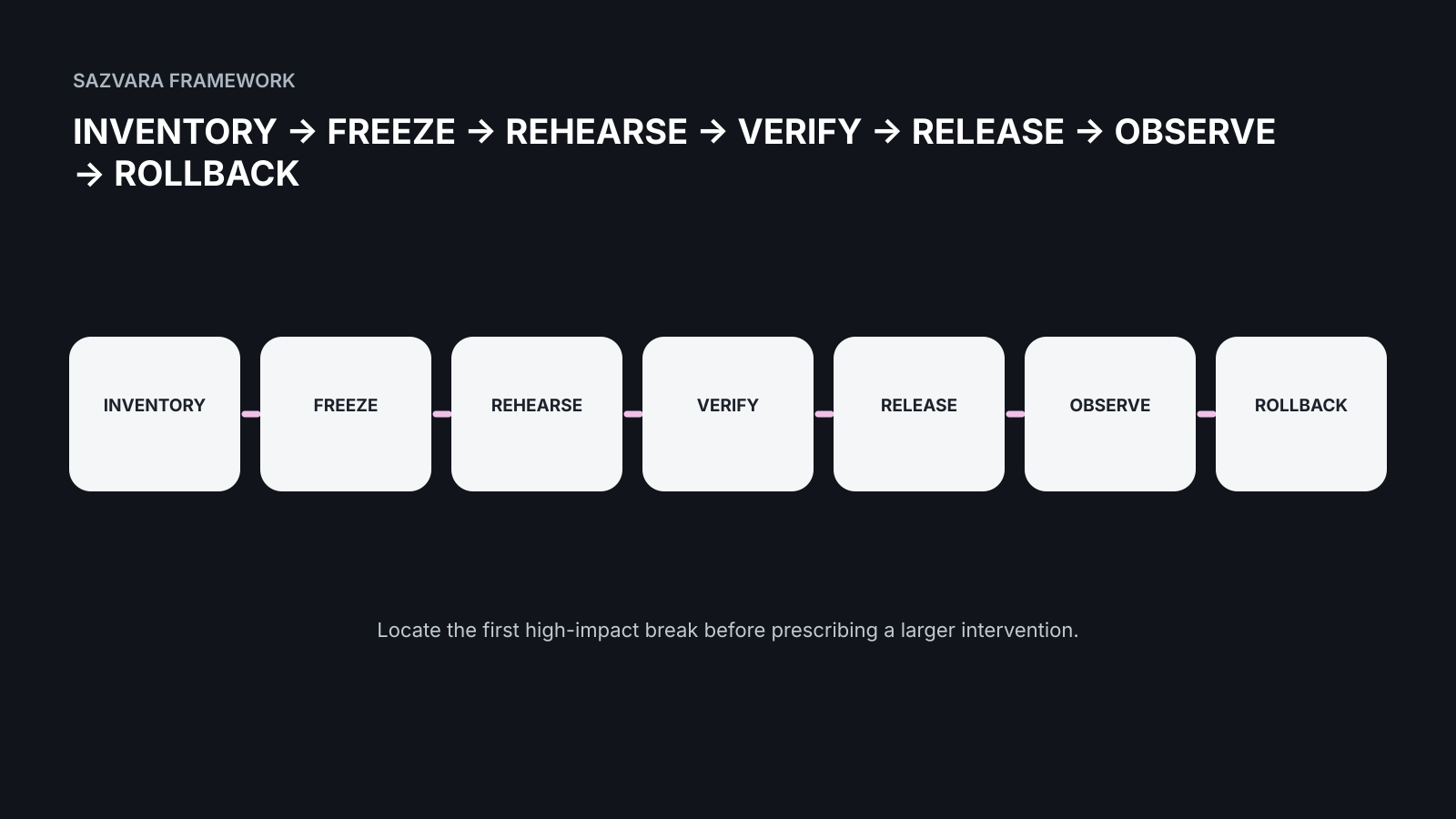
INVENTORY → FREEZE → REHEARSE → VERIFY → RELEASE → OBSERVE → ROLLBACK
The short answer#
A safe website migration is a controlled state transition. The team should know what is moving, what must remain stable, how the new system is verified, what evidence permits launch, and exactly how to return to the previous state if a critical condition fails.
The rollback plan should be designed before launch day, not after something breaks.
Evidence anchors#
- Google site moves — URL-changing moves should be mapped, redirected, tested and monitored.
- Google hosting moves — Hosting changes without URL changes have a different risk profile and monitoring path.
- Google redirects — Permanent redirects should map old URLs to relevant new destinations.
- Google robots guidance — Production robots controls should be verified after leaving staging.
- Google sitemaps — A current sitemap helps communicate the intended URL inventory.
- Google canonical guidance — Canonical tags should point to the intended production URLs after migration.
- WordPress backups — Recoverability should be established before a production cutover.
- Cloudflare DNS overview — DNS behavior and caching affect how traffic reaches old and new infrastructure.
- OWASP logging — Error and event evidence supports launch diagnosis and rollback decisions.
- Core Web Vitals — Performance should be rechecked on the production path after cutover.
Inventory the production surface#
List domains, DNS, hosting, certificates, URLs, redirects, forms, analytics, tags, APIs, CRMs, email routes, third-party scripts, scheduled jobs and ownership. Include content and media, not only code.
Unknown dependencies are the main enemy of predictable migration.
Classify URLs#
Mark each existing URL as preserve, redirect, consolidate or retire. Preserve important URLs where possible. When a URL changes, map it intentionally to the closest relevant destination.
Avoid sending large groups of old URLs to the homepage merely to avoid 404s.
Protect measurement continuity#
Record analytics and tag configuration before the move. Verify key events in the new environment and note the launch time so reporting anomalies can be interpreted.
Do not wait for post-launch confusion to discover that conversion events stopped firing.
Rehearse the migration#
Run the migration in a staging or rehearsal environment using production-like data where appropriate. Time each step, document commands or actions, and identify which steps are reversible.
A rehearsal converts assumptions into a procedure.
Freeze high-risk change#
Close to launch, avoid unrelated plugin updates, design changes or automation rewrites. A short change freeze makes failures easier to attribute.
Urgent security fixes are different; document them and reassess the launch if necessary.
Verify content and functionality#
Check representative templates, critical content, navigation, images, metadata, structured data, forms, search, ecommerce or login flows, and external integrations.
Use a written checklist and record pass/fail evidence.
Verify search controls#
Confirm robots directives, canonical URLs, sitemap output and redirect behavior. Ensure staging restrictions have not leaked into production.
Search indexing can take time after a move, so the immediate goal is technical correctness and continuity.
Lower DNS risk deliberately#
Understand TTL behavior and the hosting cutover method. DNS changes can create mixed traffic during propagation. Where possible, keep both environments capable of serving safely during the transition.
Do not make multiple infrastructure changes simultaneously without a reason.
Define launch blockers#
Examples include broken lead capture, incorrect canonical URLs at scale, inaccessible primary navigation, missing critical content, failed payment flow or inability to restore the previous production state.
Visual imperfections can often be fixed after launch; revenue and ownership failures should not be waved through.
Observe immediately after release#
Watch error logs, uptime, form receipts, analytics events, server health and business-state queues. Run synthetic enquiries and compare actual production behavior with the rehearsal.
Assign named owners for the observation window.
Execute rollback based on conditions#
Rollback should be triggered by defined conditions, not by panic. Keep the old environment and required data available long enough to execute the plan safely.
After rollback, preserve evidence from the failed release before trying again.
Post-launch verification#
Re-crawl the site, check redirected URLs, watch search coverage over time and verify that critical integrations remain healthy after caches and DNS settle.
Create a short launch report documenting what changed and any deferred issues.
Where Sazvara fits#
Sazvara's migration work emphasizes control, validation and handover. A readiness review can inspect the migration map, rollback plan, search controls, forms and integration paths before production is touched.
For inherited or fragile WordPress systems, this can be combined with a rescue assessment.
What good looks like in practice#
A migration is ready when the launch procedure is mostly a replay of a successful rehearsal. The URL map is frozen, redirects are known, critical content is present, forms and integrations have been tested, analytics events have been verified, and the team knows what evidence would stop the release. The previous known-good environment remains recoverable during the observation window.
Good launch control also narrows the number of simultaneous changes. A migration already has enough moving parts; unrelated design tweaks, plugin upgrades and automation rewrites should not be added casually. The goal is not a dramatic launch night. It is a predictable state transition with enough evidence to know whether to continue, repair or roll back.
Decision table#
| Signal | What it usually means | First action |
|---|---|---|
| URLs unchanged; only infrastructure moves | Hosting migration | Focus on infrastructure readiness and traffic transition. |
| URLs change | Search migration | Create an explicit old→new map and permanent redirects. |
| Forms/integrations differ | Operational migration | Test complete business transactions in rehearsal. |
| Several major systems change at once | High uncertainty | Separate changes or strengthen rehearsal and rollback. |
| Critical release check fails | Launch blocker | Rollback or stop before broad traffic continues. |
| Minor visual defect only | Post-launch fix | Do not confuse cosmetic defects with transactional blockers. |
Worked scenario#
A company moves from an old WordPress installation to a new stack and plans to change hosting, DNS, URL structure and analytics on the same evening. The migration checklist looks complete, but too many variables change at once. A better release separates concerns: rehearse the content and application migration, preserve important URLs, verify forms and analytics, lower DNS uncertainty, then schedule the cutover with the old environment still recoverable.
During release, a critical form integration fails. Because the rollback condition was defined in advance and the previous environment remains viable, the team can revert, preserve evidence, repair the integration and relaunch later instead of debugging under public outage pressure.
Implementation sequence#
Build the inventory and URL map first. Rehearse the migration end to end. Freeze unrelated changes. Verify the new environment using a signed checklist. Launch during a staffed observation window. Run synthetic business transactions immediately. Keep the rollback route available until critical paths have demonstrated stability.
After launch, re-crawl and compare the expected URL set, redirects, canonicals and sitemap.
Measurement plan#
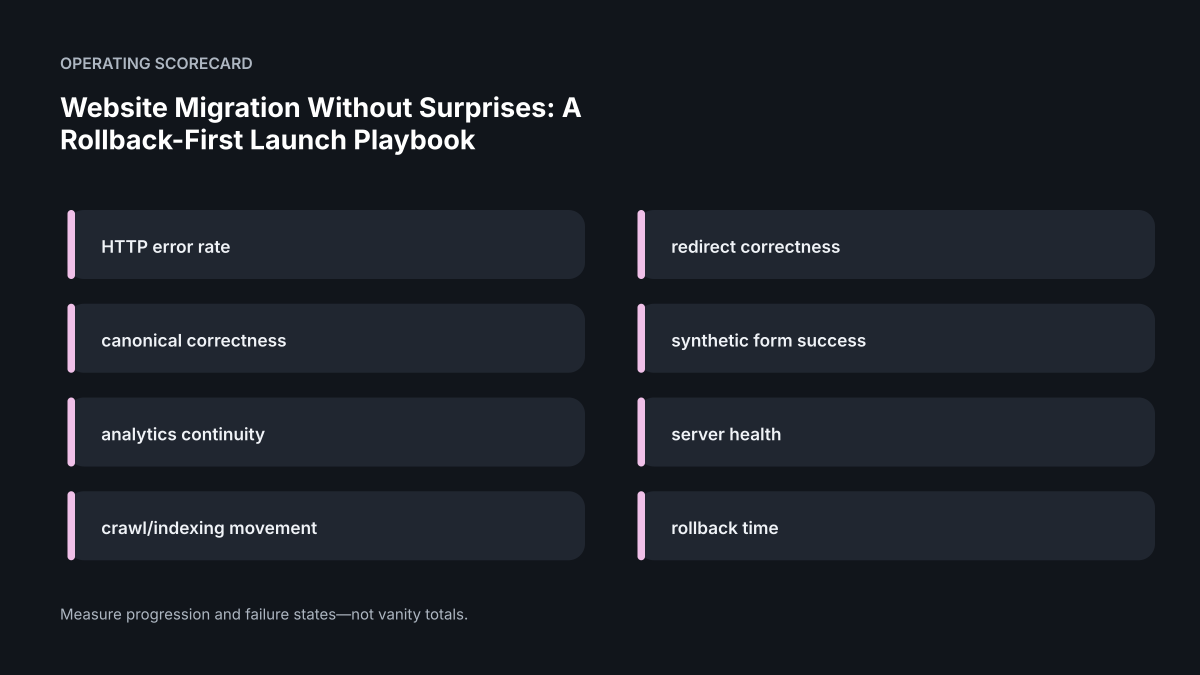
Monitor 4xx/5xx rates, redirect coverage, canonical correctness, successful form or transaction tests, analytics event continuity, Core Web Vitals, crawl/indexing changes and business-state queues. Note the exact cutover time.
Search visibility should be watched over days and weeks; transactional breakage should be caught within minutes.
Operating scorecard#
| Measure | Why it matters |
|---|---|
| HTTP error rate | Turns the operating state into a measurable signal that can drive a decision. |
| redirect correctness | Turns the operating state into a measurable signal that can drive a decision. |
| canonical correctness | Turns the operating state into a measurable signal that can drive a decision. |
| synthetic form success | Turns the operating state into a measurable signal that can drive a decision. |
| analytics continuity | Turns the operating state into a measurable signal that can drive a decision. |
| server health | Turns the operating state into a measurable signal that can drive a decision. |
| crawl/indexing movement | Turns the operating state into a measurable signal that can drive a decision. |
| rollback time | Turns the operating state into a measurable signal that can drive a decision. |
Common mistakes to avoid#
Do not delete the old environment immediately, do not migrate without a URL map, do not trust a visual smoke test, and do not assume DNS propagation is instantaneous. Avoid launching with unknown staging restrictions or a fresh analytics implementation that was never validated.
The safest migration has fewer surprises because more of the uncertainty was removed before cutover.
Founder decision questions#
Ask which production facts must remain true through the migration: key URLs resolve correctly, forms create valid records, analytics continues, search controls remain intentional, important content survives, and the business can return to the previous environment if a blocker appears. Then ask which of those facts has actually been rehearsed.
A migration that has never been rehearsed is still a hypothesis. The closer the new environment is to production conditions during rehearsal, the fewer surprises remain for launch night.
Procurement brief#
The migration brief should contain the asset inventory, URL map, redirect plan, content map, DNS/cutover method, integration checklist, analytics plan, launch blockers, observation owners and rollback procedure. Require evidence that the previous environment can be restored or reactivated within an acceptable window.
Acceptance should include a post-launch crawl, synthetic form or transaction tests, canonical and sitemap checks, server/error monitoring and a written launch report. Search visibility can take time to settle, but operational correctness should be demonstrated immediately.
Deep-dive: treat migration as a controlled state transition#
A migration is not complete when files have copied or DNS has changed. It is complete when the business can prove that important URLs, customer actions, measurement, integrations and ownership have moved to the intended state—or can be restored to the previous known-good state. That requires a migration ledger rather than a single launch checklist.
The ledger should record each release-critical surface, its pre-migration state, expected post-migration state, verification method, owner and rollback consequence. Typical entries include canonical URLs, redirects, forms, authentication, payments, analytics events, robots directives, sitemap location, certificates, DNS records, scheduled jobs and external callbacks. The list should reflect the actual business, not a generic template.
Worked scenario: new platform, changed URLs and live lead forms#
Imagine a services company moving to a new platform while reorganizing several service URLs. The new site is ready, but the old site still receives search traffic and active enquiries. A safe rehearsal validates the redirect map, confirms that every important old URL lands on the intended new page, submits test enquiries through the new forms, verifies CRM ownership, checks analytics events and inspects the generated sitemap and canonical tags.
During launch, the team keeps the old environment intact long enough to restore it if critical behavior fails. DNS and application changes are recorded separately because their rollback characteristics differ. If the new application fails but DNS still points correctly, the response may be an application rollback. If nameserver or DNS records are wrong, restoring the application alone will not recover traffic.
After cutover, the team checks real requests for unexpected 404s, failed submissions, authentication errors and integration failures. A redirect or form issue discovered early can often be repaired without a full rollback. The rollback decision should therefore depend on predefined impact conditions rather than nervousness about any single warning.
Define rollback layers before launch#
There may be several rollback targets: content release, application version, database state, hosting origin, DNS record set or full environment. Document which layer each launch action changes and how long reversal remains practical. Database writes after launch deserve special attention because restoring an old application against newer data can create inconsistency.
When the migration changes both application and data, define whether rollback means restoring both, running a forward fix, or placing the system in a temporary restricted mode. Test the chosen strategy before the live window where possible.
Preserve measurement continuity#
Record the analytics property, tag configuration, consent behavior and critical events before migration. Verify them in staging or preview, then again in production. A visually successful migration that silently loses lead, purchase or error events removes the evidence needed to evaluate the release.
Where event names or definitions must change, document the break explicitly. Do not present pre- and post-migration trends as directly comparable if the measurement contract changed at launch.
Observe more than the homepage#
Post-launch monitoring should cover representative high-value routes and business actions. Include old URLs expected to redirect, deep content pages, forms, checkout or booking paths, authenticated flows if applicable, sitemap and robots files, and any external callback endpoints. Search-engine controls can be syntactically valid while the business path is broken, and the reverse is also true.
Review server and application errors, but connect them to customer impact. A spike in harmless bot requests may be less urgent than a small number of failed qualified enquiries. Prioritize by consequence.
Post-launch reconciliation#
At the end of the observation window, reconcile the migration ledger. Every release-critical item should be verified, consciously accepted as a known issue, or assigned to a named owner with a deadline. Remove temporary access, preserve the final redirect map and configuration evidence, and capture the known-good production hash or release identifier where the tooling supports it.
Handover after migration#
Provide the final URL map, DNS ownership, hosting ownership, deployment process, backup and restore instructions, analytics configuration, integration map, launch evidence, unresolved issues and rollback history. A migration that only the launch team can understand is not yet operationally complete.
Schedule a release-room checklist with named owners#
Before the launch window, assign one owner for application state, one for DNS or hosting changes where relevant, one for business-path verification and one person with authority to call rollback. In a small team, one person may hold several roles, but the responsibilities should still be explicit. Record a communication channel and the exact evidence required for a go/no-go decision.
The release-room checklist should include timestamps. When a change is made, note when verification started, when caches or DNS propagation may affect observations, and when the next decision point occurs. This reduces confusion when different operators see different states during the transition.
Reconcile external integrations after cutover#
Webhooks, payment callbacks, CRM endpoints, email authentication, scheduled jobs and allowlists can continue pointing to the old environment even when the website appears correct. List each external integration before launch and verify the expected endpoint afterward. If an integration is managed by a vendor or another department, identify the contact and escalation path in advance.
Define when rollback becomes riskier than forward repair#
Rollback is not always the safest choice after users begin creating new data in the new system. Define a point at which restoring the previous database or environment could lose or duplicate transactions. Beyond that point, the recovery plan may shift to a forward fix, restricted mode or data reconciliation. This decision should be designed before the incident rather than improvised under pressure.
Final readiness question#
Before declaring the migration ready, ask whether a different operator could execute the launch and rollback from the written evidence without relying on undocumented memory. If the answer is no, the migration is still dependent on a person rather than a process. Close that gap before the release window.
Also confirm that the business owner understands the rollback consequence. Restoring a previous environment can reintroduce old defects or require reconciliation of new transactions. The go/no-go decision should therefore include both the risk of continuing and the risk of reversing.
Buyer checklist#
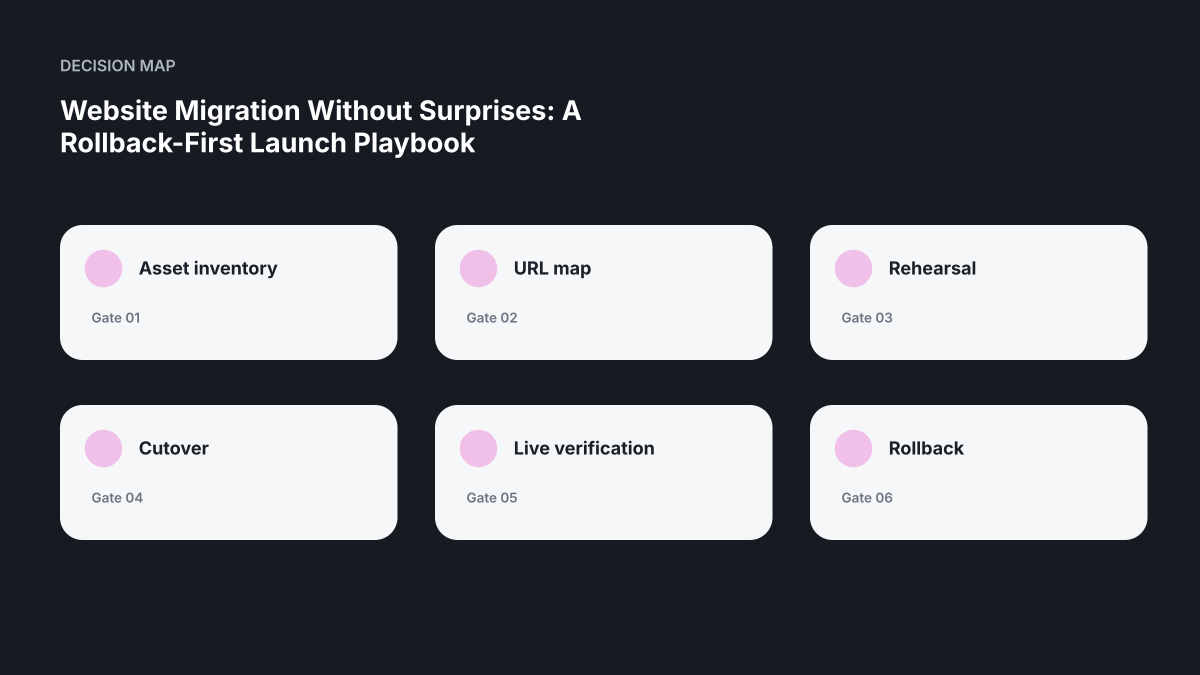
Before approving the work, confirm:
- The team can state the asset inventory condition in plain language.
- The url map evidence is inspectable rather than assumed.
- Ownership for rehearsal is named.
- A failure involving cutover has a defined response.
- The live verification signal is measured after release.
- The team knows how rollback is restored or handed over.
Release / acceptance gate#
| Gate | Evidence required before calling the work complete |
|---|---|
| Inventory | Domains, DNS, URLs, forms, analytics and integrations are listed. |
| Rehearsal | The migration has been timed and executed in a safe environment. |
| Search | Redirects, canonicals, robots and sitemap are verified. |
| Business flows | Synthetic enquiries or transactions succeed end to end. |
| Observation | Named owners watch logs and business states after cutover. |
| Rollback | Conditions and exact recovery actions are written and tested. |
A migration should stop or roll back when a defined launch blocker appears during verification.
Related Sazvara guidance#
- /services/
- /contact/
- /insights/inherited-wordpress-rescue/
- /insights/technical-handover-standard/
- /insights/website-form-to-revenue/
Editorial note#
External sources support the search, DNS, backup, logging and performance facts referenced here. The migration ledger, rollback layers and release sequence are Sazvara operating analysis; the scenario is illustrative and not a claim about a client migration.
Sources and further reading#
- Google site moves
- Google hosting moves
- Google redirects
- Google robots guidance
- Google sitemaps
- Google canonical guidance
- WordPress backups
- Cloudflare DNS overview
- OWASP logging
- Core Web Vitals
Next step#
Request a migration readiness review. Start with the highest-consequence path described in this guide, capture a baseline, and require observable acceptance evidence before expanding the scope.
Have a system that is stuck, manual or difficult to ship?
Sazvara diagnoses the system before prescribing the technology. Bring the constraints, failure modes and current state.