A founder-friendly guide to the operational controls that matter after an AI agent leaves the demo stage: scope, tools, permissions, evaluation, human authority, logs, recovery and cost. 
Editorial promise#
This guide treats agents as production systems rather than a product category. It does not claim that autonomous execution is inherently better than assisted workflows; authority should expand only when evidence justifies it.
The Sazvara framework#
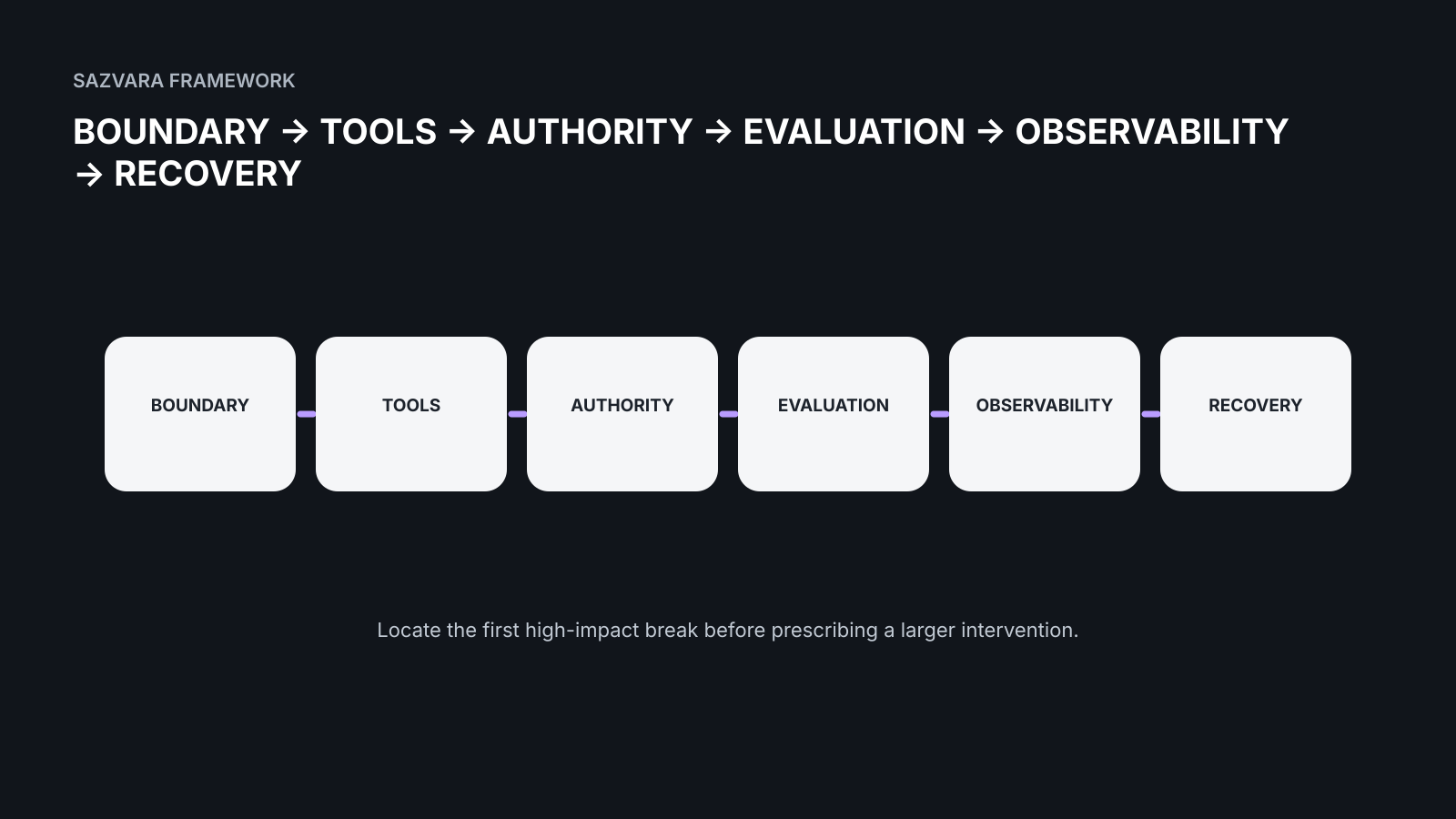
BOUNDARY → TOOLS → AUTHORITY → EVALUATION → OBSERVABILITY → RECOVERY
The short answer#
The difference between an impressive AI-agent demo and a dependable business system is not the model alone. Production use requires explicit boundaries, controlled tools, permission design, evaluation, human authority, monitoring and recovery.
Small businesses should begin with narrow workflows where the agent can assist, recommend or execute reversible actions. Expansion should follow evidence, not excitement.
Evidence anchors#
- OpenAI Agents API — Production agents need a harness that manages context, tools and long-running work.
- OpenAI Agents SDK evolution — Controlled workspaces and tool execution are part of a production agent system, not just the model.
- OpenAI Frontier — Permissions and boundaries are explicit operating concerns when agents act across business systems.
- OpenAI agent tooling overview — Tool use, orchestration and tracing are core pieces of agent applications.
- NIST AI RMF — Risk management should connect system behavior to business context and consequence.
- NIST generative AI profile — Generative AI introduces additional risks that require explicit controls and measurement.
- OWASP LLM application risks — Agent systems must treat prompt, tool and data boundaries as security surfaces.
- Microsoft human-AI guidance — Human oversight is more useful when authority and feedback are designed deliberately.
- Microsoft responsible agents guidance — Agent deployments should define responsibility, oversight and operational controls.
- OWASP secrets management — Credentials exposed to tools should be managed with least privilege and rotation in mind.
Start with a bounded job#
Describe the agent's job as a process with a beginning, an end and exclusions. “Help with operations” is too broad. “Classify inbound support requests, draft a suggested response, and route uncertain cases to a human” is testable.
A bounded job also makes cost, latency and failure analysis possible.
Treat tools as capabilities#
An agent that can call email, CRM, files or billing systems has operational power. Grant only the capabilities required for the task and separate read actions from write actions where possible.
Tool descriptions and schemas matter because they define what the model can attempt. Review them like an API surface, not marketing copy.
Design authority deliberately#
Classify actions by consequence and reversibility. Low-consequence reversible actions may be automated. High-consequence, externally visible or difficult-to-reverse actions should require stronger checks or human approval.
The goal is not to put a human in every loop. It is to place human authority where error cost justifies it.
Build evaluations before broad rollout#
Create representative test cases that include ordinary requests, ambiguous inputs, adversarial or malformed inputs, missing data and cases that should be escalated.
Measure task success against an explicit rubric. Do not rely only on anecdotal demonstrations or subjective impressions.
Use traces and logs as operational evidence#
When an agent fails, the team needs enough evidence to understand the input, tool sequence, outputs and final state without exposing unnecessary secrets or personal information.
Logs should support diagnosis, not become an uncontrolled data archive.
Control prompts and configuration as versioned assets#
Production behavior can change when prompts, tools, models, retrieval sources or routing rules change. Store important configuration in a versioned system and record releases.
This turns “the agent feels different” into an inspectable change history.
Plan for model and dependency failure#
Models time out, APIs rate-limit, tools change and external services fail. Decide what the workflow does when a dependency is unavailable: retry, queue, degrade to a human process or stop safely.
The fallback should be part of the design, not an emergency improvisation.
Watch cost per successful outcome#
Token cost alone is not a useful business metric. Track the cost of successful completed outcomes, including retries, human review and supporting infrastructure.
A cheaper model that creates more exceptions can be more expensive operationally.
Avoid silent autonomy expansion#
Agentic systems tend to accumulate tools and responsibilities. Review the boundary whenever a new integration is added. A workflow that began as drafting can gradually become an execution system without anyone making an explicit risk decision.
Maintain a capability inventory and named owner.
Privacy and data boundaries#
Document what data enters the model, what is retained by each provider, which systems the agent can query and which outputs are stored. Minimize access and avoid sending data merely because it is available.
Provider settings and terms can change, so verify them at implementation time.
A production release gate#
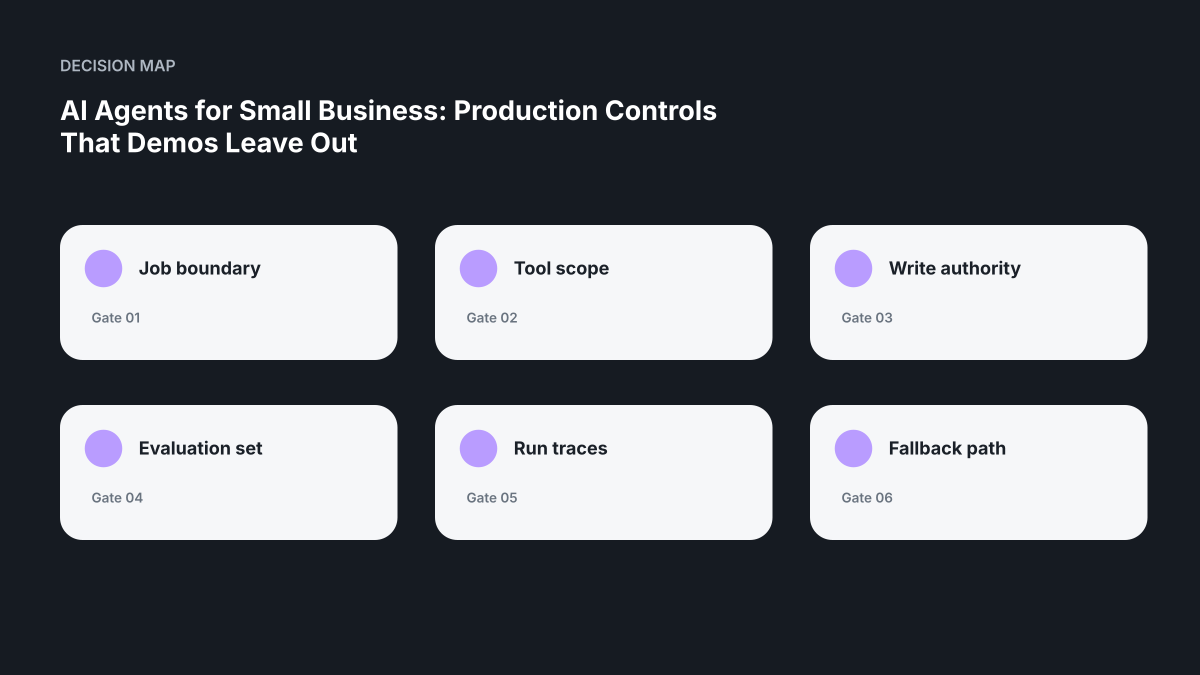
Before launch, require: bounded purpose, tool inventory, permission review, evaluation set, human-escalation rule, logging plan, failure behavior, rollback route and owner.
For higher-consequence workflows, add security review, red-team scenarios and periodic re-evaluation.
First workflows that tend to be safer#
Good early candidates often involve summarization, classification, drafting, research assistance or internal routing where a human still owns the final external action. The common property is that errors are detectable and reversible.
Avoid choosing a workflow merely because it looks impressive in a demo.
Where Sazvara fits#
Sazvara's focus is the operating layer around AI: defining readiness, connecting tools, placing human authority, validating outcomes and creating recovery paths. A production-readiness review can be narrow and evidence-based before any large build starts.
That keeps experimentation fast while preventing a prototype from quietly becoming a fragile production dependency.
What good looks like in practice#
A production-ready agent has a deliberately small job and a deliberately visible boundary. The operator can list the tools it may call, distinguish read from write authority, explain which cases require human approval, and reproduce expected behavior with a stable evaluation set. The system records enough evidence to understand what happened without retaining unnecessary sensitive data.
Good production design also makes failure unsurprising. A tool can time out, a model can produce an uncertain result, an upstream record can be incomplete, or a provider can change behavior. Each case has a safe outcome: retry, queue, escalate, degrade to a manual process or stop. The agent is valuable because it operates inside that controlled envelope, not because it has the largest possible set of permissions.
Decision table#
| Signal | What it usually means | First action |
|---|---|---|
| Task is stable and exact | Deterministic automation may be enough | Prefer rules when flexibility adds no value. |
| Task needs interpretation but action is reversible | Good assisted-agent candidate | Allow recommendation or reversible internal writes. |
| Action is externally visible or costly | Higher consequence | Require stronger verification or human approval. |
| Agent needs broad system access | Permission risk | Split read/write capabilities and minimize tool scope. |
| No representative evaluation set exists | Readiness gap | Do not expand authority until test cases exist. |
| No safe fallback exists | Operational gap | Add stop, queue or human process before launch. |
Worked scenario#
A small agency prototypes an agent that reads enquiries, researches the prospect, drafts a response and updates the CRM. In the demo, the path is impressive. In production, one ambiguous enquiry causes the agent to select the wrong service line and write an overconfident CRM note. The technical failure is not that the model produced bad prose; it is that the system granted authority without defining uncertainty and review.
The production version narrows the agent's role: classify the enquiry, collect public context, draft a recommendation, and require human approval before CRM stage changes or external messages. Confidence and exception rules determine which cases are escalated. This is less autonomous but more operationally useful.
Implementation sequence#
Start with read-only tools and a frozen evaluation set. Add one write capability at a time, beginning with reversible internal actions. Record tool calls and version the prompt/configuration. Establish a human escalation queue before widening scope.
Only expand autonomy after the workflow meets acceptance thresholds over representative cases and the operator can recover from failed tool calls.
Measurement plan#
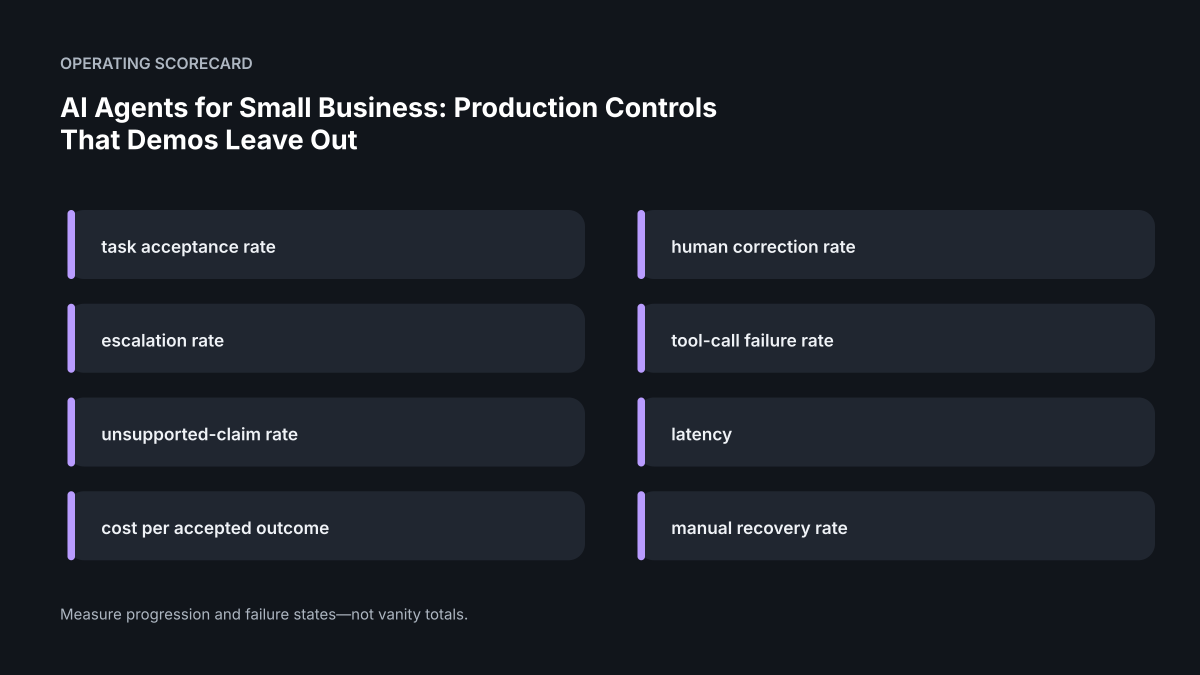
Track task completion, escalation rate, human correction rate, tool error rate, unsupported-claim rate, latency, cost per accepted outcome and the proportion of cases that require manual recovery. For workflows with customer impact, track the downstream business outcome as well.
Model-level quality metrics are useful diagnostics but should not replace process metrics.
Operating scorecard#
| Measure | Why it matters |
|---|---|
| task acceptance rate | Turns the operating state into a measurable signal that can drive a decision. |
| human correction rate | Turns the operating state into a measurable signal that can drive a decision. |
| escalation rate | Turns the operating state into a measurable signal that can drive a decision. |
| tool-call failure rate | Turns the operating state into a measurable signal that can drive a decision. |
| unsupported-claim rate | Turns the operating state into a measurable signal that can drive a decision. |
| latency | Turns the operating state into a measurable signal that can drive a decision. |
| cost per accepted outcome | Turns the operating state into a measurable signal that can drive a decision. |
| manual recovery rate | Turns the operating state into a measurable signal that can drive a decision. |
Common mistakes to avoid#
Avoid giving broad write access during experimentation, evaluating only happy-path prompts, changing model and prompt simultaneously without a release record, and treating a lower escalation rate as automatically better. Low escalation can mean the system is confidently taking actions it should have questioned.
Another mistake is retaining every trace forever. Keep enough evidence for diagnosis while minimizing unnecessary sensitive data.
Founder decision questions#
Before connecting an agent to another system, ask what new authority the connection creates. Can it read sensitive data, change customer records, send external messages, create financial commitments or trigger irreversible actions? What evidence says the model is ready for that authority? Who reviews uncertain cases? What is the safe fallback if the model or a tool is unavailable?
Also ask whether the proposed task genuinely benefits from flexible model behavior. Deterministic rules remain preferable when the process is stable and exact. An agent earns its place when interpretation, synthesis or variable language is central to the job and the surrounding controls can contain its uncertainty.
Procurement brief#
A production-agent brief should include the bounded job, excluded actions, approved tools, permission levels, evaluation set, escalation rules, logging requirements, retention limits, expected volume, latency tolerance and cost constraints. Require the implementer to explain which failures are detectable automatically and which require sampled human review.
For each write-capable tool, define the authorization rule and recovery method. Ask for a release record that ties the deployed prompt, model, tool definitions and routing configuration to evaluation results. This makes future troubleshooting possible when behavior changes after a provider update or business-process change.
Deep-dive: expand authority only after the evidence expands#
For a small business, the most important production decision is often not which model to use but what the agent is allowed to do without another person. Authority can be treated as a ladder. At the lowest level, the agent reads information and drafts a suggestion. Next, it may prepare structured actions for human approval. Later, it may execute reversible low-consequence actions within narrow rules. High-consequence, irreversible or externally binding actions should remain separately gated unless the organisation has strong evidence, monitoring and recovery controls.
An authority matrix makes this explicit. List each tool or action, the data it can read, the state it can change, the maximum consequence of an error, whether the action is reversible, and who can approve broader access. This prevents a common form of silent scope growth in which a useful prototype gradually accumulates credentials and write permissions without a corresponding review of risk.
Worked scenario: accounts-receivable triage#
Consider an agent that reviews overdue invoices and drafts follow-up messages. A safe first production boundary may allow it to read invoice status, customer contact details and prior correspondence, then draft a recommended message and classification. A human approves the communication. The system records the invoice identifier, source data version, generated draft, reviewer decision and final sent message.
After several weeks of stable operation, the business might allow automatic reminders for a narrow category: low-value invoices, no active dispute, known customer, approved template family and no legal or contractual exception. Even then, the agent should not receive unrestricted ability to alter invoice amounts, change payment terms, issue credits or threaten collection. Those actions cross a different consequence boundary.
If the accounting service becomes unavailable, the agent should fail closed rather than infer account state from stale context. If the model or prompt changes, the evaluation set should be rerun before the new configuration receives the same authority. If a customer reply signals dispute or hardship, the workflow should escalate to a person instead of continuing an automated sequence.
Production evidence should connect configuration to outcome#
A useful run record ties together the task identifier, configuration version, model, tools invoked, important tool results, approval events and final disposition. This does not mean storing unrestricted reasoning traces or sensitive content. It means retaining enough operational evidence to reproduce why a business action occurred and which version of the system produced it.
When teams cannot connect a bad outcome to a configuration and tool history, incident review becomes guesswork. Version prompts, tool definitions, policy rules and routing configuration so a release can be compared with the previous known-good state. Treat rollback of agent configuration as seriously as rollback of application code.
Cost control belongs inside the release gate#
Agent cost should be measured per useful outcome, not merely as a monthly model bill. Track repeated tool calls, loops that do not advance the task, retries caused by malformed output, human review time and external API usage. A workflow that appears inexpensive at low volume may become wasteful if it repeatedly searches, retries or asks humans to correct preventable errors.
Set a budget envelope for each task class and define what happens when it is exceeded. The safe response may be to stop, fall back to a deterministic workflow, ask for human input or defer the task. Cost limits are another form of authority boundary because they constrain how much resource an automated process can consume without review.
Recovery and continuity test#
Run a controlled exercise in which one important dependency is unavailable. Verify that queued work remains identifiable, high-consequence actions do not proceed on stale assumptions, a human can complete or defer the task, and the system can resume without duplicating external actions. Record the evidence. A production agent should be judged partly by how safely the business operates when the agent cannot finish.
Minimum production handover packet#
The owner should receive the job boundary, authority matrix, tool inventory, credential ownership map, evaluation set, release-gate results, trace location, alert rules, stop conditions, fallback procedure, cost limits and configuration versions. This packet makes it possible to reduce authority, investigate incidents and transfer operation without depending on the original builder.
A practical authority-review cadence#
Review authority after any change to tools, credentials, model family, routing rules, customer-facing scope or data access. Also schedule a periodic review even when nothing obvious changes. The question is not “has the agent behaved well lately?” but “does the evidence still justify every action it can take without a person?” Remove unused permissions and narrow tool scopes when possible.
For each autonomous action, keep a named rollback or compensating action. Some actions cannot truly be reversed, so their approval boundary should remain stricter. Sending an internal draft, updating a reversible tag and submitting a legal commitment are different classes of authority even if they are technically performed through similar APIs.
When assisted mode is the right production state#
Assisted operation is not a failed intermediate step. For tasks with changing policy, sparse examples or high consequence, human approval may be the correct steady-state design. The agent can still reduce search, drafting and classification work while a person owns the final decision. Measure whether the assisted system improves consistency and response time without obscuring accountability.
Only expand to unattended execution when repeated evaluations, production samples and incident history show that the narrower mode is stable and the failure cost is acceptably controlled.
Buyer checklist#
Before approving the work, confirm:
- The team can state the job boundary condition in plain language.
- The tool scope evidence is inspectable rather than assumed.
- Ownership for write authority is named.
- A failure involving evaluation set has a defined response.
- The run traces signal is measured after release.
- The team knows how fallback path is restored or handed over.
Release / acceptance gate#
| Gate | Evidence required before calling the work complete |
|---|---|
| Boundary | The job and excluded actions are written. |
| Tools | Every tool has a justified capability and permission scope. |
| Evaluation | Representative normal, edge and escalation cases pass. |
| Authority | High-consequence actions have explicit approval rules. |
| Traceability | Runs can be tied to configuration and tool activity. |
| Fallback | The business can continue safely when the agent or a dependency fails. |
An agent should not receive broader authority while critical evaluation, permission or fallback gates are unresolved.
Related Sazvara guidance#
- /services/
- /contact/
- /insights/ai-workflow-readiness-tests/
- /insights/human-in-the-loop-ai-small-business/
- /insights/when-no-code-becomes-fragile/
Editorial note#
External guidance supports the governance, security and agent-system facts cited here. The authority ladder, release controls and accounts-receivable scenario are Sazvara operating synthesis, not a claim that any specific agent will achieve a particular business result.
Sources and further reading#
- OpenAI Agents API
- OpenAI Agents SDK evolution
- OpenAI Frontier
- OpenAI agent tooling overview
- NIST AI RMF
- NIST generative AI profile
- OWASP LLM application risks
- Microsoft human-AI guidance
- Microsoft responsible agents guidance
- OWASP secrets management
Next step#
Request an AI workflow production-readiness review. Start with the highest-consequence path described in this guide, capture a baseline, and require observable acceptance evidence before expanding the scope.
Have a system that is stuck, manual or difficult to ship?
Sazvara diagnoses the system before prescribing the technology. Bring the constraints, failure modes and current state.